
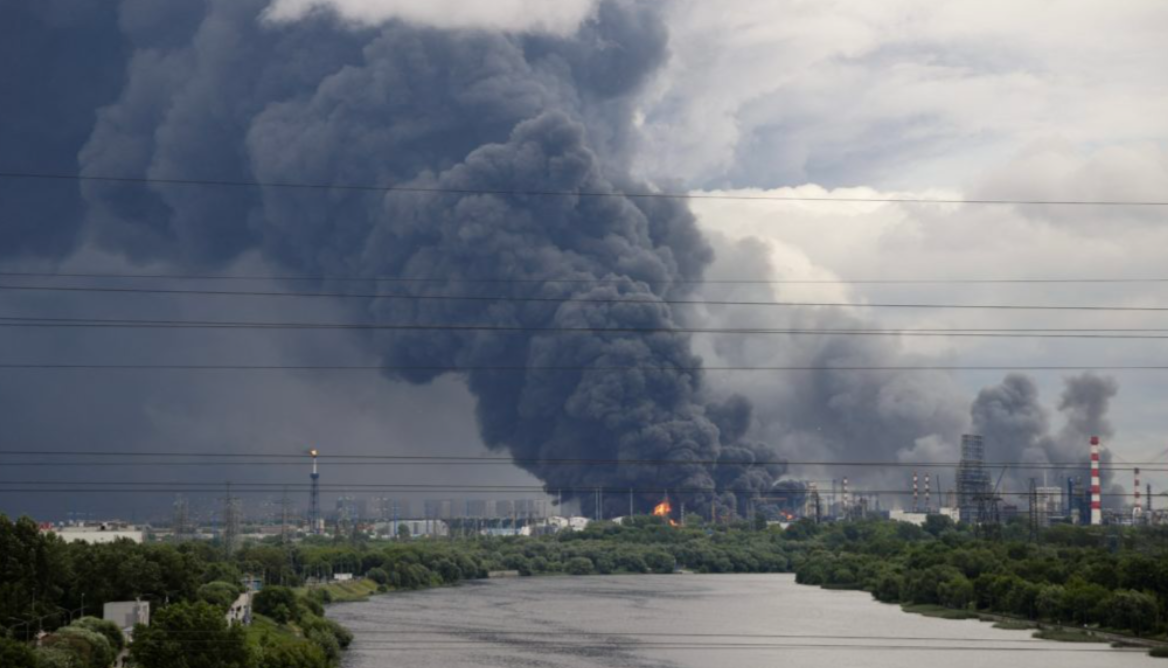
In one of the most significant escalations yet in Ukraine’s campaign against Russian energy infrastructure, Ukrainian forces launched a massive drone assault on Moscow on June 18, 2026 — striking Gazprom Neft’s Kapotnya (Moscow) oil refinery for the second time in just days.
Nearly 200 drones targeted the facility on the southeastern outskirts of the Russian capital, roughly 15 km from the Kremlin. The attack triggered fires, explosions, thick black smoke billowing over southern Moscow, reports of “black rain” or oil rain in some districts, and temporary shutdowns of major roads and airports.
Moscow Mayor Sergei Sobyanin confirmed damage to facilities at the site. Industry sources reported that the June 16 strike had already damaged a primary refining unit accounting for about 53% of the plant’s capacity and halted operations. The June 18 barrage struck additional key units — including the integrated crude processing unit and Euro+ processing unit — along with pipelines, secondary installations, and storage tanks, leading analysts to conclude that 100% of the refinery’s primary oil refining capacity was hit, fully halting refining operations.
The Kapotnya refinery is the largest fuel supplier to the Moscow region. It supplies a major share of the capital’s gasoline (around 40%), diesel (up to half), and aviation fuel.
Fears of Fuel Shortages and Rising Prices
Muscovites are already facing rising gasoline prices and potential shortages in the wake of the strike. The attack comes amid a broader surge in Ukrainian strikes on Russian refineries, which have doubled since the start of 2026. This has led to full or partial shutdowns across multiple facilities, reducing the output of gasoline, diesel, and jet fuel.
Other recent examples include Tatneft’s TANECO refinery in Tatarstan (hit June 12), which suspended crude processing and prompted the company to impose nationwide caps on fuel purchases at its stations (e.g., limits of 20 liters of gasoline or 40 liters of diesel per vehicle in some cases, cash-only at certain locations). Localized shortages, long queues, and panic buying have been reported in regions including Crimea, southern Russia, and Russian-controlled areas of Donetsk.
Who Are Russia’s Downstream Customers — and Who Gets Hit First?
Domestic Russian consumers are feeling the immediate pinch. The strikes and resulting production losses have tightened supplies in central Russia and beyond, prompting purchase restrictions, higher prices, and concerns over availability for summer harvesting and everyday transport.
Military and war efforts are also directly impacted. The Moscow refinery explicitly “fuels Russia’s war effort,” providing critical diesel for military vehicles and logistics, plus aviation fuel for aircraft. Ukrainian strikes target both the revenue stream that funds the war (through refined product sales) and the physical fuel supply chain supporting Russian operations.
Exports represent another major downstream channel, but these are secondary in the current crisis. Russia’s refined petroleum products (gasoline, diesel, jet fuel, etc.) are primarily exported to Turkey (historically the largest buyer), followed by China, Brazil, Singapore, India, and others.
However, due to domestic shortages, Russia has repeatedly imposed or extended export bans and restrictions on gasoline and diesel to prioritize internal supply. This means reduced volumes are available for international customers. Cumulative refinery damage has already contributed to lower product exports in recent periods, with more crude being diverted to export markets instead of being refined domestically.
In short:
It is not only Russian consumers who are affected. The military/war machine is a key target and beneficiary of domestic fuel allocation, while export markets face reduced supply due to both physical damage and Russian government policy prioritizing the home front.
How Long Might the Refineries Be Down?
No official timeline has been released for the Kapotnya facility. The June 16 damage alone was expected to keep at least one major unit offline for some time, with a second unit potentially resuming sooner. The follow-up June 18 strike on additional primary processing units makes a swift full recovery unlikely.
Historical precedent from other Ukrainian drone hits on Russian refineries shows that damaged primary distillation or conversion units often require weeks to several months for repairs. Repeated strikes (as seen here) significantly extend downtime. Russia frequently refers to these as “unscheduled repairs.”On a broader scale, the International Energy Agency and other analysts have indicated that the cumulative impact of the drone campaign will continue suppressing Russian refinery throughput at least into mid-2026, with potential for longer effects depending on the pace of repairs and further attacks.
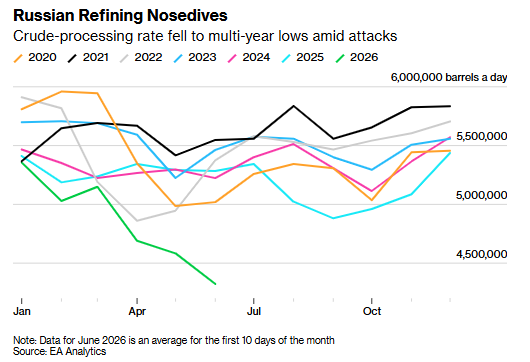
Cumulative Impact of Attacks on Russian Refineries (Last Several Years)
Ukraine’s drone campaign against Russian oil refineries intensified significantly from late 2023 onward and accelerated sharply in 2025–2026.
By late 2025, strikes had disrupted 17–20% (and at peaks up to ~40%) of Russia’s refining capacity.
In 2026, the number of targeted refineries doubled compared to prior periods.
May 2026 saw record attacks (at least 16 on fuel facilities, ~30 total on oil assets), hitting 8 of Russia’s 10 largest refineries. Average crude processing fell to 4.58 million barrels per day — down ~700,000 bpd (13%) year-over-year and the lowest level since October 2009.
April 2026 throughput reached a 17-year low.
Diesel production dropped sharply — by up to ~20% in two months (April–May 2026), with reductions of nearly 1 million tonnes in April and 600,000 tonnes in May.
Overall, Ukrainian strikes have knocked offline significant portions of primary refining capacity (estimates of one-third or more idle at various points in 2026), forcing Russia to implement export curbs, increase blending, draw supplies from Belarus, and even begin importing gasoline by sea for the first time.
These losses represent a sustained financial and logistical drain on Russia’s war economy while creating domestic fuel pressures.
The strike on Moscow’s refinery coincides with diplomatic efforts, including European Council President Antonio Costa’s reported outreach to establish back-channel communications with the Kremlin.
Ukraine frames these long-range strikes as legitimate responses to Russian attacks on Ukrainian infrastructure and a means to degrade Russia’s ability to sustain the war.
Outlook
The latest attack on the Moscow refinery underscores the vulnerability of Russia’s downstream sector to precision long-range strikes. While Russia retains substantial overall oil production and export capacity (shifting more crude abroad), the repeated hits on refining assets are creating real constraints on domestic fuel availability and pressuring the government’s ability to balance military needs, civilian supply, and export revenues.
Repair timelines, the intensity of future Ukrainian drone campaigns, and Russian adaptive measures (including potential further import reliance or rationing) will determine how long these fuel pressures persist. For now, the combination of physical damage and policy responses points to continued tightness in Russian fuel markets in the weeks and months ahead.
Sources and Links (Appendix)
- Bloomberg: “Ukraine’s Biggest Strike on Moscow Brings Fears of Fuel Shortage” (June 19, 2026) — https://www.bloomberg.com/news/articles/2026-06-19/ukraine-s-biggest-strike-on-moscow-brings-fears-of-fuel-shortage
- Bloomberg: “EU Chief Reaches Out to Moscow to Set Up Back Channel to Putin” (June 17, 2026) — https://www.bloomberg.com/news/articles/2026-06-17/eu-chief-reaches-out-to-moscow-to-set-up-back-channel-to-putin
- Reuters: “Ukrainian drone strike halts operations at Moscow oil refinery, sources say” (June 16, 2026 reporting) — https://www.reuters.com/world/moscow-oil-refinery-damaged-ukrainian-drone-attack-mayor-says-2026-06-16/
- Additional supporting data from Reuters, Bloomberg, Energy Intelligence, Stratfor, Baker Institute, and other analyses on cumulative impacts (2022–2026) as referenced in search results.
Visuals sourced from verified news reporting of the June 18, 2026 events. This article is based on the latest available open-source reporting as of June 19, 2026. Developments are fluid.
The post Ukraine’s Biggest Strike on Moscow Brings Fears of Fuel Shortage appeared first on Energy News Beat.