
OPEC released its 20th edition of the World Oil Outlook (WOO 2026) on June 18, 2026, delivering a comprehensive, data-driven assessment of global energy trends through 2050. The report projects continued strong growth in global oil demand, reaching 124.1 million barrels per day (mb/d) by mid-century — an increase of approximately 19 mb/d from 2025 levels — with no peak on the horizon.
This bullish outlook contrasts with more cautious transition-focused forecasts from some organizations and underscores OPEC’s view that all energy sources will be required to meet rising demand driven by population growth, economic development, and urbanization, particularly in developing nations.
Key Assumptions Underpinning the Outlook
The WOO 2026 is grounded in demographic and macroeconomic projections:
World population rises from 8.23 billion in 2025 to 9.66 billion in 2050 (+1.43 billion).
Global GDP grows at an average 2.9% per year, roughly doubling from $177 trillion (2025) to $359 trillion (2050) in 2021 PPP terms.
Growth is concentrated in non-OECD economies, with India (5.7% p.a.), Africa (4.4%), and Other Asia (3.5%) leading.
These drivers fuel higher energy needs for industrialization, transport, petrochemicals, data centers, and improved living standards.
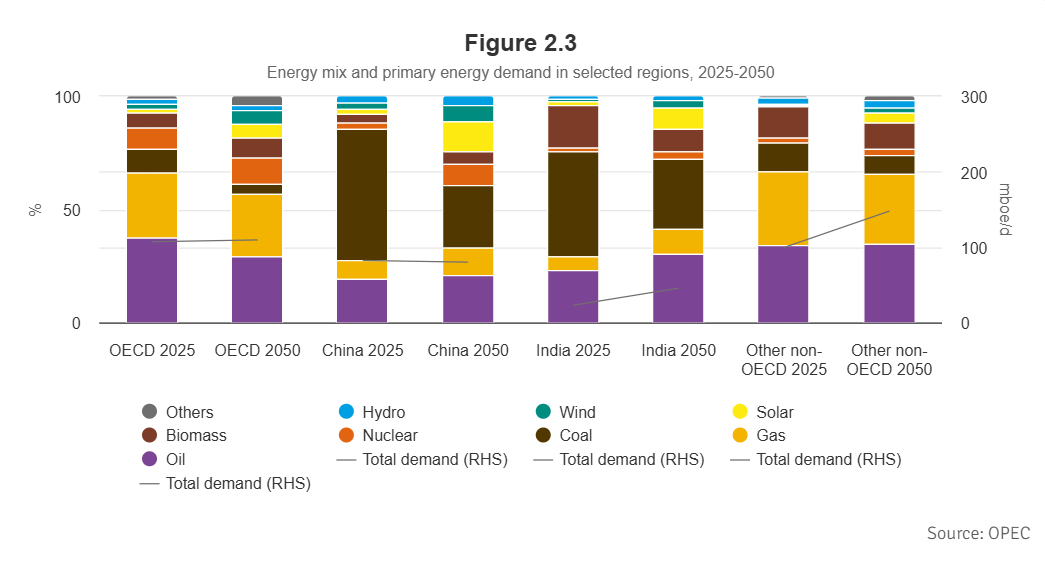
Global Energy Demand: +23% by 2050
Primary energy demand increases 23% (or ~70 mboe/d) from 2025 levels to approximately 382 mboe/d by 2050.Oil retains the largest share (~29.7% in 2050, down slightly from ~30.4%).
Renewables grow fastest (+51 mboe/d, to ~26% share).
Natural gas rises steadily.
Coal declines sharply.
Nuclear rebounds.
Growth is almost entirely from non-OECD countries (+68 mboe/d), while OECD demand rises only marginally.
Oil Demand: Detailed Breakdown
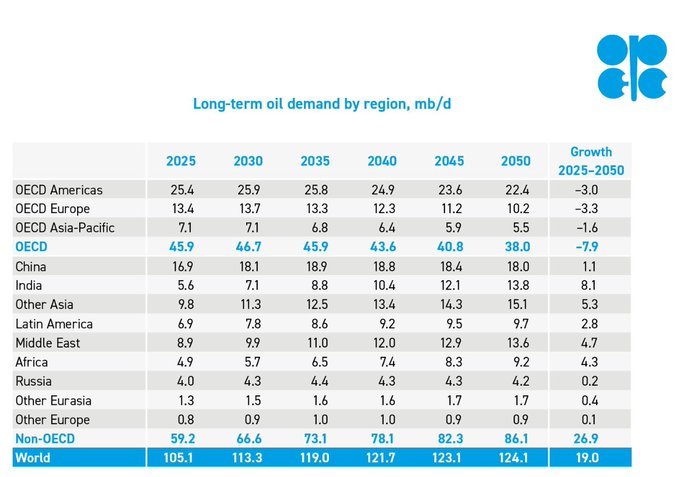
Global oil (liquids) demand:2025: 105.1 mb/d
2030: 113.3 mb/d
2040: 121.7 mb/d
2050: 124.1 mb/d (+19 mb/d overall)
Regional highlights:Non-OECD: +26.9 mb/d to 86.1 mb/d by 2050 (dominant driver).India: +8.1 mb/d (largest single contributor) to 13.8 mb/d.
Other Asia: +5.3 mb/d.
Middle East: +4.7 mb/d.
Africa: +4.3 mb/d.
China: modest +1.1 mb/d to 18.0 mb/d.
OECD: Declines by 7.9 mb/d to 38.0 mb/d by 2050 due to efficiency gains and electrification.
Sectoral drivers (2025 → 2050):
Road transport: 47.0 → 52.7 mb/d (+5.7 mb/d) — supported by fleet growth to ~3 billion vehicles (ICE vehicles still ~73% of fleet).
Aviation: 7.2 → 11.5 mb/d (+4.2 mb/d).
Petrochemicals: 16.1 → 20.7 mb/d (+4.6 mb/d) — strong growth from plastics and chemicals demand.
Other industry and marine bunkers also contribute positively.
Light and middle distillates drive most product growth.
Liquids Supply Outlook
Supply is projected to match demand at ~124.2 mb/d by 2050.OPEC/Declaration of Cooperation (DoC) liquids supply rises from ~50.6 mb/d (48% share in 2025) to 64.5 mb/d (52% share) in 2050.
Non-DoC supply grows modestly to ~59.6 mb/d by 2050, after peaking around 60 mb/d in the 2030s and then plateauing.
U.S. tight oil peaks in 2025 and declines gradually; growth comes from Brazil, Canada (oil sands), Argentina, and others.
Cumulative investment needs for the oil sector (2026–2050): $17.7 trillion (~$700+ billion annually), with $14.5 trillion upstream.
Policy Context and Key Messages
OPEC Secretary General Haitham Al Ghais emphasizes a pragmatic approach: governments are recalibrating policies to balance energy security, affordability, emissions reductions, and sustainable development. The report stresses that “the future is not one in which the world can choose some energies while disregarding others” and that oil remains vital for the global economy.
publications.opec.org
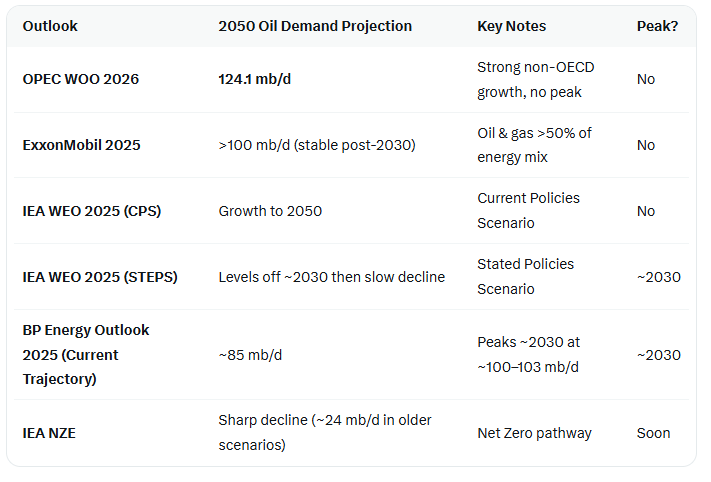
Key differences:
- OPEC and ExxonMobil align closely in seeing sustained high demand driven by developing economies and petrochemicals/aviation.
- BP is more moderate, forecasting a post-2030 decline even in its Current Trajectory scenario.
- IEA scenarios vary widely: its Current Policies Scenario (CPS) shows continued growth (closer to OPEC), while STEPS and especially NZE are lower.
- Analysts note that OPEC’s forecast is generally higher than that of many other forecasters, reflecting its emphasis on energy security and realistic policy shifts away from aggressive net-zero timelines.
Implications
The WOO 2026 sends a clear message to policymakers and investors: significant, sustained investment in oil (and all energies) is essential to avoid supply shortfalls. It highlights opportunities in non-OECD markets, petrochemicals, and aviation, while acknowledging efficiency and substitution trends in OECD nations.OPEC positions its outlook as a transparent, objective contribution to global dialogue on energy realities.
Appendix: Sources and Links
Primary Source – OPEC WOO 2026:
- Interactive WOO 2026: https://publications.opec.org/woo
- Chapter 1 – Key Assumptions: https://publications.opec.org/woo/chapter/157/2941
- Chapter 2 – Energy Demand: https://publications.opec.org/woo/chapter/157/2942
- Chapter 3 – Oil Demand: https://publications.opec.org/woo/chapter/157/2943
- Chapter 4 – Liquids Supply: https://publications.opec.org/woo/chapter/157/2944
- Official launch/press: https://www.opec.org (search WOO 2026)
News Coverage of WOO 2026:
- Reuters: “OPEC sticks to robust oil demand outlook, sees no peak on horizon” (June 18, 2026)
- World Oil, S&P Global, Argus Media, Hellenic Shipping News (various June 18–19, 2026 articles)
Other Major Outlooks:
- IEA World Energy Outlook 2025: https://www.iea.org/reports/world-energy-outlook-2025
- ExxonMobil 2025 Global Outlook: https://corporate.exxonmobil.com/publications/global-outlook
- BP Energy Outlook 2025: https://www.bp.com/energyoutlook
All data and projections are drawn directly from the cited OPEC WOO 2026 materials and cross-referenced public summaries/news reports as of June 2026. The full interactive report and chapters on the OPEC publications site provide the most detailed tables and regional breakdowns. Energy News Beat Channel – Delivering clear, fact-based analysis on global energy markets.
The post World Oil Outlook 2050 – OPEC’s WOO 2026: Robust Growth to 124 mb/d, No Peak in Sight appeared first on Energy News Beat.