
Williams Companies CEO Chad Zamarin delivered a stark assessment today: U.S. natural gas demand over the next 10 years is expected to grow more than it did during the past 15 years, driven primarily by the explosive power needs of artificial intelligence data centers. Speaking in a Bloomberg interview tied to the fresh reporting, Zamarin highlighted how the AI boom is creating the biggest natural gas demand surge in decades. Data centers supporting AI are overwhelming traditional grid infrastructure, positioning abundant, reliable domestic natural gas as the backbone for powering America’s technological future.
The AI Power Surge Reshaping Energy Markets
The numbers tell a compelling story. Hyperscalers (Amazon, Google, Microsoft, Meta, and others) are pouring hundreds of billions into data center infrastructure annually, with collective capex projected to reach extraordinary levels. This is translating into massive electricity demand growth.
Projections show U.S. data center power demand could add hundreds of terawatt-hours (TWh) annually by 2030. East Daley Analytics tracks roughly 290 data center-related power projects totaling around 81 GW of new capacity, forecasting 4.2–6.1 billion cubic feet per day (Bcf/d) of incremental natural gas demand by 2030 in their base case — with upside potential higher if more load shifts to on-site generation.
Data centers already account for a growing share of U.S. electricity (recent estimates put current use at 4–5%, heading toward 8–12% or more). Natural gas remains the largest single source for U.S. power generation (~40% nationally) and is on track to fuel most new data center power needs in the near term due to its speed, reliability, and scalability.
Modern data center campuses increasingly pair with dedicated or co-located power infrastructure to meet AI-driven loads.
Data Center by State
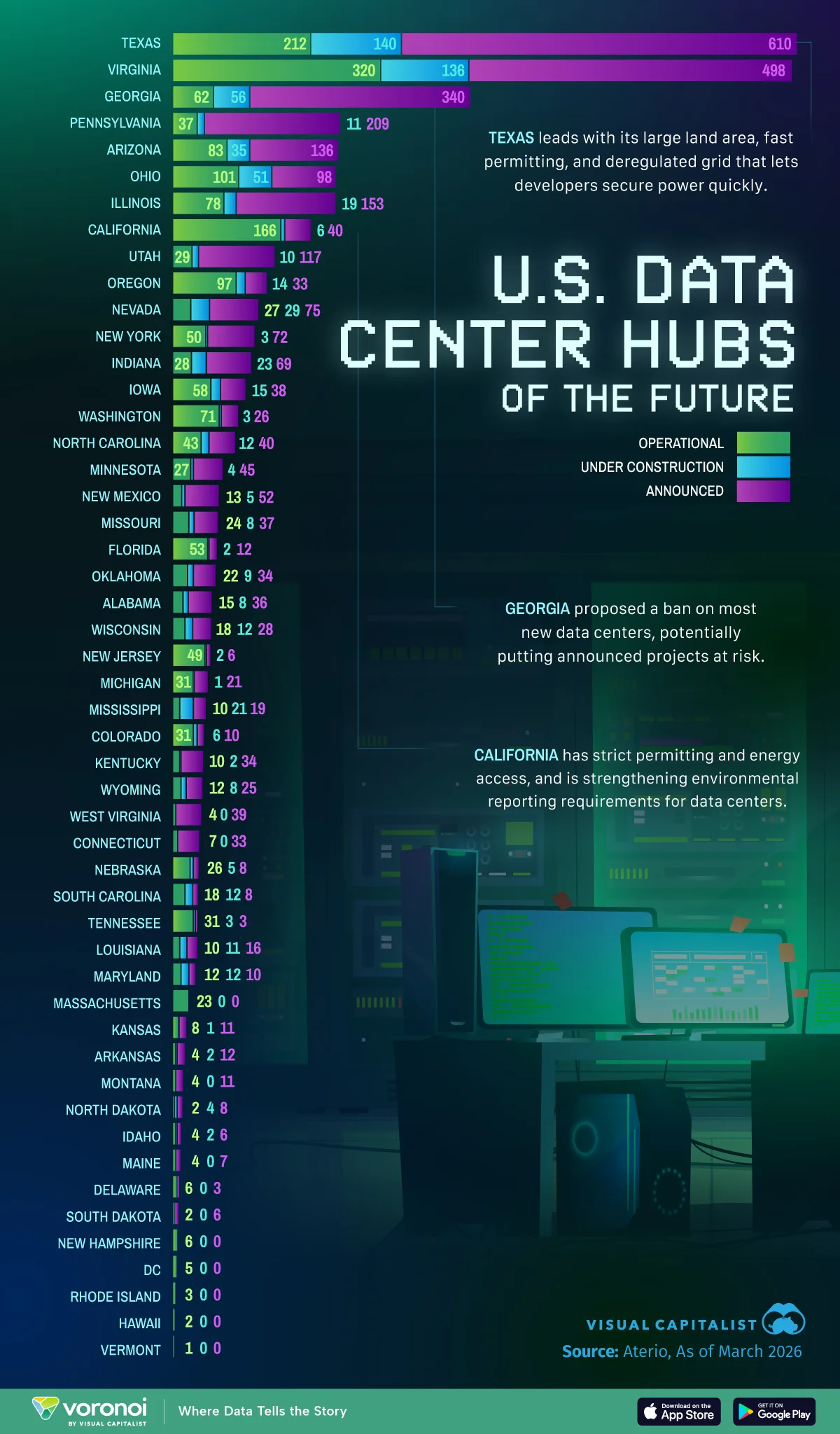
Why Natural Gas?
Speed, Reliability, and ScaleGrid interconnection queues are years long. Renewables and nuclear face their own timelines and intermittency challenges for always-on AI workloads. Natural gas-fired generation — especially behind-the-meter (BTM) or on-site plants — offers a practical solution. As of 2026, developers have announced approximately 101 GW of behind-the-meter natural gas generation capacity in the U.S. to serve data centers directly.
Examples include multi-GW-scale projects and modular gas plants designed for rapid deployment. Williams itself is executing on this trend with a $5.1 billion “power innovation” portfolio, including modular gas-fired plants sited at data centers, a $3.1 billion commitment to two major projects, and the $1.6 billion Project Socrates (targeted for H2 2026 completion), providing committed power generation and associated pipeline infrastructure.
Williams executives have noted that data centers are expected to drive roughly two-thirds of U.S. gas-fired electricity demand growth through 2035. The company is leveraging its midstream expertise in key basins (Marcellus, Haynesville) and expanding into integrated “pipes + power” solutions — a one-stop offering for hyperscalers seeking speed-to-market.
Behind-the-meter and on-site natural gas generation is emerging as a fast-track solution for data center power needs.
Williams’ Strategic Positioning
Williams is transforming beyond traditional midstream. The company is exploring upstream production assets to offer fully integrated supply solutions and has emphasized that this is fundamentally an infrastructure story, not a supply shortage. U.S. natural gas resources are abundant; the challenge (and opportunity) lies in pipelines, compression, power generation, and permitting.
CEO Zamarin has repeatedly framed natural gas as America’s “affordability superpower” and a foundation for energy security. In today’s Bloomberg discussion, he underscored resilience even amid global disruptions. The company sees a “golden age” for energy infrastructure tied to AI and data centers, alongside LNG export growth.
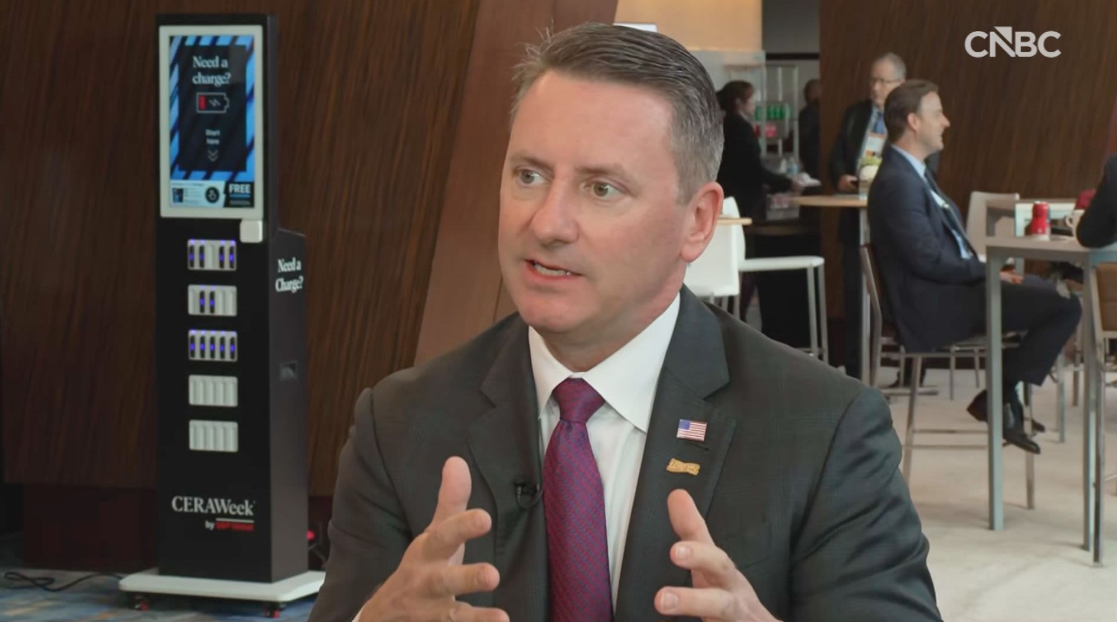
Williams CEO Chad Zamarin discusses energy infrastructure and the AI-driven demand surge.
Broader Implications and Outlook
This shift has major ramifications:
Economic — New gas plants, pipelines, and data centers bring jobs, investment, and tax revenue, particularly in gas-rich states like Texas, Pennsylvania, Ohio, and Louisiana.
Grid & Reliability — Gas provides dispatchable power that complements renewables while bridging gaps.
Policy — Calls for permitting reform are growing louder to accelerate infrastructure without compromising safety or the environment.
Energy Mix Reality — While some hyperscalers prioritize renewables and nuclear long-term, pragmatic near-term needs are accelerating gas solutions (both grid-connected and dedicated).
Not every new data center will run exclusively on natural gas — many will draw from a diversified mix or pursue corporate renewable PPAs. However, the data is clear: natural gas is powering the majority of the incremental reliable capacity needed to keep the AI revolution on track in the United States through at least 2030.
Bottom Line
Williams’ CEO is not alone in this view. Across the energy sector, executives, analysts (East Daley, EIA, Rystad, Goldman Sachs), and grid operators are revising forecasts upward for both data center load and the natural gas required to serve it. The U.S. has the resources, the companies, and the technology — what’s needed now is faster infrastructure execution.
The AI era isn’t just about chips and algorithms. It’s about pipes, power plants, and the reliable molecules that make it all possible. Natural gas demand is surging, and Williams is positioning itself squarely in the middle of it.
Appendix: Sources & Further ReadingPrimary Bloomberg Source
- “Williams CEO Sees Gas Demand Outpacing Past Years on Powering AI” (Bloomberg, May 19, 2026) — https://www.bloomberg.com/news/articles/2026-05-19/williams-ceo-sees-gas-demand-outpacing-past-years-on-powering-ai
Williams Companies Official & Related
- “Natural gas infrastructure is the fix for surging energy demand” (Williams, Feb 13, 2026) — https://www.williams.com/2026/02/13/natural-gas-infrastructure-is-the-fix-for-surging-energy-demand/
- Williams power innovation and project announcements (various 2025–2026 coverage via company statements and analyst notes).
Data Center & Gas Demand Analysis
- East Daley Analytics: “Data Centers Could Add 6 Bcf/d to Gas Demand” (Feb 2025, with ongoing updates) — https://eastdaley.com/burner-tip-posts/data-centers-could-add-6-bcf-d-to-gas-demand-eda-forecast
- EIA: “Fossil generation could rise with faster-than-expected electricity demand growth” (March 2026) — https://www.eia.gov/todayinenergy/detail.php?id=67344
- Multiple reports on ~101 GW announced behind-the-meter gas capacity and project pipelines (2026 analyses).
Additional Context
- IEA, Rystad Energy, Goldman Sachs, and Grid Strategies report on data center load growth (2025–2026).
- Industry coverage on BTM/on-site generation trends and hyperscaler investments.
All information was synthesized from publicly available reporting as of May 19, 2026. Projections and forecasts are subject to change based on project execution, policy, and technology developments. For the latest, follow Energy News Beat and primary sources. Energy News Beat — Your trusted source for energy intelligence.
The post Williams CEO Sees Gas Demand Outpacing Past Years Due to AI and Data Center Growth appeared first on Energy News Beat.