
Russian President Vladimir Putin arrived in Beijing on May 19, 2026, for a two-day state visit with Chinese President Xi Jinping. This marks Putin’s 25th trip to China and coincides with the 25th anniversary of the Sino-Russian Treaty of Friendship. The timing is critical: it unfolds against the backdrop of the ongoing war in Iran, the effective closure of the Strait of Hormuz (disrupting roughly one-fifth of global oil supplies), and a tightening global energy market.
The summit focuses on deepening economic and energy cooperation, signing declarations on a “multipolar world,” and addressing regional issues, including the Iran conflict. Energy deals top the agenda, with Russia pushing progress on the Power of Siberia-2 gas pipeline and additional oil export routes. China, facing energy insecurity from Middle East disruptions, is actively weighing long-term alternatives to Gulf supplies.
Russia’s Energy Pivot East: Limited Implications for UK and EU Exports
For the UK and EU, the Putin-Xi meeting changes very little in terms of direct Russian energy availability.
Western sanctions following Russia’s 2022 invasion of Ukraine have already drastically curtailed flows:
EU seaborne crude oil imports from Russia have collapsed to around 1% of total petroleum imports (down from ~27-29% pre-war).
Remaining volumes are mostly limited pipeline deliveries to Hungary and Slovakia under exemptions, plus some LNG.
The EU has implemented or is phasing in full bans on Russian pipeline gas and LNG, with targets to end most imports by 2026-2027.
The UK banned direct imports of Russian oil, products, gas, and coal years ago. Any indirect refined products face strict controls (with rare, temporary licenses issued recently due to global shortages from the Iran crisis).
Russia has successfully redirected the vast majority of its crude exports to Asia. In recent data, China takes approximately 48-51% of Russia’s crude exports, with India close behind at ~37-38%. Combined, Asia absorbs over 90% of Russian crude.
The Beijing summit reinforces Russia’s “pivot to the East.” It does not unlock new physical volumes for the UK or EU markets, which remain effectively closed by policy and sanctions. Western buyers have diversified successfully to the US, Norway, the Middle East (pre-crisis), and others. However, the global price volatility from the Iran/Hormuz crisis affects everyone through higher costs, even if direct Russian barrels do not flow west.
Russia’s Production Capacity: Constrained, Not Abundant Spare
Russia remains a major producer but operates with limited deliverable spare capacity in the current environment:
Crude oil production recently averaged around 8.8–9.2 million barrels per day (mb/d). April 2026 figures showed ~8.8 mb/d (down ~460,000 b/d year-on-year per IEA), impacted by Ukrainian drone strikes on refineries and infrastructure, which forced some production cuts due to limited domestic processing and storage.
Total liquids production hovers near the 10.5 mb/d range in recent years, with 2026 projections relatively flat or slightly declining (around 511 million tonnes of crude + condensate in base scenarios).
Pre-sanctions peaks were higher. Current output sits below OPEC+ quotas at times due to field decline in Western Siberia, sanctions restricting access to Western technology and services, underinvestment, and war-related disruptions.
Major projects like Vostok Oil face delays. Analyses describe the notion of vast, quickly deployable OPEC+ spare capacity (including Russia’s) as overstated in practice.
Russia has some operational flexibility and has maintained exports resiliently via its “shadow fleet,” but structural constraints mean it cannot rapidly ramp up significantly without major investment and technology access.
Will China Pull All of Russia’s Spare Capacity?
No — not immediately or entirely, though China will likely increase offtake where feasible amid the current crisis.
China is already Russia’s largest energy customer:
It has purchased over $367 billion in Russian fossil fuels since the Iran conflict escalated (per CREA data).
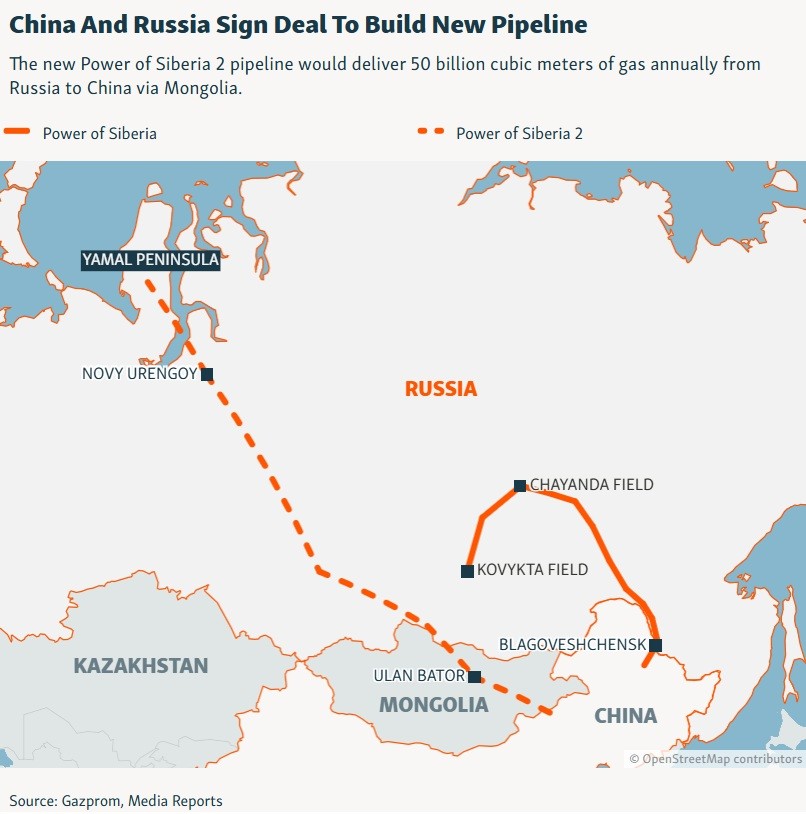
Pipeline gas via Power of Siberia-1 (PoS-1) is at or near full capacity (~38 bcm/year, with possible expansion to 44 bcm).
Additional oil volumes (e.g., +2.5 million metric tons annually via Kazakhstan) have been agreed.
Seaborne crude imports remain strong, often at discounts, though subject to sanctions risks and logistics.
Power of Siberia-2 (PoS-2) — a proposed ~50 bcm/year pipeline via Mongolia — is on the agenda. A memorandum was signed in 2025, but final pricing, commercial terms, and timelines remain under negotiation. Full ramp-up would take years, even if agreed quickly. A smaller Far East route (targeting 12 bcm) is slated to start in 2027.
Why China won’t simply “pull all spare capacity”:
Infrastructure limits: PoS-1 is maxed; PoS-2 is not ready. Seaborne options face tanker availability and sanctions pressures.
Diversification strategy: China avoids over-reliance on any single supplier. It maintains strategic reserves (covering months of imports), domestic production, and other sources.
Russia’s limited spare: As noted, Russia’s deliverable upside is constrained by sanctions, attacks, and field conditions.
Commercial caution: China drives hard bargains on price and has historically been measured in increasing dependence on Russia, despite the strategic partnership.
The Iran crisis makes Russian supplies more attractive as a non-Gulf, overland, or pipeline alternative, and we may see stepped-up purchases. However, this is incremental rather than a wholesale absorption of all available Russian barrels.
Broader Implications
This summit underscores the deepening Russia-China energy axis. Russia gains a reliable (if asymmetric) partner to sustain revenues despite Western sanctions. China secures more diversified and resilient supply routes amid Middle East turmoil.
For global markets: It supports the flow of Russian energy to Asia, potentially easing some regional tightness, but does little to expand overall global spare capacity quickly. For the UK and EU, it highlights the success (and permanence) of their diversification away from Russian supplies — at the cost of higher global price exposure during crises.
Watch for any concrete announcements on PoS-2 pricing or new oil deals in the coming days. The relationship is pragmatic and mutually beneficial in the short-to-medium term, but China’s long-term preference for supplier diversity remains a key limiter.
- OilPrice.com: “Putin Heads to China Amid Global Energy Crisis” (May 19, 2026) — https://oilprice.com/Energy/Energy-General/Putin-Heads-to-China-Amid-Global-Energy-Crisis.html
- CREA (Centre for Research on Energy and Clean Air) monthly analyses on Russian fossil fuel exports (2026 reports)
- IEA Oil Market Report and statements on Russian production (May 2026)
- EIA Country Analysis: Russia
- Reuters, Financial Times, and Japan Times reporting on the May 2026 Putin-Xi summit and PoS-2
- EU and UK sanctions updates / REPowerEU documentation
- Columbia University Center on Global Energy Policy and other expert analyses on PoS-2 and China-Russia energy ties
This analysis draws on the latest available data as of May 19, 2026. Energy markets remain fluid amid the Iran situation — further developments from the Beijing talks could shift dynamics.
The post President Putin and Xi to Meet Amid Global Energy Crisis: What It Means for Energy Markets, Russia’s Pivot, and Western Supplies appeared first on Energy News Beat.