
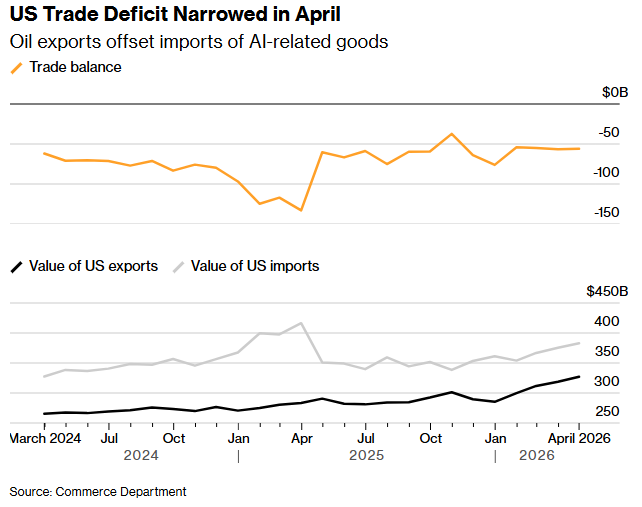
The U.S. trade deficit narrowed in April 2026, with exports hitting a record high as surging crude oil and petroleum product shipments more than offset a sharp rise in imports of computers, semiconductors, and telecommunications equipment tied to the AI data center boom.
According to data from the Bureau of Economic Analysis (BEA), the trade gap shrank to $55.9 billion in April from a revised $56.6 billion in March—beating economists’ expectations of $56.1 billion. Total exports jumped 2.6% to a record $327.1 billion, led by industrial supplies (up $2.5 billion, driven by crude oil and petroleum products amid elevated energy prices from Middle East tensions) and capital goods. Imports rose a more modest 2.0% to $383.0 billion, almost entirely from capital goods—primarily computers, semiconductors, and telecom gear fueling hyperscale AI infrastructure.
This dynamic—oil exports cushioning the blow from AI-driven hardware imports—highlights how America’s traditional energy strengths are counterbalancing the explosive demand from the tech sector. Bloomberg’s coverage of the April figures underscores this exact tension: energy exports are providing a timely buffer as the AI buildout accelerates imports of high-tech components, many sourced from Asia.
What Does This Mean for Investors?
For energy investors, the message is bullish. Strong global oil demand and U.S. export capacity are supporting prices and margins for producers, midstream operators, and refiners. The AI surge, while inflating imports, is creating massive domestic power demand that benefits natural gas, renewables, and grid infrastructure plays. Utilities and independent power producers in high-growth states stand to gain from higher load factors and long-term contracts, though grid upgrade costs and policy shifts could introduce volatility.
Tech and AI investors should note the interdependence: sustained data center construction supports hyperscalers and chipmakers, but reliance on imported hardware keeps the trade gap sensitive to global supply chains and tariffs. Broader market implications include a potentially stronger dollar from a narrowing deficit, which could ease inflationary pressures and influence Federal Reserve policy. Overall, the data reinforces a “energy + AI” investment thesis—where traditional fossil fuel exports fund and offset the infrastructure needs of the digital economy.
Top 5 States Building AI Data Centers: Energy Profiles and National Rankings
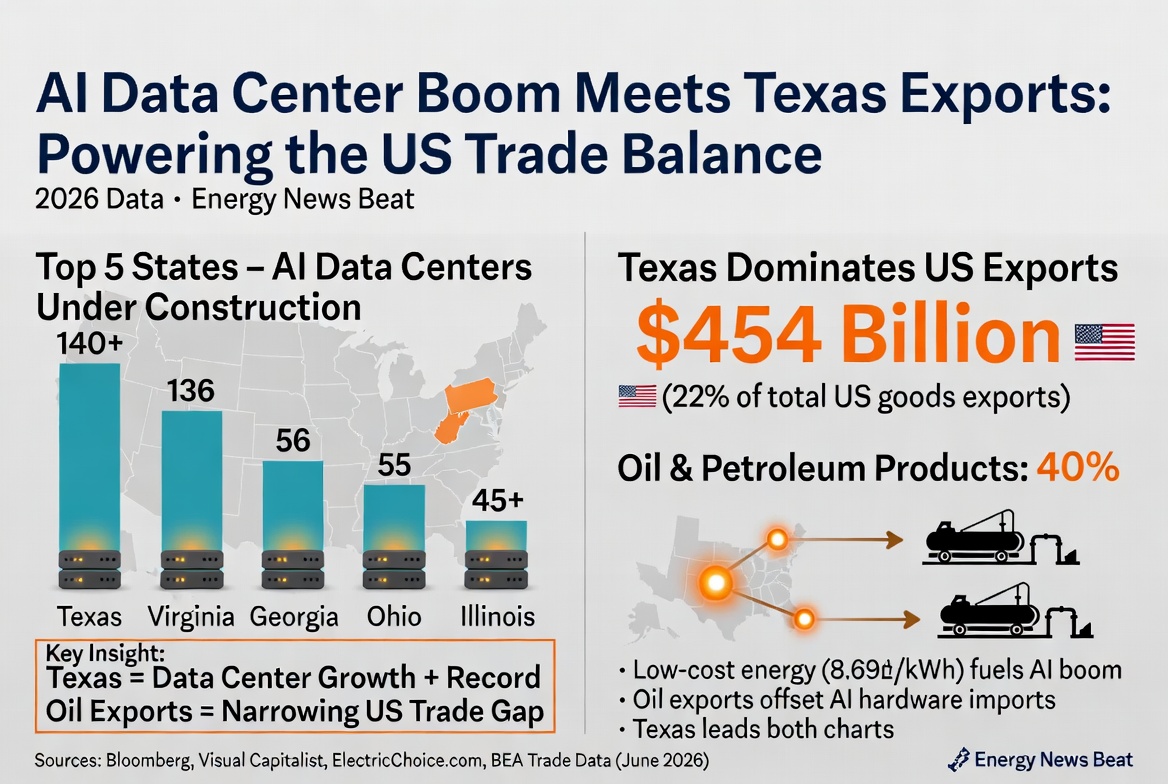
AI data center growth is heavily concentrated in a handful of states, with over 700 projects under construction nationwide and Texas poised to overtake Virginia as the top hub. Here are the leading states by current momentum (under-construction and announced projects), their electricity prices (June 2026 data, commercial rates critical for data centers), national rankings, and key energy policies:
Texas (140+ under construction; ~962 total pipeline sites projected) Commercial electricity rate: ~8.69¢/kWh (among the nation’s lowest; ranks ~3rd cheapest).
Policy: Deregulated ERCOT market, abundant natural gas, and wind. SB 6 (2025) requires large loads (>75 MW) to fund interconnection upgrades and participate in demand response. Strong tax incentives historically, now balanced with grid reliability rules. Pro-business, fossil + renewable mix.
Virginia (136 under construction; still leads in operating facilities) Commercial electricity rate: ~9.45–10.16¢/kWh (mid-tier; better than the national average but higher than Texas).
Policy: “Data Center Alley” (Loudoun County) benefits from fiber proximity. Sales/use tax exemptions under review—proposals to tie incentives to renewable procurement or emission-free backups. Some bills seek to phase out or condition incentives amid grid strain.
Georgia (56 under construction; explosive planned growth) Commercial electricity rate: ~11.08–11.57¢/kWh (competitive, below national avg).
Policy: Tax credits for data centers, but 2026 legislation (SB 476) targets cutting many credits to fund income tax relief. Business-friendly Southeast energy mix (natural gas, some nuclear/renewables).
Ohio (51–58 under construction) Commercial electricity rate: ~11.21–13.12¢/kWh (mid-range).
Policy: Part of PJM grid facing capacity auction pressures from data center demand. Incentives available but facing scrutiny; focus on reliability and potential large-load tariffs.
Illinois (strong planned growth; part of Midwest boom) Commercial electricity rate: ~13.07–13.27¢/kWh (near or above national avg).
Policy: POWER Act proposals for hyperscale centers (>50 MW) emphasize affordability and environmental rules. Recent moves to suspend or condition tax incentives; carbon-neutral requirements in some programs.
National context: U.S. commercial average ~14.37¢/kWh. Texas and other low-cost states dominate the rankings for cheapest electricity.
The Correlation: Rapid AI/Data Center Growth + Low-Cost Energy = Economic Win
There is a clear, strong correlation between low-cost energy, supportive policies, and explosive data center growth. States like Texas lead because cheap, reliable power (enabled by deregulated markets and domestic natural gas/wind resources) minimizes one of the biggest operating expenses for AI facilities—electricity can account for 60-80% of data center costs. Virginia succeeds more on location and infrastructure, but the shift toward Texas, Georgia, and Midwest states shows developers prioritizing energy economics amid soaring demand.
These states’ growing economies are directly helping narrow the national trade gap. Texas, America’s top export state (over $454 billion in goods in recent years, nearly 22% of U.S. total), leverages oil and gas exports to offset the very hardware imports its data centers drive. Local economic multipliers—jobs, tax revenue, and supply chain activity—boost overall U.S. competitiveness.
Texas is at the center stage. It combines record oil exports with the fastest data center pipeline, making it a microcosm of the national story: energy exports balance AI imports while powering domestic tech growth. As one analysis noted, Texas is “emerging as a test case for how U.S. policymakers manage the collision of artificial intelligence growth… and supply chain risks.”
Bottom Line for Energy Investors
The April trade data confirms that America’s energy advantage remains a strategic asset in the AI era. Low-cost, policy-flexible states are capturing the data center boom, driving local growth that supports national trade rebalancing. Investors should watch energy producers, midstream, utilities in the top growth states, and infrastructure plays—while monitoring policy shifts around incentives and grid costs. The oil-export offset isn’t a one-month fluke; it’s a structural feature of an economy where traditional energy and next-gen tech are increasingly intertwined.
Appendix: Sources and Links
- Bloomberg: “US Trade Gap Narrowed in April as Exports Outpaced Imports” (June 9, 2026) – https://www.bloomberg.com/news/articles/2026-06-09/us-trade-gap-narrowed-in-april-as-exports-outpaced-imports?srnd=phx-industries
- Trading Economics / BEA data on April 2026 trade: https://tradingeconomics.com/united-states/balance-of-trade
- ElectricChoice.com: U.S. Data Center Power Consumption Map & Electricity Prices by State (June 2026) – https://www.electricchoice.com/datacenters/ and https://www.electricchoice.com/electricity-prices-by-state/
- Visual Capitalist: “Ranked: The U.S. States Building the Most Data Centers” (April 2, 2026) – https://www.visualcapitalist.com/ranked-us-states-data-center-hotspots/
- Pew Research: Data center locations (April 2026) – https://www.pewresearch.org/short-reads/2026/04/13/most-new-data-centers-in-the-us-are-coming-to-rural-areas/
- EIA Electric Power Monthly (March/June 2026 data references) – https://www.eia.gov/electricity/monthly/
- Additional policy context: MultiState, AFS Law, and state legislative trackers (2026 data center bills in TX, VA, GA, IL, OH).
- Texas export analysis: Austin American-Statesman / Fitch Ratings (March 2026).
All data is current as of June 2026 reporting. Energy News Beat will continue monitoring this evolving intersection of energy and AI.
The post US Trade Gap Narrows as Oil Exports Offset AI-Driven Imports appeared first on Energy News Beat.