
After two overtime days, nations rejected a late cover decision. The European Union and island states said the draft was too weak on fossil fuels; oil producers and a Russian delegate pushed back, including on security grounds. A climate-scenario paper says the old highest-emission pathway, SSP5-8.5, has become implausible this century.
The United Nations climate conference in Antalya, Turkey, closed Sunday without a major agreement after the longest session on record. Bloomberg reported that COP31 began Nov. 9, ran two days past its scheduled close, and ended Nov. 22 with only modest advances on less contentious items. The United Nations said the conference closed “without consensus on an overarching outcome.”
That missing piece is what diplomats call a cover decision — a political wrap-up, not the entire Paris rulebook. Countries rejected a late draft often referred to as the Antalya Pact. The fight was about fossil fuels, money, carbon capture, and whether governments can keep the lights on while they sign the next promise. This is not investment advice.
What countries would not sign
Bloomberg, in a Nov. 22 report by Jennifer A. Dlouhy and John Ainger, said dozens of countries refused a deal seen as “pandering to the fossil fuel industry.” Norway, Vanuatu, Panama, and EU nations would not endorse it. The draft left out calls for an accelerated transition from fossil fuels, a point Germany, the EU, and Pacific nations criticized.
Darragh O’Brien, Ireland’s climate minister, speaking for the European Union, said, “It is unconscionable that we would have a climate pact that makes no reference to fossil fuels — and no reference to transition away from fossil fuel either.” Kathy Jetnil-Kijiner, representing the Marshall Islands, said: “We will not be forced to accept false solutions. We will not compromise our future to benefit fossil fuel interests. We will not accept an outcome that undermines our security and threatens our future.” That is only one side of the hall. Bloomberg reported that Saudi Arabia, the world’s third-largest oil producer in its account, led a push for language encouraging rapid carbon-capture deployment. An unnamed Saudi representative, speaking for the 22-member Arab group, said, “It makes no sense that solutions — concrete solutions, which is what this COP is supposed to represent — are being taken off the table.” Bloomberg’s own assessment is that carbon capture is favored by oil and gas producers and “has done little to pare planet-warming pollution.”
A Russian delegate, Bloomberg reported, opposed fossil-fuel language on national security grounds and criticized EU carbon levies, saying, “Climate policy should not turn into trade policy by other means.” Chris Bowen, Australia’s climate minister, who oversaw the negotiations in a power-sharing arrangement with Turkey, said: “An obvious issue is the transition away from fossil fuels where some parties insisted that it must be mentioned. Other parties insisted that if it was mentioned, they would veto.” Turkey’s COP31 president, Murat Kurum, told the closing plenary there was no agreement on the text and the decisions had not been adopted, according to UN News. Bloomberg said delegates had gone all night Friday and Saturday before leaving with no broad declaration.
Energy security was already in the room
Ilana Seid, Palau’s UN ambassador and chair of the Alliance of Small Island States, put the wider backdrop on the record. “The COP process can’t be isolated from what’s going on in the world, and so obviously we have geopolitics, we have wars, we have energy shocks — and the COP process operates within that environment,” she told Bloomberg. “As a function of what’s going on in the world, it’s difficult to find consensus.”
That is a fair description of the week, not a complete explanation for it. Money was a second fault line. Bloomberg reported that the EU had ruled out new climate finance before the talks, and that the idea was called “dead in the water.” Vulnerable nations said rich countries refused to speed up adaptation funding. A year ago, countries agreed to at least triple that funding by 2035, but they never fixed the baseline. Heatmap News, writing before the final plenary, reported that Rachel Cleetus of the Union of Concerned Scientists said the European Union was blocking an agreement on that baseline.
Turkey had backing from more than 75 countries for a voluntary electrification pledge meant to be part of an Antalya Pact, Bloomberg reported; the collapse halted a formal, wide endorsement. The BBC reported that Russia warned against turning to “slogans” over coal, oil, and gas, and said that moving away too quickly would lead to “fuel poverty.” None of that proves energy security, by itself, sank the text. It does show that security and bills were part of why consensus was so hard.
What the official scenario papers actually say
There is another reason some governments are less willing to sign the steepest promises. In a May 16 Energy News Beat piece, we reported on a shift in the high-end climate scenarios that have loomed over policy debates for years. That piece framed the shift as a quiet admission by the UN climate panel. The paper is real, but it is a research paper, not an IPCC assessment.
The precise wording is in an April 7, 2026, scenario-design paper in Geoscientific Model Development by Detlef van Vuuren and colleagues. It sets the framework for ScenarioMIP in CMIP7, the next round of climate-model experiments, which is expected to inform the IPCC’s Seventh Assessment Report. It is not itself an IPCC assessment. The authors wrote that, for the 21st century, “on the high-end of the range, the CMIP6 high emission levels (quantified by SSP5-8.5) have become implausible, based on trends in the costs of renewables, the emergence of climate policy and recent emission trends.” They cited the same critique of SSP5-8.5 and its precursor, RCP8.5, that Zeke Hausfather and Glen Peters advanced in 2020. The new “high emission” case, they said, should be “as high as judged to be plausible” and is “expected to result in forcings below SSP5-8.5.”
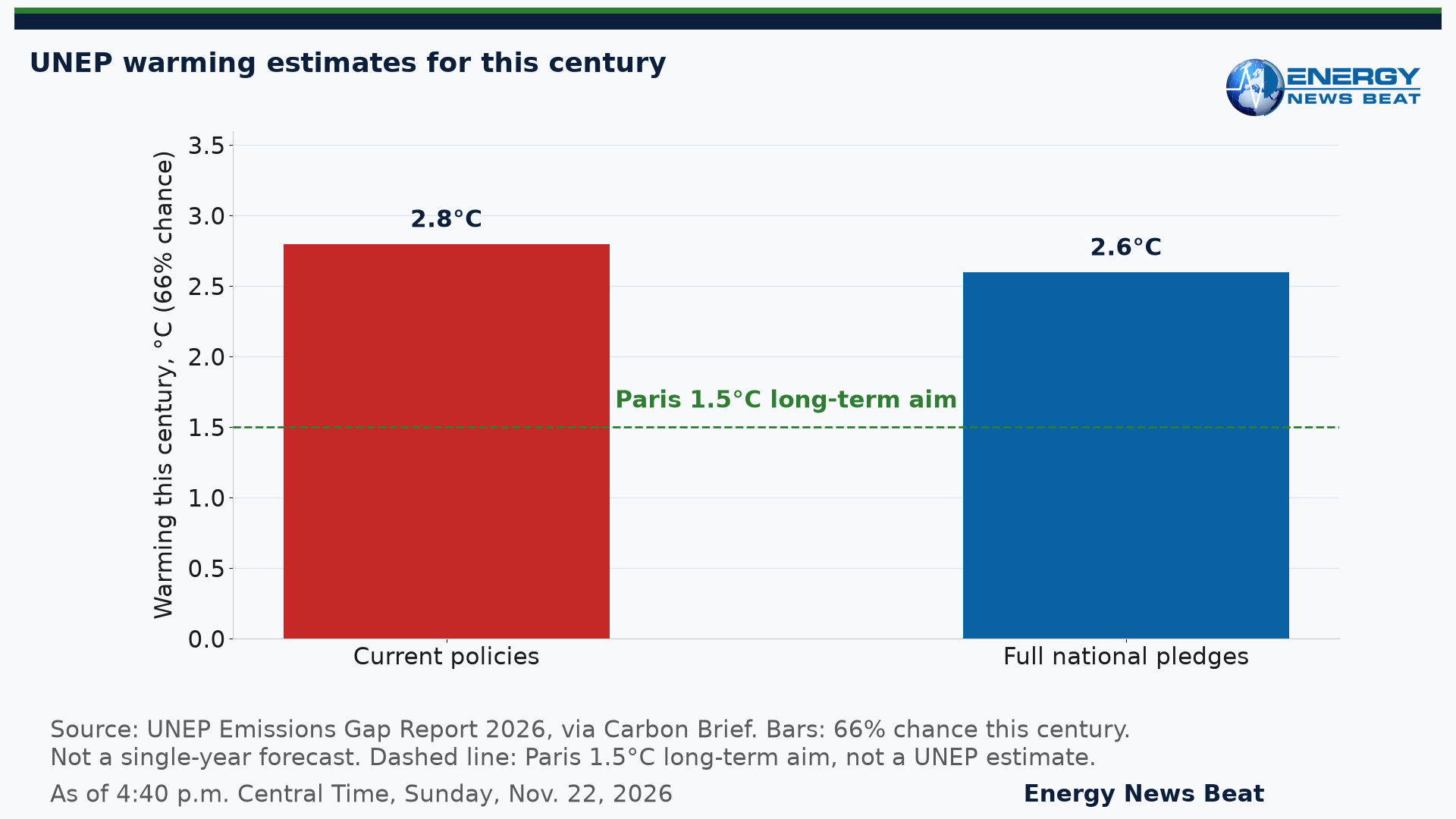
The IPCC’s Sixth Assessment already treated that high end with caution, noting that RCP8.5 and SSP5-8.5 “have recently been argued to be implausible to unfold” and “are becoming less likely with climate policy and technology change,” while warning that high-end warming could still be reached if carbon-cycle feedbacks are strong. The latest UN Environment Programme Emissions Gap Report, as Carbon Brief summarized it, is more immediate: if current policies continue, there is a 66% chance of 2.8°C of warming this century; if national pledges are fully implemented, that figure is 2.6°C. That is well above the Paris Agreement’s 1.5°C long-term aim, and well below SSP5-8.5 at 4.4°C (3.3–5.7°C) for 2081–2100, in IPCC AR6 Working Group I Table 4.2. A useful stress test is not the same thing as a forecast.
If you pay a power bill
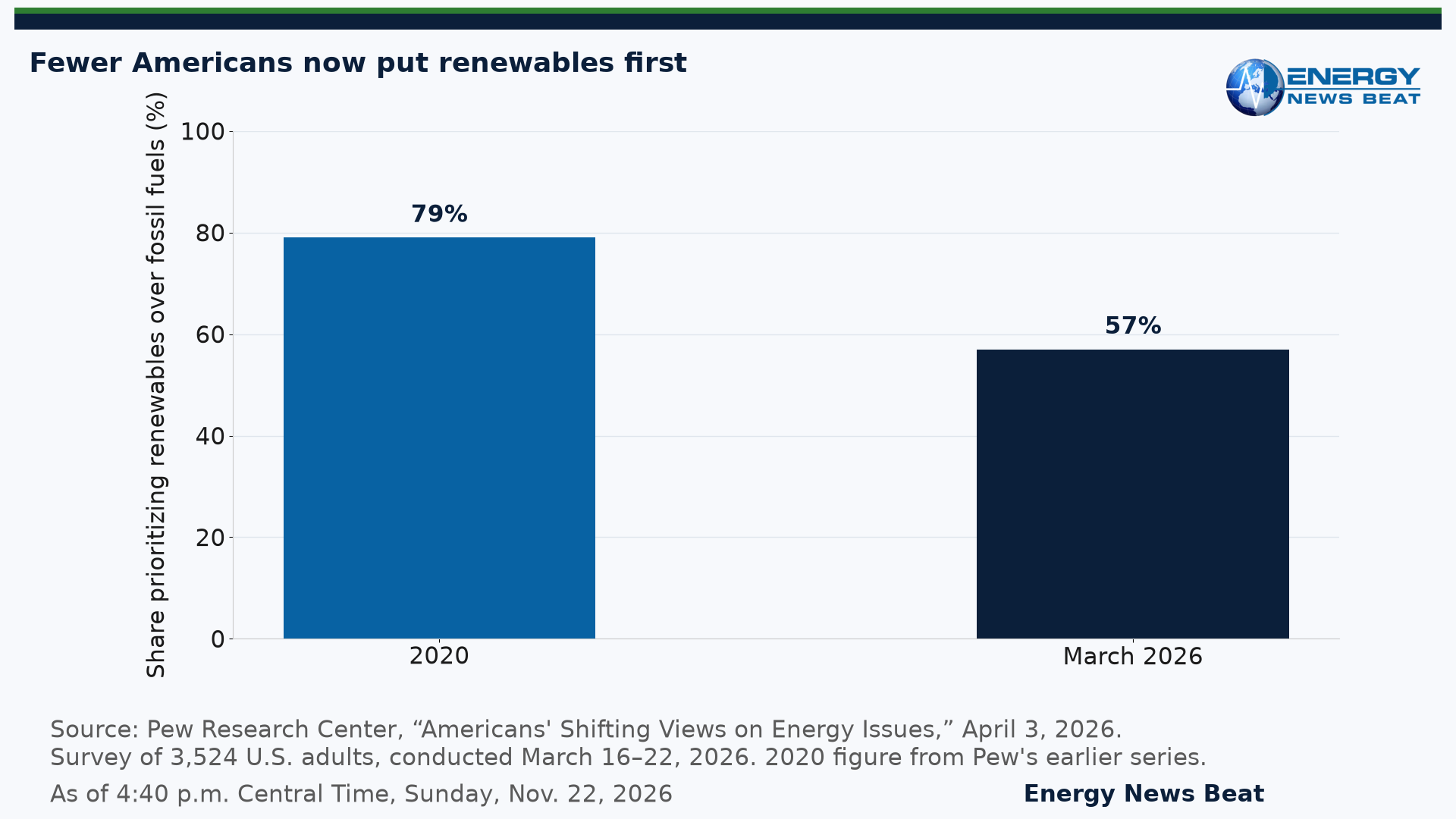
Households do not sit in the plenary. They sit with the bill. A Pew Research Center survey of 3,524 U.S. adults, conducted March 16–22, 2026, found that 57% still say renewable energy should be prioritized over fossil fuels — a majority, but down from 79% in 2020. Republicans have moved sharply: 71% now say the priority should be oil, coal, and natural gas. Americans, especially Republicans, are also more likely to see wind and solar as less reliable than other sources. The survey was fielded during a period of higher gasoline prices. If your government is promising a faster shift, it is fair to ask what firm power replaces retiring plants, and how much of the argument is about climate science versus energy security. This is not a recommendation to buy or sell any stock, fuel, or utility.
Consumer and Investor Views
Pew’s March survey also found that 65% of U.S. adults still want the federal government to encourage wind and solar production, even as fewer people want those sources put first.
Analysts who follow the process are not uniform. Alden Meyer, a senior associate at the think tank E3G, said in a statement carried by Carbon Brief that “despite the failure of the cover decision, the COP did not ‘collapse’, as some headlines are saying,” because parties adopted other decisions, including on a just-transition work programme and the global goal on adaptation. Joanna Depledge, a University of Cambridge research fellow, told Carbon Brief the cover decision was “an add-on,” not the conference’s core mandated task. Mohamed Adow of Power Shift Africa, quoted by the Guardian, called it “the worst Cop ever.” Those are arguments, not a price target. This is not investment advice.
Timeline
Key dates for the official climate-scenario debate and the Antalya conference.
August 2021. The IPCC Sixth Assessment Report, Working Group I, notes that RCP8.5 and SSP5-8.5 “have recently been argued to be implausible to unfold,” while still presenting results from the high-end pathway where relevant.
April 4, 2022. IPCC Working Group III says high-end emission scenarios such as RCP8.5 and SSP5-8.5 “are becoming less likely with climate policy and technology change.”
April 7, 2026. Van Vuuren and colleagues publish the ScenarioMIP-CMIP7 design paper, stating that CMIP6 high emission levels “quantified by SSP5-8.5” have “become implausible.”
May 16, 2026. Energy News Beat reports on that shift in a Publisher’s Pick that framed it as a quiet admission by the UN climate panel.
November 9, 2026. COP31 opens in Antalya, Türkiye, with Murat Kurum as COP president and Chris Bowen as president of negotiations, as scheduled by the UNFCCC.
November 20, 2026. The official session dates end; talks run into overtime.
November 21–22, 2026. Delegates meet through the night. A late cover decision, referred to as the Antalya Pact, is put to the hall and rejected. The conference closes Sunday without consensus on an overarching outcome.
Caveats and Criticism
A failed cover decision is not the same as the collapse of the UN climate process. Bloomberg itself noted that cover decisions are relatively recent and that most summits have not ended with a sweeping deal; it pointed to the 2009 Copenhagen breakdown, which later fed into the Paris Agreement. Bloomberg also reported acrimony in the hall: Ghana’s environment minister said she was cut off, and Kurum at one point told UN climate chief Simon Stiell to “please sit down.”
Plausibility, the ScenarioMIP authors said, is a subjective and conditional judgment. High-end warming is not thereby off the table. Energy security helps explain the deadlock; it does not, by itself, prove why any one country voted as it did. The EU’s rejection was a rejection of a text it saw as too weak, not too strong. UNEP’s 2.8°C and 2.6°C figures are probabilistic (a 66% chance) and are not forecasts of a single year’s weather.
Stu’s Take
Energy security is at the forefront, and that showed up in Antalya. The European Union and island states rejected a draft that never mentioned fossil fuels. Oil producers, led by Saudi Arabia, pushed for carbon-capture language, and a Russian delegate argued on national security and trade grounds. Given that the scientists who design the next round of official climate-model scenarios have already judged the old highest-emission pathway, SSP5-8.5, implausible for this century, it is no surprise that some governments will not accept further deindustrialization, fossil-fuel bans, and reliance on wind and solar. Energy security starts at home, and your energy dominance is displayed through your exports.
And when you look at the article UN Climate Panel Quietly Admits Its Doomsday Climate Scenarios Were ‘Implausible’ – How much money has been spent on Net Zero because of lies?, you start to realize that the entire climate movement is a real wealth transfer. The indoctrination of our kids, funding and forcing an energy transition before the technology would allow, is really criminal. And the Blue and Red states that used the UN Climate agenda to influence energy policies should be removed from office. We need to deliver the lowest kWh to everyone on the planet with the least impact on the environment. Wind, Solar and Storage would not exist without oil, natural gas or coal, and let that set in for a moment.
Sources
Primary and secondary sources used in this article, with access dates. The official close of COP31 is from the United Nations. The session dates and venue are from the UNFCCC. Account of the rejected cover decision, including the verbatim quotes used in the article, is from Bloomberg’s Nov. 22, 2026, report, which is available to subscribers. The high-end scenario finding is from the ScenarioMIP-CMIP7 design paper, not from an IPCC assessment report.
- Bloomberg, Jennifer A. Dlouhy and John Ainger, with assistance from Azman Usmani, Lili Pike, and Selcan Hacaoglu, “UN Climate Talks Collapse in Acrimony as Nations Reject Deal,” Nov. 22, 2026, 6:02 a.m. Central Time, updated 9:03 a.m. Central Time. Subscription article; URL slug still uses the earlier wording “slide toward collapse.” Accessed Nov. 22, 2026. https://www.bloomberg.com/news/articles/2026-11-22/un-climate-talks-slide-toward-collapse-as-nations-reject-deal
- United Nations, “COP31,” official conference page, recording that the UN climate conference in Antalya, Türkiye, closed on 22 November without consensus on an overarching outcome. Accessed Nov. 22, 2026. https://www.un.org/en/climatechange/cop31
- UN Climate Change, COP 31 conference page, Antalya, Republic of Türkiye. Official session dates: Monday, 9 November, to Friday, 20 November 2026. Accessed Nov. 22, 2026. https://unfccc.int/cop31
- UNFCCC, notification to Parties and observer States, 17 July 2026, on the thirty-first session of the Conference of the Parties in Antalya. Accessed Nov. 22, 2026. https://unfccc.int/sites/default/files/resource/notification_to_parties_and_observer_states_cop31.pdf
- UN News, report on the close of COP31, including remarks by COP31 President Murat Kurum that there was no agreement on the text and the decisions had not been adopted. Accessed Nov. 22, 2026. https://news.un.org/en/story/2026/11/1168855
- BBC News, report on the close of COP31, including Russia’s warning against “slogans” and “fuel poverty,” and Chris Bowen’s remarks on the talks. Accessed Nov. 22, 2026. https://www.bbc.com/news/articles/cqwy06zrd26lo
- The Guardian, “Cop31 climate talks break down as key deal rejected,” Nov. 22, 2026, including Mohamed Adow’s “worst Cop ever” remark. Accessed Nov. 22, 2026. https://www.theguardian.com/environment/2026/nov/22/cop31-climate-talks-set-to-end-in-deep-division-as-key-deal-rejected
- Politico, report on the collapse of the COP31 cover decision amid fossil-fuel rows. Accessed Nov. 22, 2026. https://www.politico.eu/article/climate-deal-collapses-amid-fossil-fuel-rows/
- Deutsche Welle, report on the close of COP31, including the rejected draft and electrification language. Accessed Nov. 22, 2026. https://www.dw.com/en/cop31-climate-talks-end-without-consensus-on-how-to-fund-vulnerable-countries-or-move-the-world-away-from-coal-oil-and-gas-use/a-80003610
- Carbon Brief, “Experts: Is there a precedent for events at COP31?,” Nov. 22, 2026, 7:55 a.m. Central Time (updated later that morning), including statements by Alden Meyer, Joanna Depledge, Catherine Abreu, and others. Accessed Nov. 22, 2026. https://connect.carbonbrief.org/t/experts-is-there-a-precedent-for-events-at-cop31/216
- Heatmap News, adaptation-finance report from COP31, Nov. 21, 2026, written before the final plenary, including Rachel Cleetus of the Union of Concerned Scientists on the European Union and the unresolved baseline for last year’s pledge to at least triple adaptation funding by 2035. Accessed Nov. 22, 2026. https://heatmap.news/adaptation/cop31-adaptation-finance
- Energy News Beat, “UN Climate Panel Quietly Admits Its Doomsday Climate Scenarios Were ‘Implausible’…,” Publisher’s Pick, May 16, 2026. Accessed Nov. 22, 2026. https://energynewsbeat.co/enb-publisher-picks/un-climate-panel-quietly-admits-its-doomsday-climate-scenarios-were-implausible-how-much-money-has-been-spent-on-net-zero-because-of-lies/
- Detlef P. van Vuuren et al., “The Scenario Model Intercomparison Project for CMIP7 (ScenarioMIP-CMIP7),” Geoscientific Model Development, 19, 2627, published April 7, 2026. Accessed Nov. 22, 2026. https://gmd.copernicus.org/articles/19/2627/2026/
- IPCC, Sixth Assessment Report, Working Group I, Chapter 4, on arguments that RCP8.5 and SSP5-8.5 have been judged implausible to unfold. Accessed Nov. 22, 2026. https://www.ipcc.ch/report/ar6/wg1/downloads/report/IPCC_AR6_WGI_Chapter04.pdf
- IPCC, Sixth Assessment Report, Working Group III, Chapter 3 (official PDF), on high-end emission scenarios becoming less likely with climate policy and technology change. Accessed Nov. 22, 2026. https://www.ipcc.ch/report/ar6/wg3/downloads/report/IPCC_AR6_WGIII_Chapter03.pdf
- UN Environment Programme, Emissions Gap Report 2026. Accessed Nov. 22, 2026. https://www.unep.org/en/publications/report/emissions-gap-report-2026
- Carbon Brief, “UNEP: Opportunity has ‘been lost’ to meet 1.5C warming limit without ‘overshoot’,” summary of the 2026 Emissions Gap Report. Accessed Nov. 22, 2026. https://www.carbonbrief.org/unep-opportunity-has-been-lost-to-meet-1-5c-warming-limit-without-overshoot
- Pew Research Center, “Americans’ Shifting Views on Energy Issues,” April 3, 2026, reporting a survey conducted March 16–22, 2026, among 3,524 U.S. adults. Accessed Nov. 22, 2026. https://www.pewresearch.org/science/2026/04/03/americans-shifting-views-on-energy-issues/
Key Excerpts
United Nations, COP31 conference page. “The UN climate conference in Antalya, Türkiye closed on 22 November without consensus on an overarching outcome.”
Bloomberg, Dlouhy and Ainger, Nov. 22, 2026. COP31 in Antalya, Turkey, began Nov. 9, ran two days past its scheduled close — the longest session on record — and ended Nov. 22 without a major agreement, with only modest advances on less contentious items. Delegates went all night Friday and Saturday and concluded it was better to leave with no broad declaration.
Darragh O’Brien, speaking for the European Union, in Bloomberg. “It is unconscionable that we would have a climate pact that makes no reference to fossil fuels — and no reference to transition away from fossil fuel either.”
Kathy Jetnil-Kijiner, Marshall Islands, in Bloomberg. “We will not be forced to accept false solutions. We will not compromise our future to benefit fossil fuel interests. We will not accept an outcome that undermines our security and threatens our future.”
Unnamed Saudi representative for the 22-member Arab group, in Bloomberg. “It makes no sense that solutions — concrete solutions, which is what this COP is supposed to represent — are being taken off the table.”
Unnamed Russian delegate, in Bloomberg. “Climate policy should not turn into trade policy by other means.” Bloomberg reported that the delegate opposed fossil-fuel language on national security grounds and criticized EU carbon levies.
Chris Bowen, Australia’s climate minister, in Bloomberg. “An obvious issue is the transition away from fossil fuels where some parties insisted that it must be mentioned. Other parties insisted that if it was mentioned, they would veto.”
Ilana Seid, Palau’s UN ambassador and AOSIS chair, in Bloomberg. “The COP process can’t be isolated from what’s going on in the world, and so obviously we have geopolitics, we have wars, we have energy shocks — and the COP process operates within that environment. As a function of what’s going on in the world, it’s difficult to find consensus.”
Detlef van Vuuren et al., Geoscientific Model Development, April 7, 2026. “For the 21st century, this range will be smaller than assessed before: on the high-end of the range, the CMIP6 high emission levels (quantified by SSP5-8.5) have become implausible, based on trends in the costs of renewables, the emergence of climate policy and recent emission trends (Hausfather and Peters, 2020).” The paper designs ScenarioMIP-CMIP7; it is not itself an IPCC assessment.
Alden Meyer, E3G, statement carried by Carbon Brief, Nov. 22, 2026. “Despite the failure of the cover decision, the COP did not ‘collapse’, as some headlines are saying. Parties adopted a number of decisions, many of them procedural but others substantive, including on the just transition work programme and the global goal on adaptation.”
Joanna Depledge, University of Cambridge, in Carbon Brief. “COP31 is not a failure as such. Copenhagen and The Hague were, because they failed to reach agreement on their core mandated task. This [COP31] cover decision was an add-on.”
Pew Research Center, April 3, 2026. A survey of 3,524 U.S. adults, conducted March 16–22, 2026, found that 57% still say renewable energy should be prioritized over fossil fuels, down from 79% in 2020. Republicans: 71% now say the priority should be oil, coal, and natural gas. 65% say the federal government should encourage wind and solar.
Data Tables
Figures used in the article and charts, with as-of dates and sources. As of 4:40 p.m. Central Time, Sunday, Nov. 22, 2026
Table A. Official COP31 meeting facts
| Item | Figure or fact | Source |
| Meeting | COP 31 / CMP 21 / CMA 8 | UNFCCC |
| Host / venue | COP31 Venue in Soğucaksu, Antalya, Republic of Türkiye | UNFCCC notification, 17 July 2026 |
| Scheduled dates | Monday, Nov. 9, to Friday, Nov. 20, 2026 | UNFCCC notification, 17 July 2026 |
| Actual close | Sunday, Nov. 22, 2026, two days overtime; longest COP on record | UN; Bloomberg |
| COP president / negotiations president | Murat Kurum (Türkiye); Chris Bowen (Australia) | UNFCCC; Bloomberg |
| Overarching outcome | No consensus on a cover decision (the “Antalya Pact”) | UN; Bloomberg |
| Other outcomes | Modest or other decisions on less contentious items, including a just-transition work programme and global-goal-on-adaptation items, per later wrap-ups | Bloomberg; Carbon Brief / E3G |
A failed cover decision is not the same as the collapse of the entire UN climate process. Official documents use Türkiye; news reports, including Bloomberg, often say Turkey.
Table B. UNEP Emissions Gap Report 2026 warming figures used in Chart 1
| Case | Warming this century | Probability |
| Current policies | 2.8°C | 66% chance |
| Full implementation of national pledges (NDCs) | 2.6°C | 66% chance |
| Paris Agreement long-term temperature aim (reference, not a UNEP pathway estimate) | 1.5°C | — |
Source: UNEP Emissions Gap Report 2026, as summarized by Carbon Brief. These are probabilistic estimates of warming this century, not forecasts of a single year’s weather. They are well below SSP5-8.5 in IPCC AR6 Working Group I Table 4.2, 4.4°C (3.3–5.7°C) for 2081–2100.
Table C. Pew Research Center energy-priority figures used in Chart 2
| Measure | Share | Sample / date |
| U.S. adults prioritizing renewable energy over fossil fuels, 2020 | 79% | Pew earlier series, as reported April 3, 2026 |
| U.S. adults prioritizing renewable energy over fossil fuels, 2026 | 57% | March 16–22, 2026, n=3,524 |
| Republicans prioritizing oil, coal, and natural gas, 2026 | 71% | Same survey |
| U.S. adults who say the federal government should encourage wind and solar, 2026 | 65% | Same survey |
Source: Pew Research Center, “Americans’ Shifting Views on Energy Issues,” April 3, 2026. The survey was fielded during a period of higher gasoline prices. Public attitudes, not an audit of any COP text.
Table D. High-end climate-scenario language cited in the article
| Source | Date | Finding, in brief |
| IPCC AR6 Working Group I, Chapter 4 | August 2021 | RCP8.5 and SSP5-8.5 “have recently been argued to be implausible to unfold”; results from SSP5-8.5 are still shown where relevant. |
| IPCC AR6 Working Group III, Chapter 3 | April 4, 2022 | High-end emission scenarios “are becoming less likely with climate policy and technology change,” but high-end warming may still be reached with strong carbon or climate feedbacks. |
| Van Vuuren et al., ScenarioMIP-CMIP7, Geoscientific Model Development | April 7, 2026 | CMIP6 high emission levels “quantified by SSP5-8.5” “have become implausible.” The new high-emission case should be “as high as judged to be plausible” and is “expected to result in forcings below SSP5-8.5.” |
| Energy News Beat Publisher’s Pick | May 16, 2026 | Reported the shift; framed it as a quiet admission by “the UN climate panel” that the scenarios were “implausible.” |
The April 2026 paper designs the next round of climate-model scenarios (ScenarioMIP for CMIP7), which is expected to inform the IPCC’s Seventh Assessment Report. It is not itself an IPCC plenary decision or assessment. Plausibility, the authors said, is a subjective and conditional judgment.
The post COP31 in Antalya Ended Without a Major Deal After the Longest Climate Summit on Record appeared first on Energy News Beat.