
Republik 21’s expert council says Germany’s economy and society will not survive a 10-to-13.8-trillion-euro cost. The Bundestag brief it cites does not calculate that total. Households already paid 36.18 euro cents a kilowatt-hour in the first half of 2026, and Berlin is buying new firm power.
On Sunday morning, Nov. 22, 2026, UK energy consultant Kathryn Porter highlighted a November declaration from Republik 21’s expert council on climate and energy policy. The think tank says German society and the economy “will not survive” a withdrawal of value added on the scale of 10 to 13.8 trillion euros through 2045, a range it attributes to the Bundestag’s scientific research service. The service’s 2024 brief does not calculate that total. It reports a spread of other studies, from 500 billion euros a year up to a PwC gross figure of 13.3 trillion euros.
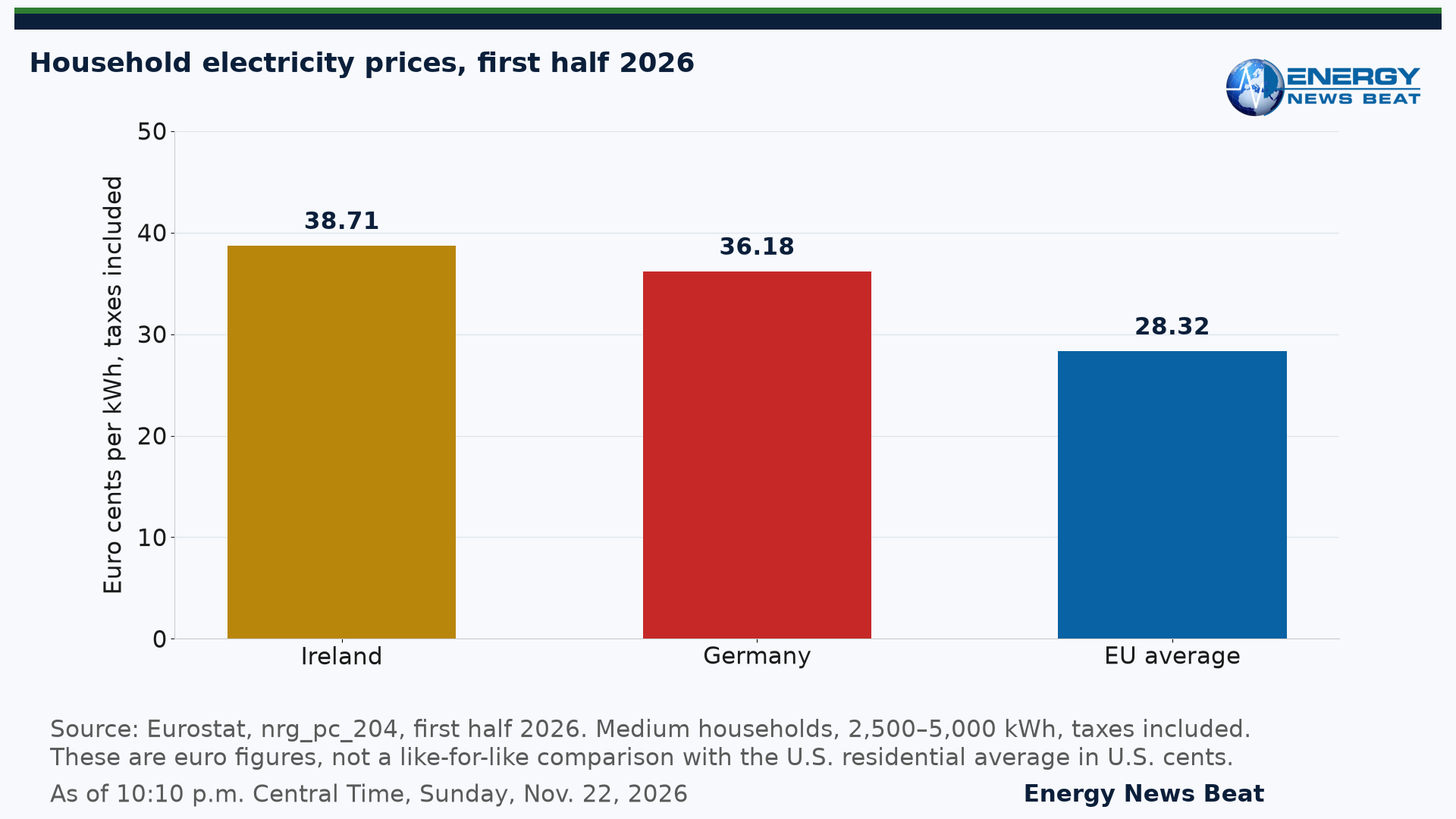
Households can already measure the bill. In the first half of 2026, German medium-sized households paid 36.18 euro cents a kilowatt-hour, including taxes, compared with an EU average of 28.32 euro cents, according to Eurostat. The U.S. residential average in August 2026 was 18.16 U.S. cents a kilowatt-hour, according to the Energy Information Administration. They are not a like-for-like comparison.
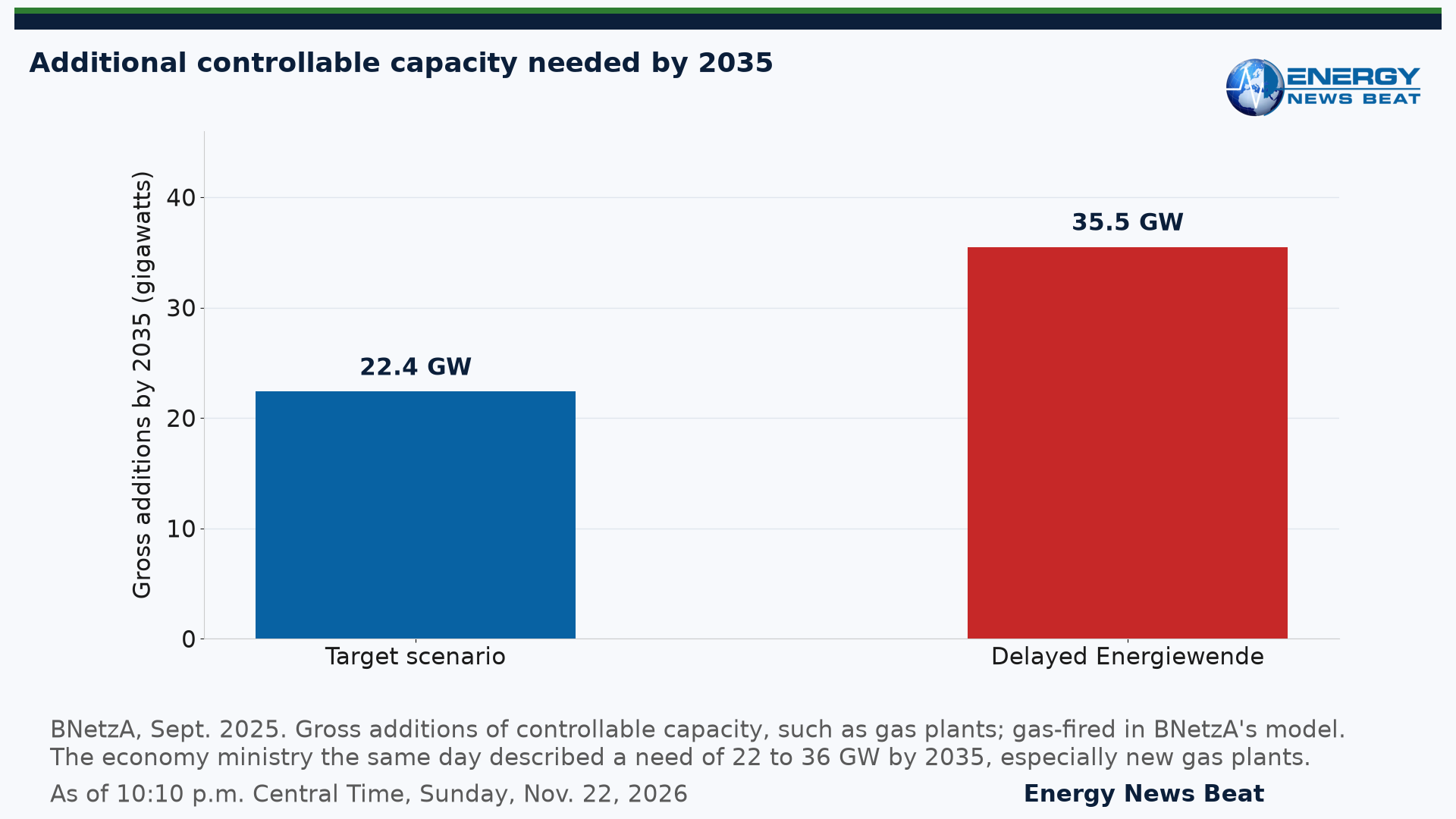
Berlin is also buying new firm power. The Federal Network Agency calculated a need for 22.4 or 35.5 gigawatts of additional controllable capacity by 2035. Economy Minister Katherina Reiche rounded that finding to 22 to 36 gigawatts, especially new gas plants. The first auction under the Electricity Supply Security and Capacity Act awarded about 5,160 megawatts of reduced capacity on Nov. 3. A second round closes Dec. 29.
What the council actually said
Republik 21, or R21, describes itself as a think tank for a new bourgeois politics. Its climate and energy council is not the official Expertenrat für Klimafragen created by the Federal Climate Change Act. Bild reported the declaration as an exclusive on Nov. 20. R21 posted the 59-page paper the next day.
The executive summary states, in an Energy News Beat translation: “The scientific service of the German Bundestag puts the costs of the energy transition to 2045 at 10 to 13.8 trillion euros. The German economy and society will not survive a withdrawal of value added of this magnitude.” The council also calls missed climate and energy policy “one of the central causes” of economic decline, says a DIHK study prices grid expansion at 2,100 billion euros, calls the nuclear exit a “historic mistake,” and warns that if a power import fails to arrive, “that is immediately and unavoidably associated with a blackout.” It says Germany is “up to 80 percent” dependent on China for solar hardware, and “for batteries the figure is likely even higher.” Those are the council’s judgments.
Its recommendations include ending national climate policy, a nuclear demolition ban, and lifting the fracking ban. The last three reactors — Emsland, Isar 2, and Neckarwestheim 2 — were shut down on April 15, 2023. Porter said her United Kingdom report is coming “next week.” That paper had not been published as of this article’s as-of time and is not a source for the German figures here.
Which numbers hold up
The brief R21 cites is WD 5-3000-135/24, dated Sept. 16, 2024. “The federal government does not produce its own total cost calculation” for the Energiewende, the service wrote. It surveyed other studies: “Depending on the period examined, costs are put at amounts between 500 billion euros a year or 13.3 trillion euros in total by 2045.” The footnotes point to a 2019 ifo commentary by Karen Pittel and Hans-Martin Henning and to PwC’s 2024 paper. That PwC figure is a total investment-and-energy bill through 2050 under a business-as-usual path; its faster net-zero path was about 13.2 trillion. The service did not adopt 10 to 13.8 trillion as its own estimate. R21’s “will not survive” sentence is the council’s conclusion, not a Bundestag finding.
The DIHK grid figure does not match the chamber’s published study. R21 says a DIHK study prices grid expansion and conversion at 2,100 billion euros. DIHK and Frontier Economics, in their “Plan B” study, put total system costs for 2025 to 2049 under current policy at 4.8 to 5.4 trillion euros, of which grids — expansion and operation — are about 1.2 trillion. The 2.0 to 2.3 trillion line in that study is energy imports, not grids.
Destatis reported that in 2025, 88.0 percent of Germany’s imported photovoltaic plants — essentially solar cells and modules — came from China. That series does not include inverters, mounting systems, or batteries. R21’s claim that the battery share is “likely even higher” than 80 percent was not confirmed in an official trade table.
The capacity numbers need a precise split. In its September 2025 supply-security report, the Bundesnetzagentur said security of supply can be maintained if additional controllable capacity of up to 22.4 gigawatts in the target scenario, or up to 35.5 gigawatts in a “Delayed Energiewende” case, is built by 2035. In a Sept. 3, 2025, ministry statement, Economy Minister Katherina Reiche said the report showed a need to add new controllable capacity, especially new gas plants, of 22 to 36 gigawatts by 2035. Photon noted that the ministry had equated the broader need with gas plants.
The first StromVKG auction, announced Nov. 3, awarded about 5,160 rMW of reduced capacity at a volume-weighted average of 155,296 euros per rMW per year. A second auction, for about 3,840 rMW, has a bid deadline of Dec. 29, 2026.
What it means for households
Eurostat’s household figures are for medium consumers using 2,500 to 5,000 kilowatt-hours a year, including taxes, levies, and VAT. Germany’s 36.18 euro cents in the first half of 2026 was second in the EU and about 28 percent above the union’s weighted average of 28.32 euro cents (statistics explained; Oct. 30 news note). The U.S. residential average of 18.16 cents in August 2026, from EIA Table 5.6.A, released Oct. 23, is a national average retail price in U.S. cents, not a tax-inclusive euro household tariff.
R21 warns that a missed power import is “unavoidably associated with a blackout.” The official reliability record is quieter. For 2024, the Bundesnetzagentur reported an average unplanned interruption, excluding force majeure, of 11.7 minutes per final customer, down from 12.8 minutes in 2023. In the regulator’s target scenario, loss-of-load expectation stays below 0.3 hours a year if the additional controllable capacity is built. With demand flexibility cut to a fifth and the same plant fleet, LOLE reaches 11.6 hours in 2035, above the 2.77-hour threshold. Hours of unmet demand are not a nationwide blackout.
Public support has not collapsed. KfW’s 2026 Energiewende Barometer, published Aug. 27 from a survey of more than 4,300 households, found that 84 percent of private households still call the transition important or very important. Under very high electricity-cost pressure, that share falls to 71 percent. In an Aug. 12, 2026, statement, BDI said it stands by climate neutrality but that the transformation works only if power is affordable, secure, and predictable. It supports the capacity auctions and opposes financing them with an additional surcharge on the power price.
A U.S. parallel, carefully drawn
The R21 paper is not a finding that U.S. state net-zero mandates will fail, or that U.S. households will pay German-level bills.
NERC’s 2025 Long-Term Reliability Assessment, released with a Jan. 29, 2026, note, said resource-adequacy risks are intensifying across North America. Summer peak demand is forecast to grow 224 gigawatts over 10 years, and winter peak 246 gigawatts, with new data centers accounting for most of the projected increase. NERC called the assessment “not a prediction of failure but an early warning.” In New York, the state grid operator has already identified a statewide resource deficiency.
Germany’s ministry has put a public number on new dispatchable capacity through 2035 and has started paying for it. In the United States, the reliability organization is also flagging a growing need for resources that can run when the wind is still and the sun is down. That is an institutional parallel. It is not proof of a coming blackout.
Consumer and Investor Views
For German households, the documented bill is already high by European standards: 36.18 euro cents a kilowatt-hour in the first half of 2026, taxes included, against an EU average of 28.32 euro cents. KfW still finds 84 percent support for the Energiewende, falling to 71 percent when electricity-cost pressure is very high.
Investors can see a first capacity auction that cleared about 5,160 rMW at a volume-weighted average of 155,296 euros per rMW per year, under a 15-year obligation, with a second round due Dec. 29. BDI supports the auctions and opposes an extra surcharge on the power price. This is not investment advice.
Timeline
Key dates for the German capacity debate, the R21 declaration, and the official figures cited here.
April 15, 2023. Germany shuts its last three nuclear plants: Emsland, Isar 2, and Neckarwestheim 2.
Sept. 16, 2024. The Bundestag research service issues WD 5-3000-135/24, a short brief surveying other studies’ Energiewende cost figures. It does not adopt a 10-to-13.8-trillion-euro estimate of its own.
Sept. 3, 2025. The Bundesnetzagentur publishes its electricity supply-security report, with additional controllable capacity of up to 22.4 or 35.5 gigawatts by 2035. Economy Minister Katherina Reiche describes a need of 22 to 36 gigawatts, especially new gas plants.
Oct. 9, 2025. The Bundesnetzagentur reports a 2024 SAIDI of 11.7 minutes per final customer.
Jan. 29, 2026. NERC releases a news note on its 2025 Long-Term Reliability Assessment, warning of intensifying resource-adequacy risk in North America.
March 12, 2026. Destatis reports that 88.0 percent of Germany’s 2025 photovoltaic-plant imports came from China.
First half of 2026. Eurostat records German medium-household electricity prices at 36.18 euro cents a kilowatt-hour, against an EU average of 28.32 euro cents, taxes included.
Aug. 12, 2026. BDI says it stands by climate neutrality but that the transformation depends on affordable, secure, and predictable power, and opposes an extra surcharge to finance capacity auctions.
Aug. 27, 2026. KfW publishes the 2026 Energiewende Barometer: 84 percent support, falling to 71 percent under very high electricity-cost pressure.
August 2026. EIA’s Electric Power Monthly, released Oct. 23, puts the U.S. residential average at 18.16 U.S. cents a kilowatt-hour.
Nov. 3, 2026. The Bundesnetzagentur announces the first StromVKG long-term capacity awards, about 5,160 rMW.
Nov. 20–21, 2026. Bild reports the R21 declaration as an exclusive; R21 posts the 59-page paper the next day.
Nov. 22, 2026, 1:46 a.m. Central Time. Kathryn Porter highlights the declaration on X and says her United Kingdom report is coming “next week.” That paper had not been published as of this article’s as-of time.
Dec. 29, 2026. Bids are due in the second StromVKG long-term capacity auction, for about 3,840 rMW.
Caveats and Criticism
The council’s claim that missed climate and energy policy is a central cause of economic decline is the council’s judgment, not a finding of this article. The 10-to-13.8-trillion-euro range is not a Bundestag calculation, and the 2,100 billion euro DIHK grid figure does not match the chamber’s published Plan B study. The battery-share claim above 80 percent is unverified here.
Reduced-capacity megawatts from the StromVKG auction should not be added, without conversion, to the regulator’s nameplate gigawatt figures. Eurostat’s tax-inclusive euro household prices and EIA’s U.S. retail averages are not the same product. SAIDI describes past unplanned interruptions, excluding force majeure; loss-of-load hours in a model are not a nationwide blackout.
Stu’s Take
The R21 council says German society and the economy will not survive a withdrawal of value added on the scale of 10 to 13.8 trillion euros through 2045. That range is not a Bundestag calculation, and the 2,100 billion euro grid number does not match DIHK’s published study. German medium households paid 36.18 euro cents a kilowatt-hour in the first half of 2026, well above the EU average. The regulator has put a 22.4 to 35.5 gigawatt figure on additional controllable capacity by 2035; the ministry rounded that to 22 to 36 gigawatts, especially new gas plants, and the first auction has already awarded about 5,160 megawatts of reduced capacity. The Bundesnetzagentur reported an average unplanned interruption of 11.7 minutes per final customer in 2024.
The parallels with Blue States energy policies is amazing. The more they push wind, solar, storage while pulling coal, nuclear or natural gas off the grid, just makes the overall grid more unstable and more expensive.
Sources
Primary and named secondary sources used in this article, with access dates. R21 claims are taken from the public November 2026 PDF. Cost-citation checks use the Bundestag research-service brief WD 5-3000-135/24. Capacity, auction, reliability, price, and trade figures are from official agencies. Translations of German excerpts are labeled as Energy News Beat translations. English quotations from WD 5-3000-135/24 in the body are Energy News Beat translations.
- Kathryn Porter, X post, Nov. 22, 2026, 1:46 a.m. Central Time, highlighting the R21 declaration and saying a United Kingdom report is coming “next week.” Accessed Nov. 22, 2026. https://x.com/KathrynPorter26/status/2124409088737980855
- Republik 21, Erklärung des Expertenrates Klima- und Energiepolitik, November 2026, 59-page PDF. Accessed Nov. 22, 2026. https://denkfabrik-r21.de/wp-content/uploads/2026/11/Erklaerung_Expertenrat_R21_November-2026.pdf
- Republik 21, HTML posting of the declaration, Nov. 21, 2026. Accessed Nov. 22, 2026. https://denkfabrik-r21.de/erklaerung-des-expertenrates-fuer-klima-und-energiepolitik/
- Republik 21, organization site. Accessed Nov. 22, 2026. https://denkfabrik-r21.de/
- Die Weltwoche, report on the R21 declaration, identifying Professor Joachim Weimann of the University of Magdeburg as council chair, Nov. 22, 2026. Accessed Nov. 22, 2026. https://weltwoche.ch/daily/deutschlands-wirtschaft-und-gesellschaft-werden-die-energiewende-nicht-ueberleben-warnt-ein-gutachten/
- Bild, exclusive report on the R21 declaration, Nov. 20, 2026. Accessed Nov. 22, 2026. https://www.bild.de/politik/inland/exklusiv-deutschland-wird-energiewende-nicht-ueberleben-6afec00aa3767a11a0be9dcd
- Statement.com, “Experts savage German energy policy,” Nov. 20, 2026. Accessed Nov. 22, 2026. https://statement.com/1372236/experts-savage-german-energy-policy
- Wissenschaftliche Dienste des Deutschen Bundestages, WD 5-3000-135/24, Zur Berechnung der Investitionskosten für die Energiewende, Sept. 16, 2024. Accessed Nov. 22, 2026. https://www.energieende.de/Quellen/WD-5-135-24-pdf.pdf
- Karen Pittel and Hans-Martin Henning, “Was uns die Energiewende wirklich kosten wird,” ifo / FAZ guest article, July 12, 2019. Accessed Nov. 22, 2026. https://www.ifo.de/medienbeitrag/2019-07-12/was-uns-die-energiewende-wirklich-kosten-wird
- PwC, “Beschleunigte Investitionen in den Klimaschutz lohnen sich – jetzt auch ökonomisch!,” 2024. Accessed Nov. 22, 2026. https://www.pwc.de/de/energiewirtschaft/klimaschutzinvestitionen-lohnen-sich.html
- DIHK / Frontier Economics, “Neue Wege für die Energiewende (Plan B),” total system costs 2025–2049 and grid costs. Accessed Nov. 22, 2026. https://www.dihk.de/de/newsroom/aktuelle-energiewende-politik-kostet-bis-zu-5-4-billionen-euro-141284
- EWI Cologne / ef.Ruhr, Abschätzung der Netzausbaukosten zum Jahr 2045, April 2024. Accessed Nov. 22, 2026. https://www.ewi.uni-koeln.de/cms/wp-content/uploads/2024/04/2024_04_Abschlussbericht_Netzentgelte_BW_DE.pdf
- Bundesnetzagentur, Bericht Stand und Entwicklung der Versorgungssicherheit im Bereich der Versorgung mit Elektrizität, Sept. 3, 2025. Accessed Nov. 22, 2026. https://www.bundesnetzagentur.de/DE/Fachthemen/ElektrizitaetundGas/Versorgungssicherheit/Monitoring_Strom/DL/Bericht.pdf?__blob=publicationFile&v=1
- Federal Ministry for Economic Affairs and Energy, press release on the Bundesnetzagentur supply-security report, Sept. 3, 2025, including Economy Minister Katherina Reiche’s statement. Accessed Nov. 22, 2026. https://www.bundeswirtschaftsministerium.de/Redaktion/DE/Pressemitteilungen/2025/09/20250903-bundesnetzagentur-legt-bericht-zur-versorgungssicherheit-strom-vor.html
- Photon, “BMWE setzt steuerbare Kapazitäten im BNetzA-Bericht mit Gaskraftwerken gleich,” Sept. 4, 2025. Accessed Nov. 22, 2026. https://www.photon.info/news/bmwe-setzt-steuerbare-kapazitaeten-im-bnetza-bericht-mit-gaskraftwerken-gleich/
- Bundesnetzagentur, StromVKG first long-term capacity auction results, Nov. 3, 2026 (German). Accessed Nov. 22, 2026. https://www.bundesnetzagentur.de/SharedDocs/Pressemitteilungen/DE/2026/20261103_StromVKG.html
- Bundesnetzagentur, English press release on the first StromVKG auction, Nov. 3, 2026. Accessed Nov. 22, 2026. https://www.bundesnetzagentur.de/SharedDocs/Pressemitteilungen/EN/2026/20261103_StromVKG.html
- Bundesnetzagentur, official list of first-round StromVKG awards. Accessed Nov. 22, 2026. https://www.bundesnetzagentur.de/DE/Fachthemen/ElektrizitaetundGas/Kapazitaetsmarkt/Ausschreibung/Gebotstermin_Sep26/_DL/Zuschlagsliste.pdf?__blob=publicationFile&v=3
- Bundesnetzagentur, second StromVKG long-term capacity auction, bid deadline Dec. 29, 2026. Accessed Nov. 22, 2026. https://www.bundesnetzagentur.de/1119730
- Bundesnetzagentur, English press release, electricity supply interruptions in 2024 (SAIDI 11.7 minutes), Oct. 9, 2025. Accessed Nov. 22, 2026. https://www.bundesnetzagentur.de/SharedDocs/Pressemitteilungen/EN/2025/20251009_SAIDI_Strom.html
- Eurostat, Electricity price statistics, household consumers, first half 2026 (nrg_pc_204). Accessed Nov. 22, 2026. https://ec.europa.eu/eurostat/statistics-explained/index.php?title=Electricity_price_statistics
- Eurostat, “Household electricity prices ease in 1st half of 2026,” Oct. 30, 2026. Accessed Nov. 22, 2026. https://ec.europa.eu/eurostat/web/products-eurostat-news/w/ddn-20261030-2
- U.S. Energy Information Administration, Electric Power Monthly, Table 5.6.A, August 2026, released Oct. 23, 2026. Accessed Nov. 22, 2026. https://www.eia.gov/electricity/monthly/epm_table_grapher.php?t=epmt_5_6_a
- Destatis, press release PD26_N017_43, photovoltaic plants and 2025 import shares, March 12, 2026. Accessed Nov. 22, 2026. https://www.destatis.de/DE/Presse/Pressemitteilungen/2026/03/PD26_N017_43.html
- KfW, Energiewendebarometer 2026. Accessed Nov. 22, 2026. https://www.kfw.de/PDF/Download-Center/Konzernthemen/Research/PDF-Dokumente-KfW-Energiewendebarometer/KfW-Energiewendebarometer-2026.pdf
- KfW, press release on the 2026 Energiewende Barometer, Aug. 27, 2026. Accessed Nov. 22, 2026. https://www.kfw.de/%C3%9Cber-die-KfW/Newsroom/Aktuelles/Pressemitteilungen-Details_905088.html
- BDI, “Wettbewerbsfähigkeit statt Kostenfalle,” Aug. 12, 2026. Accessed Nov. 22, 2026. https://bdi.eu/de/articles/energie-mobilitaet-und-umwelt/wettbewerbsfaehigkeit-statt-kostenfalle-warum-bezahlbarer-strom-ueber-den-erfolg-der-transformation-entscheidet
- Federal Ministry for Economic Affairs and Climate Action, announcement of the April 15, 2023, nuclear shutdown. Accessed Nov. 22, 2026. https://www.bundeswirtschaftsministerium.de/Redaktion/DE/Pressemitteilungen/2023/04/20230413-deutschland-beendet-das-zeitalter-der-atomkraft.html
- BASE, the last three nuclear plants: Emsland, Isar 2, and Neckarwestheim 2. Accessed Nov. 22, 2026. https://www.base.bund.de/de/nukleare-sicherheit/atomausstieg/abgeschaltete-akw/2022/die-drei-letzten-akw.html
- NERC, news note, “Resource adequacy risks intensify across North America as demand growth surges,” Jan. 29, 2026. Accessed Nov. 22, 2026. https://www.nerc.com/newsroom/resource-adequacy-risks-intensify-across-north-america-as-demand-growth-surges
- NERC, 2025 Long-Term Reliability Assessment. Accessed Nov. 22, 2026. https://www.nerc.com/globalassets/our-work/assessments/nerc_ltra_2025.pdf
- NYISO, press release on a first-ever statewide resource deficiency. Accessed Nov. 22, 2026. https://www.nyiso.com/-/press-release-nyiso-report-identifies-first-ever-statewide-resource-deficiency
Key Excerpts
Republik 21, executive summary, November 2026 (Energy News Beat translation). German original: „Der wissenschaftliche Dienst des deutschen Bundestages beziffert die Kosten der Energiewende bis 2045 auf 10 bis 13,8 Billionen Euro. Einen Wertschöpfungsentzug in dieser Größenordnung wird die deutsche Wirtschaft und Gesellschaft nicht überleben.“ Energy News Beat translation: “The scientific service of the German Bundestag puts the costs of the energy transition to 2045 at 10 to 13.8 trillion euros. The German economy and society will not survive a withdrawal of value added of this magnitude.”
Republik 21, body text on the same cost range (Energy News Beat translation). German original: “Das entspricht dem Zwei- bis Dreifachen der jährlichen Wirtschaftsleistung für einen Zeitraum von zwanzig Jahren.” Energy News Beat translation: “That equals two to three times annual economic output over a twenty-year period.”
Republik 21, on grids and DIHK (Energy News Beat translation). German original: „Die Energiewende führt zwar nicht zu mehr Produktion, dafür aber zu höheren Kosten. Allein der notwendige Aus- und Umbau der Netze wird nach einer Studie der DIHK 2.100 Milliarden kosten.“ Energy News Beat translation: “The energy transition does not lead to more production, but it does lead to higher costs. Grid expansion and conversion alone will, according to a DIHK study, cost 2,100 billion.”
Republik 21, on imports and blackouts (Energy News Beat translation). German original: “Wenn ein Stromimport ausbleibt, ist das unmittelbar und unvermeidbar mit einem Blackout verbunden, der unbestritten extreme Folgen haben kann.” And: “Im Bereich Photovoltaiksysteme (Vorprodukte, Anlagen, Peripheriegeräte wie Wechselrichter und Batteriespeicher) sind wir zu bis zu 80 % von China abhängig, bei Batterien dürfte der Wert noch höher liegen.” Energy News Beat translation: “If a power import fails to arrive, that is immediately and unavoidably associated with a blackout, which can undeniably have extreme consequences.” “In photovoltaic systems (intermediate products, installations, and peripheral equipment such as inverters and battery storage), we are up to 80 percent dependent on China; for batteries the figure is likely even higher.”
Wissenschaftliche Dienste, WD 5-3000-135/24, Sept. 16, 2024 (Energy News Beat translation). German original: “Die Bundesregierung erstellt keine (eigene) Gesamtkostenrechnung für die voraussichtlich durch die Energiewende entstehenden Kosten.” And: “Je nach Betrachtungszeitraum werden die Kosten auf Beträge zwischen 500 Milliarden Euro pro Jahr oder 13,3 Billionen Euro insgesamt bis zum Jahr 2045 beziffert.” Energy News Beat translation: “The federal government does not produce its own total cost calculation for the costs expected to arise from the energy transition.” “Depending on the period examined, costs are put at amounts between 500 billion euros a year or 13.3 trillion euros in total by 2045.”
Economy Minister Katherina Reiche, Sept. 3, 2025 ministry statement (Energy News Beat translation). German original, as reproduced in contemporaneous coverage of the official release, including pv magazine (Sept. 3, 2025): “Der Bericht der Bundesnetzagentur zeigt, dass wir Handlungsbedarf haben und neue steuerbare Kapazitäten, insbesondere neue Gaskraftwerke, zubauen müssen. Bis 2035 sieht der Bericht einen Bedarf im Umfang von 22 bis zu 36 Gigawatt.” Energy News Beat translation: “The Bundesnetzagentur report shows that we have a need to act and must add new controllable capacity, especially new gas plants. Through 2035, the report sees a need on the order of 22 to 36 gigawatts.”
Bundesnetzagentur, first StromVKG auction, Nov. 3, 2026, English release. “The Bundesnetzagentur awarded 11 bids with a total volume of about 5,160 rMW.” “The average volume-weighted award price was €155,296 per rMW per year, which is well below the price cap set of €244,000.” President Klaus Müller: “The auction saw intense competition among the different technologies — power plants and electricity storage facilities …”
Bundesnetzagentur, SAIDI press release, Oct. 9, 2025. “The non-availability of electricity averaged 11.7 minutes per final customer. In 2023 it had been 12.8 minutes.” President Klaus Müller: “The electricity supply in Germany is still very stable. The energy transition is making headway without any loss of reliable electricity supply.”
Eurostat, Electricity price statistics, first half 2026. For medium-sized household consumers (2,500 to 5,000 kWh a year), including taxes, levies and VAT, “electricity prices in the first half of 2026 were highest in Ireland (€0.3871 per kWh), Germany (€0.3618 per kWh), and Belgium (€0.3575 per kWh).” “The EU average price in the first half of 2026 … was €0.2832 per kWh.”
Destatis, PD26_N017_43, March 12, 2026 (Energy News Beat translation). German original: “88,0 % der nach Deutschland eingeführten Photovoltaikanlagen kamen 2025 aus der Volksrepublik. Danach folgten mit großem Abstand die Niederlande (5,2 %).” Energy News Beat translation: “88.0 percent of the photovoltaic plants imported into Germany in 2025 came from the People’s Republic of China. The Netherlands followed at a large distance (5.2 percent).”
KfW, Energiewendebarometer 2026. 84 percent of private households said the Energiewende is important or very important. Under very high electricity-cost pressure, 71 percent still called it important, compared with 86 percent under very low cost pressure.
NERC, 2025 Long-Term Reliability Assessment news note, Jan. 29, 2026. “This assessment is not a prediction of failure but an early warning.” Summer peak demand is forecast to grow 224 GW, winter 246 GW, with new data centers for artificial intelligence and the digital economy accounting for most of the projected increase.
Data Tables
Figures used in the article and charts, with as-of dates and sources. As of 10:10 p.m. Central Time, Sunday, Nov. 22, 2026
Table A. Household electricity prices
| Item | Figure | Period and unit | Source |
| Germany, medium households | €0.3618 / kWh | H1 2026; euro, taxes included; 2,500–5,000 kWh | Eurostat nrg_pc_204 |
| EU weighted average | €0.2832 / kWh | H1 2026; same band and tax basis | Eurostat |
| Ireland (highest in EU) | €0.3871 / kWh | H1 2026; same band and tax basis | Eurostat |
| U.S. residential average | 18.16¢ / kWh | August 2026; U.S. cents, national average retail | EIA Table 5.6.A, released Oct. 23, 2026 |
Euro and U.S. cent figures are not a like-for-like comparison.
Table B. Capacity and the first StromVKG auction
| Item | Figure | Source |
| Additional controllable capacity, target scenario, by 2035 | Up to 22.4 GW gross | BNetzA supply-security report, Sept. 2025 |
| Additional controllable capacity, Delayed Energiewende, by 2035 | Up to 35.5 GW gross | BNetzA, Sept. 2025 |
| Net additions (report range) | 12.5 to 25.6 GW | BNetzA, Sept. 2025 |
| Ministry formulation | 22 to 36 GW, especially new gas plants | Reiche / BMWE, Sept. 3, 2025 |
| First auction tender volume | 4,500 rMW | BNetzA, Nov. 3, 2026 |
| First auction awards | 11 bids, about 5,160 rMW | BNetzA, Nov. 3, 2026 |
| Volume-weighted average award | €155,296 per rMW per year | BNetzA; ceiling €244,000 |
| Winning bidders (official list) | RWE Generation; LEAG; Gaskraftwerk Leipheim 20; Stadtwerke Karlsruhe | BNetzA award list |
| Second auction | About 3,840 rMW; bids due Dec. 29, 2026 | BNetzA |
Reduced-capacity megawatts (rMW) are not the same as nameplate gigawatts.
Table C. Reliability, trade, and opinion
| Item | Figure | Source |
| SAIDI, unplanned, excluding force majeure | 11.7 minutes in 2024 (12.8 in 2023; 10-year average 12.7) | BNetzA, Oct. 9, 2025 |
| Target-scenario LOLE | Below 0.3 hours a year if additional capacity is built | BNetzA, Sept. 2025 |
| Low-flexibility sensitivity, same fleet | LOLE 11.6 hours in 2035, above the 2.77-hour threshold | BNetzA, Sept. 2025 |
| China share of German PV-plant imports, 2025 | 88.0 percent (Netherlands 5.2 percent) | Destatis, March 12, 2026 |
| KfW support for the Energiewende | 84 percent; 71 percent under very high electricity-cost pressure | KfW Barometer 2026 |
SAIDI is a backward-looking outage index. LOLE hours are not a nationwide blackout.
Background
Republik 21 is a liberal-conservative German think tank. Its November 2026 paper is a declaration of its expert council on climate and energy policy, not a report of the official Expertenrat für Klimafragen. Professor Joachim Weimann of the University of Magdeburg chairs the council; a member list was not printed in the November PDF, and the January 2025 published list is the latest confirmed roster. The last three German nuclear plants were shut down on April 15, 2023. Porter’s United Kingdom report, described in her Nov. 22 post as coming “next week,” had not been published as of this article’s as-of time.
The post A German Think Tank Says Germany’s Economy Won’t ‘Survive’ the Energiewende. The Cost Figure It Cites Isn’t a Bundestag Calculation appeared first on Energy News Beat.