
Dow Jones reported that Energy Secretary Chris Wright said prices are likely to keep falling from record highs as Persian Gulf refined products return and unsanctioned Russian diesel adds supply. Distillate stocks have rebuilt to 104.9 million barrels, still about 7 percent below the five-year average. EIA now sees tight product markets through 2027, with retail diesel averaging $5.03 next year.
Energy News Beat cover. AAA national diesel average $5.8182 a gallon as of Nov. 23, 2026, down 18 cents from a week earlier and 71 cents from the Sept. 22 record of $6.5276. U.S. distillate stocks were 104.9 million barrels in the week ended Nov. 13, about 7 percent below the 2021-2025 average. Energy Secretary Chris Wright’s price comments are as reported by Dow Jones Newswires.
Energy Secretary Chris Wright said U.S. diesel prices are likely to keep falling from record highs, Dow Jones Newswires reported Thursday, as refined products from the Persian Gulf return to the market and unsanctioned Russian diesel adds to the downward pressure. Dow Jones carried that account in a 4 p.m. ET energy-headlines roundup, later posted by Morningstar. We could not locate a transcript of that interview, so the reasons here follow Dow Jones. On Fox News the same day, speaking from Poland, Wright said, “With the trends we have right now, I expect gasoline and diesel to continue downward.”
At the pump, the slide is already on the ticket. AAA put the national average at $5.8182 a gallon as of Monday, Nov. 23, down 18 cents from $5.9989 a week earlier and 71 cents, or about 11 percent, from the all-time high of $6.5276 set on Sept. 22. Regular gasoline is $3.6366. Diesel is still $2.18 a gallon more expensive than regular, and $2.03 above its year-ago average of $3.7928.
That is a further step down from the first break under $6, which Energy News Beat marked on Nov. 17, when the national average had just slipped to $5.9989 on Monday and $5.9848 the next morning. By Friday, Nov. 20, in our report on diesel’s winter tug-of-war, AAA’s average was $5.8982. Today’s print is another 8 cents lower.
What the pump actually shows
Eighteen cents in a week is real money if you fill a truck, a tractor or a delivery van — about $18 on a 100-gallon fill. It is not a cheap gallon. AAA’s record is barely two months old. A month ago the same national average was $6.3172, so diesel has now fallen 50 cents, or about 8 percent, over that stretch. Regular gasoline has come down farther in percentage terms, from $4.2926 a month ago, or about 15 percent.
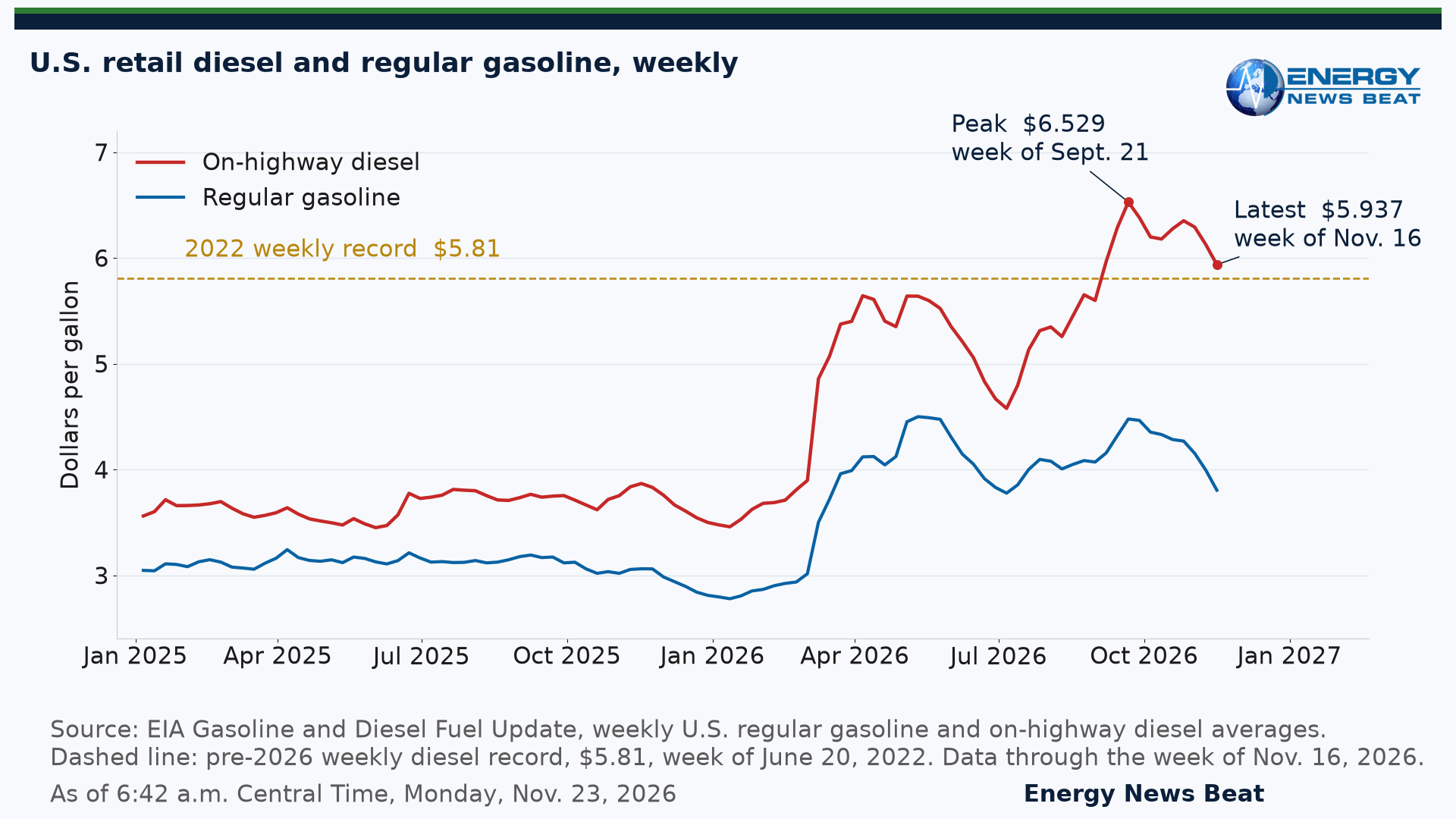
The government’s weekly survey still lags the daily AAA print, as it did when diesel first slipped under $6. The Energy Information Administration put on-highway diesel at $5.937 a gallon in the week of Nov. 16, down 19 cents from $6.127 the week before, the same 19-cent drop as regular gasoline, which fell to $3.805. EIA’s weekly series peaked at $6.529 in the week of Sept. 21. Before this year, the official weekly record was $5.81, in the week of June 20, 2022. Even after this month’s decline, the Nov. 16 weekly average was still above that earlier peak.
The tanks have started to refill
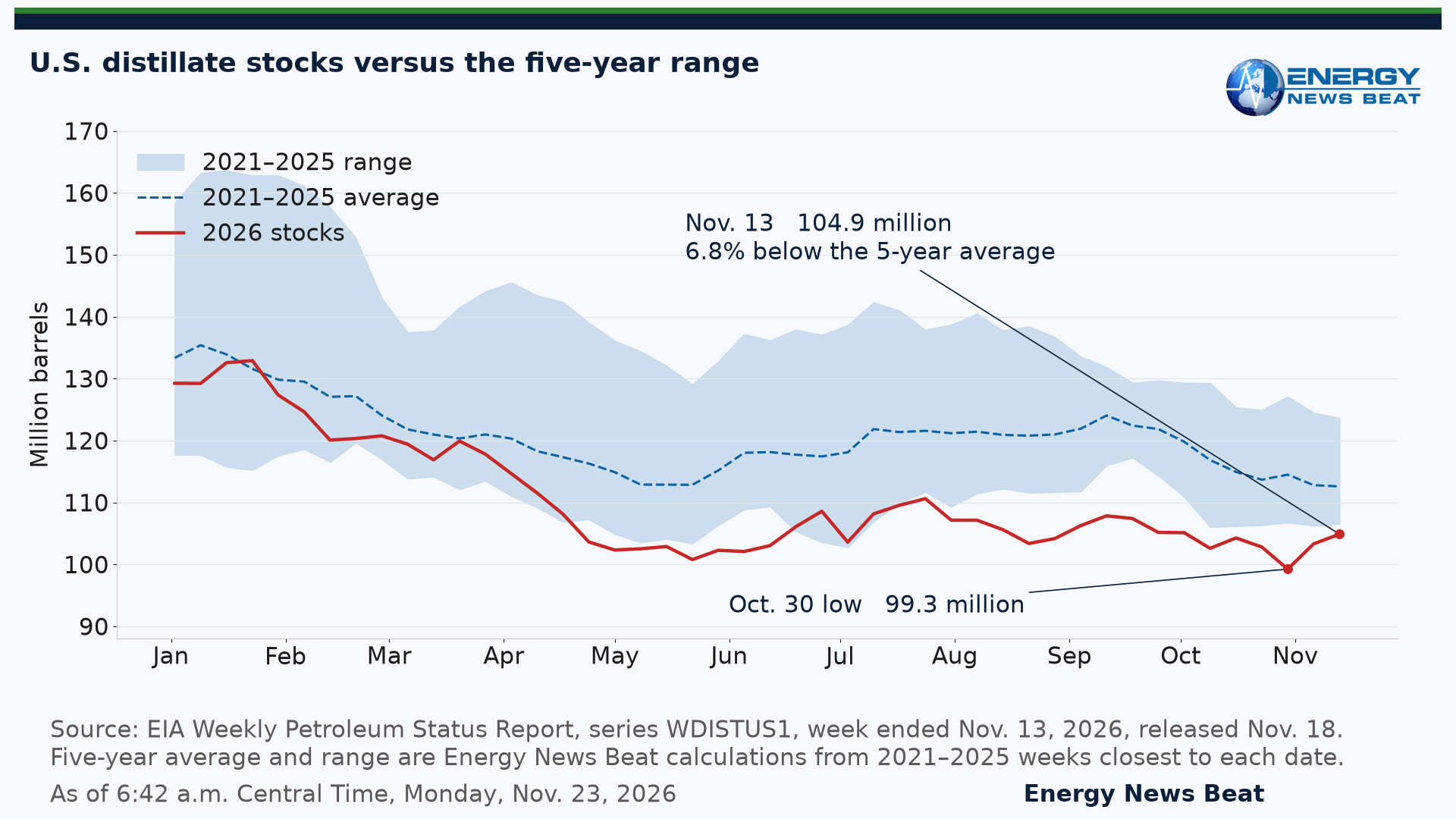
The stock picture is easing at the margin, not back to normal. In the week ended Nov. 13, the latest Weekly Petroleum Status Report, released Nov. 18, showed U.S. distillate inventories — diesel and heating oil — at 104.9 million barrels, up 1.6 million from the week before. That was the second weekly build after a low of 99.3 million barrels on Oct. 30, the smallest weekly total since early May 2003.
Even after the gain, the tanks were about 7 percent below the 2021-2025 average for a mid-November week. Energy News Beat’s calculation, using EIA’s weekly series and the 2021-2025 readings closest to Nov. 13, puts that five-year average at 112.6 million barrels, which leaves the latest week 6.8 percent short. The same week a year earlier held 111.1 million. On the East Coast, where trucking and home heating oil share the same barrel, stocks were 24.4 million barrels, 7.8 percent below a year earlier and 26.7 percent below two years earlier, according to EIA’s Table 6.
Refining margins have come off their highs, but they are still wide. On Nov. 18, the December NYMEX ultra-low-sulfur diesel contract settled at $3.9723 a gallon and December West Texas Intermediate at $83.26 a barrel, according to DTN, figures that match a settlement recap by The Edge. Converted to a barrel (ULSD times 42, minus WTI), that diesel crack is $83.58 — still about four times the $20.98 gasoline crack from the same session’s December RBOB settlement of $2.4819 a gallon. A crack is a gross margin before other costs, not a profit number. It does show why diesel has been the more valuable product.
What Wright said, and what EIA still expects
Wright made the comments on Thursday, Nov. 19, a day he was in Warsaw for the seventh Partnership for Transatlantic Energy Cooperation ministerial. The Energy Department issued a joint statement with Poland’s energy minister that day. At a press conference there, Wright said, “Are we considering ramping up oil and diesel exports to Europe? Absolutely,” according to Reuters. We wrote about that remark, and about the tighter East Coast inventory picture, in our Nov. 20 piece on diesel’s winter tug-of-war.
The Dow Jones account of his price outlook is a view that supply is improving — Gulf refined products coming back, and unsanctioned Russian diesel adding pressure — not an independent finding that those two flows caused this week’s 18-cent drop. The next Weekly Petroleum Status Report, due Nov. 25, will show whether the stock rebuild extended past 104.9 million barrels.
EIA’s November Short-Term Energy Outlook, released Nov. 10, is the official longer view, and it is less sunny than a week of falling pump prices. The agency now assumes “global petroleum product markets will face continued supply constraints through the end of 2027.” In that forecast, U.S. retail diesel averages $5.25 a gallon in 2026 and $5.03 in 2027. The 2027 figure is 12 percent higher than the $4.49 EIA published in October. Gasoline averages $3.73 next year. EIA also said crack spreads “will remain elevated for the remainder of the year and through most of 2027,” which, in its telling, keeps refinery utilization high. The outlook’s inputs were finalized on Nov. 5, and the agency said this month’s forecast “does not specifically account for market events after that day.” The November monthly diesel average in that same table is $6.10 a gallon, already above today’s AAA print. November is not over, and the forecast is three weeks old.
Consumer and Investor Views
Not investment advice. For truckers, farmers and anyone else who fills a diesel tank, the direction is finally lower. An 18-cent weekly drop and a 71-cent decline from the September record are the first meaningful relief since diesel spent more than two months at or near $6. The fuel is still historically expensive: the national average remains more than $2 above a year ago, and EIA’s Nov. 16 weekly average was still above the 2022 weekly peak. On the East Coast, heating-oil households draw from the same tight distillate stack. A simple average of the monthly retail heating-oil prices in EIA’s November outlook is $5.14 a gallon for 2026 and $4.90 for 2027, with the winter months still elevated in that table. This is not a forecast of anyone’s fuel bill, and it is not a claim about grocery prices or freight rates.
For refiners, the diesel crack has narrowed from the extreme levels of September and early October, but it remains much wider than the gasoline crack. EIA expects those product margins to stay elevated through most of 2027 because global product markets, in its view, stay tight. High cracks are a reason U.S. refineries have been running hard; they are not a recommendation to buy or sell any stock, refiner or otherwise. None of this is investment advice.
Timeline
A short path from the September record to this morning’s AAA print, with the official inventory and forecast dates in between.
Sept. 21–22, 2026. EIA’s weekly on-highway diesel series peaks at $6.529 in the week of Sept. 21. AAA’s national average hits a record $6.5276 on Sept. 22.
Oct. 30, 2026. U.S. distillate stocks fall to 99.3 million barrels, the smallest weekly total since early May 2003.
Nov. 5–10, 2026. EIA finalizes, then publishes, the November Short-Term Energy Outlook, raising its 2027 retail diesel forecast to $5.03 and assuming tight product markets through the end of 2027.
Nov. 16–17, 2026. AAA’s national average slips to $5.9989 on Nov. 16, the first print under $6 since early September, and to $5.9848 on Nov. 17, the figures in Energy News Beat’s Nov. 17 report. EIA’s weekly survey, released Nov. 17, shows $5.937 for the week of Nov. 16.
Nov. 18, 2026. EIA reports distillate stocks of 104.9 million barrels for the week ended Nov. 13, up 1.6 million. December NYMEX diesel and WTI settlements imply a diesel crack of $83.58 a barrel.
Nov. 19, 2026. Dow Jones reports Wright’s view that diesel is likely to keep falling. In Warsaw, he tells a press conference the United States is considering more oil and diesel exports to Europe.
Nov. 20, 2026. AAA’s national average is $5.8982, the figure in Energy News Beat’s Nov. 20 report.
Nov. 23, 2026. AAA’s national average is $5.8182, down 18 cents from a week earlier.
Caveats
We could not find a published transcript of the interview behind the Dow Jones account, so Wright’s reasons follow Dow Jones Newswires as carried by Morningstar. His on-camera line that he expects “gasoline and diesel to continue downward” is from Fox News’s America Reports the same day. Seeking Alpha published a similar paraphrase the same evening; its page cuts off after beginning a quotation. A Spanish-language recap attributed additional sentences to The Wall Street Journal; those lines are not used here because we could not verify them against the Journal or Dow Jones. The “Absolutely” quotation on U.S. exports to Europe is from Reuters, from a press conference the same day, and is a different remark.
Wright’s reported reasons — returning Persian Gulf refined products and unsanctioned Russian diesel — are not treated here as proven causes of this week’s drop at the pump. The November Short-Term Energy Outlook was completed on Nov. 5 and, by EIA’s own note, does not specifically account for later market events. The next EIA weekly retail diesel update is due Nov. 24, and the next Weekly Petroleum Status Report is due Nov. 25.
AAA’s daily national average and EIA’s weekly retail survey are different samples and will not match on any given day. The “about 7 percent” inventory gap is Energy News Beat’s arithmetic on EIA weekly data, using the 2021-2025 observations closest to Nov. 13; it is 6.8 percent versus an average of 112.6 million barrels. The $83.58 diesel crack is calculated from the Nov. 18 December-contract settlements (ultra-low-sulfur diesel times 42, minus WTI). It is a gross margin before other costs. A trade-press figure of $85.98 for the same day did not rebuild from those settlements and is not used here.
Stu’s Take
The pump has come down. AAA’s national diesel average is $5.8182 a gallon as of Monday, Nov. 23, 18 cents below a week earlier and 71 cents below the Sept. 22 record of $6.5276. Energy Secretary Chris Wright, as reported by Dow Jones, said prices are likely to keep falling as Persian Gulf refined products return and unsanctioned Russian diesel adds supply. On Fox News the same day, he said he expects “gasoline and diesel to continue downward.” Inventories have started to rebuild — 104.9 million barrels in the week ended Nov. 13 — but they remain about 7 percent below the 2021-2025 average for that week. EIA’s November Short-Term Energy Outlook, locked in on Nov. 5, now sees tight product markets through 2027 and a $5.03 average diesel price next year. That is relief from $6.53. It is not a cheap gallon.
Sources
Links, what each source was used for, and the time it was accessed, in Central Time, on Monday, Nov. 23, 2026, unless a later stamp is noted.
- Dow Jones Newswires, “U.S. Diesel Prices to Continue to Fall in Relief for Consumers, U.S. Energy Secretary Says,” in “Dow Jones Top Energy Headlines at 4 PM ET,” as carried by Morningstar, dated Nov. 19, 2026, 4:15 p.m. ET (21:15 GMT, shown as 9:15 p.m. on the Morningstar page); the roundup is labeled 4 p.m. ET. Used for Wright’s reported diesel-price comments. Accessed 6:34 a.m. CT. https://www.morningstar.com/news/dow-jones/202611199216/dow-jones-top-energy-headlines-at-4-pm-et-us-diesel-prices-to-continue-to-fall-in-relief-for-consumers-us-energy-secretary-says-oil
- Seeking Alpha, Carl Surran, “Decline in U.S. diesel prices likely to continue, Energy Secretary says,” Nov. 19, 2026, 7:57 p.m. ET. Similar paraphrase; the page cuts off after beginning a quotation. Not used for verbatim wording. Accessed 6:34 a.m. CT. https://seekingalpha.com/news/4674991-decline-in-us-diesel-prices-likely-to-continue-energy-secretary-says
- Fox News, “Gas prices fall to $3.72 a gallon after nearly $1 drop in a month,” America Reports video, Nov. 19, 2026, 6:34. Wright, appearing from Poland, at about 4:11. Used for the on-camera quotation that he expects gasoline and diesel to continue downward. Accessed 7:11 a.m. CT. https://www.foxnews.com/video/6408614737112
- AAA Fuel Prices, national averages as of Nov. 23, 2026, including diesel $5.8182, regular $3.6366, week-ago, month-ago and year-ago comparisons, and the highest recorded diesel average of $6.5276 on Sept. 22, 2026. Accessed 6:35 a.m. CT. https://gasprices.aaa.com/
- U.S. Energy Information Administration, Gasoline and Diesel Fuel Update, diesel release date Nov. 17, 2026 (next release Nov. 24). Weekly U.S. on-highway diesel $5.937 and regular gasoline $3.805 for the week of Nov. 16; regional table; historical series EMD_EPD2D_PTE_NUS_DPG and EMM_EPMR_PTE_NUS_DPG (workbook psw18vwall.xls and pswrgvwall.xls). Accessed 6:33 a.m. CT. https://www.eia.gov/petroleum/gasdiesel/
- U.S. Energy Information Administration, Weekly Petroleum Status Report, data for the week ended Nov. 13, 2026, released Nov. 18 (next release Nov. 25). Table 1 (U.S. petroleum balance sheet) and Table 6 (distillate stocks by PAD district). Accessed 6:33 a.m. CT. https://www.eia.gov/petroleum/supply/weekly/
- U.S. Energy Information Administration, weekly U.S. ending stocks of distillate fuel oil, series WDISTUS1, workbook wdistus1w.xls, latest data for Nov. 13, 2026, release dated Nov. 18, 2026. Used for the Oct. 30 low, the historical comparison since May 2003, and the 2021-2025 average. Accessed 6:33 a.m. CT. https://www.eia.gov/dnav/pet/hist/LeafHandler.ashx?n=PET&s=WDISTUS1&f=W
- U.S. Energy Information Administration, Short-Term Energy Outlook, November 2026, released Nov. 10; forecast completed Nov. 5; next release Dec. 8. Overview, petroleum-products section, and Table 2 (nominal energy prices) in STEO_m.xlsx. Accessed 6:36 a.m. CT. https://www.eia.gov/outlooks/steo/
- U.S. Energy Information Administration, Short-Term Energy Outlook, “U.S. Petroleum products” page, November 2026, including the annual retail diesel and gasoline table and the crack-spread discussion. Accessed 6:36 a.m. CT. https://www.eia.gov/outlooks/steo/report/petro_prod.php
- U.S. Energy Information Administration, press release, “EIA raises November natural gas storage forecast after warm start to month,” Nov. 10, 2026, restating the $5.03 and $3.73 2027 retail forecasts. Accessed 6:36 a.m. CT. https://www.eia.gov/pressroom/releases/press594.php
- DTN, Barani Krishnan, “WTI Down 3% as US Crude Build Adds to Global Supply,” Nov. 18, 2026, 2:06 p.m. CT. December NYMEX WTI settlement $83.26, December ULSD $3.9723 a gallon, December RBOB $2.4819 a gallon, and the 1.571-million-barrel distillate build. Accessed 6:37 a.m. CT. https://www.dtnpf.com/agriculture/web/AG/news/world-policy/article/2026/11/18/wti-3-us-crude-build-adds-global
- The Edge, “Commodities Wrap 18 November: Natural Gas Settles 5.11% Higher, the Only Contract to Rise,” updated 22:12 GMT Nov. 18, 2026. Confirms the same December WTI, ULSD and RBOB settlements. Accessed 6:37 a.m. CT. https://edgeconsultancykw.com/commodities-wrap-18-november-2026/
- U.S. Department of Energy, “Joint Statement from U.S. Energy Secretary Chris Wright and Polish Energy Minister Miłosz Motyka Regarding Seventh P-TEC,” Nov. 19, 2026, Warsaw. Used to place Wright in Warsaw that day. Accessed 6:34 a.m. CT. https://www.energy.gov/articles/joint-statement-us-energy-secretary-chris-wright-and-polish-energy-minister-milosz-motyka
- Reuters, as carried by Devdiscourse, “US mulls ramping up diesel and oil exports to Europe, US energy chief Wright says,” updated 17:14 IST Nov. 19, 2026. Source for the “Absolutely” quotation. Accessed 6:34 a.m. CT. https://www.devdiscourse.com/article/international/4009451-us-mulls-ramping-up-diesel-and-oil-exports-to-europe-us-energy-chief-wright-says
- OilPrice.net, “Distillate Stocks Rebuild as Diesel Margin Narrows,” Nov. 21, 2026. Cross-check for the 104.9 million-barrel stock figure and the “about 7 percent” gap. Its $85.98 Nov. 18 crack does not match the December-contract settlements and is not used here. Accessed 6:37 a.m. CT. https://oilprice.net/article/distillate-stocks-rebuild-as-diesel-margin-narrows
- Energy News Beat, “Diesel’s Winter Tug-of-War: Russian Refining Cuts Pull One Way, a Sliding European Crack the Other,” Nov. 20, 2026, and “Diesel Dips Below $6, but the Relief Still Lags Gasoline,” Nov. 17, 2026. Prior coverage tied in only for facts that were re-verified for this article (AAA averages on those dates; the Reuters export quotation; the 104.9 million-barrel stock print). The Nov. 20 piece is at the link below. https://energynewsbeat.co/diesel/diesels-winter-tug-of-war-russian-refining-cuts-pull-one-way-a-sliding-european-crack-the-other/
Key Excerpts
Dow Jones Newswires, as carried by Morningstar, Nov. 19, 2026. “Diesel prices are likely to continue falling from record highs as refined products from the Persian Gulf return to the market and unsanctioned Russian diesel adds to the downward pressure on prices, said Energy Secretary Chris Wright.”
Fox News, America Reports, Nov. 19, 2026, at about 4:11. “With the trends we have right now, I expect gasoline and diesel to continue downward.”
Reuters, as carried by Devdiscourse, Nov. 19, 2026. “Are we considering ramping up oil and diesel exports to Europe? Absolutely,” Wright told a press conference.
EIA Short-Term Energy Outlook, November 2026, forecast overview. “Although we expect the U.S. average retail price of gasoline and diesel to decline in 2027, we raised our forecast for those prices from last month’s outlook. In our forecast, the U.S. retail diesel price averages $5.03 per gallon (gal) next year, 12% higher than we forecast last month. Gasoline prices average $3.73/gal, 5% higher than last month. We now assume global petroleum product markets will face continued supply constraints through the end of 2027. These market conditions will support wider petroleum product crack spreads next year and incentivize elevated U.S. refinery operations.” And: “We finalized inputs into the model on November 5, 2026. This month’s forecast does not specifically account for market events after that day.”
EIA Short-Term Energy Outlook, “U.S. Petroleum products,” November 2026. “U.S. refineries have been running at very high rates in 2026, driven by high crack spreads, an indicator of refinery profitability. Crack spreads have been high this year because of damage to refineries in the Middle East and Russia that has reduced volumes of refined petroleum product exports available to the global market. We expect U.S. crack spreads will remain elevated for the remainder of the year and through most of 2027.”
DTN, Nov. 18, 2026. “NYMEX WTI crude for December delivery settled down $2.75, or 3.2%, at $83.26 bbl…” “Ultra-low sulfur diesel (ULSD) for December delivery fell $0.0752, or 1.86%, to end at $3.9723 gallon…” “RBOB for December delivery retreated by $0.0530, or 2.09%, to finish at $2.4819 gallon…” EIA “reported distillate inventories rose 1.571 million bbl during the week ended Nov. 13…”
AAA Fuel Prices, national table, as of Nov. 23, 2026. Diesel current average $5.8182; yesterday $5.8445; week ago $5.9989; month ago $6.3172; year ago $3.7928. Highest recorded average diesel price $6.5276 on 9/22/26. Regular current average $3.6366.
EIA Weekly Petroleum Status Report, Table 1, week ended Nov. 13, 2026. Distillate fuel oil stocks 104.9 million barrels, versus 103.3 million the prior week (up 1.6 million, or 1.5 percent) and 111.1 million a year earlier (down 6.2 million, or 5.6 percent).
EIA Weekly Petroleum Status Report, Table 6, week ended Nov. 13, 2026. East Coast (PADD 1) distillate stocks 24.4 million barrels, versus 23.8 million the prior week, 26.5 million a year earlier (−7.8 percent) and 33.3 million two years earlier (−26.7 percent). U.S. stocks of 15 ppm sulfur and under: 94.2 million barrels.
Data Tables
Figures below are as published by the source, or, where noted, Energy News Beat arithmetic from those published figures. As-of dates are in the column or the table note.
Table A. AAA national pump prices, as of Nov. 23, 2026
| Item | Dollars per gallon | As of / note |
| Diesel, current average | $5.8182 | Nov. 23, 2026 |
| Diesel, yesterday | $5.8445 | Nov. 22, 2026 |
| Diesel, week ago | $5.9989 | Nov. 16, 2026 |
| Diesel, month ago | $6.3172 | About Oct. 23, 2026 |
| Diesel, year ago | $3.7928 | About Nov. 23, 2025 |
| Diesel, highest recorded average | $6.5276 | Sept. 22, 2026 |
| Change vs. week ago | −$0.1807, or 18 cents | ENB arithmetic |
| Change vs. Sept. 22 record | −$0.7094, or 71 cents (about 11%) | ENB arithmetic |
| Regular gasoline, current average | $3.6366 | Nov. 23, 2026 |
| Diesel minus regular | $2.1816, or $2.18 | ENB arithmetic |
| Diesel vs. year ago | +$2.0254, or $2.03 | ENB arithmetic |
Source: AAA Fuel Prices, https://gasprices.aaa.com/, accessed 6:35 a.m. CT, Nov. 23, 2026. The page is stamped “Price as of 11/23/26.” Week, month and year-ago dates are AAA’s labels, not independently dated beyond the current stamp.
Table B. EIA weekly U.S. on-highway diesel and regular gasoline
| Week of | Diesel, $/gal | Regular gasoline, $/gal | Diesel–gasoline gap |
| Sept. 21, 2026 (diesel peak) | $6.529 | — | — |
| Nov. 2, 2026 | $6.292 | $4.153 | $2.139 |
| Nov. 9, 2026 | $6.127 | $3.995 | $2.132 |
| Nov. 16, 2026 (latest) | $5.937 | $3.805 | $2.132 |
| June 20, 2022 (prior weekly diesel record) | $5.81 | — | — |
Source: EIA Gasoline and Diesel Fuel Update, series EMD_EPD2D_PTE_NUS_DPG and EMM_EPMR_PTE_NUS_DPG, and the Nov. 17, 2026 weekly tables. Release date Nov. 17; next release Nov. 24. Gaps are Energy News Beat arithmetic. The June 20, 2022 diesel figure is the pre-2026 high on the same weekly series. Gasoline is omitted on the two peak-only rows.
Table C. U.S. distillate fuel oil stocks, EIA weekly
| Week ending | Stocks, million barrels | Change / note |
| Oct. 23, 2026 | 102.8 | — |
| Oct. 30, 2026 | 99.3 | Low since early May 2003 (99,259 thousand barrels) |
| Nov. 6, 2026 | 103.3 | +4.1 million from the Oct. 30 low |
| Nov. 13, 2026 (latest) | 104.9 | +1.6 million week over week (104,901 thousand) |
| Nov. 14, 2025 (year earlier) | 111.1 | Latest week is 5.6% lower, per EIA Table 1 |
| 2021–2025 average, weeks closest to Nov. 13 | 112.6 | ENB calculation; latest week is 6.8% below |
Source: EIA series WDISTUS1 and WPSR Tables 1 and 6, week ended Nov. 13, 2026, released Nov. 18; next release Nov. 25. Million-barrel figures are EIA’s published rounded totals, except the 99,259 and 104,901 thousand-barrel exacts from the weekly workbook. The five-year average uses the 2021-2025 observations closest to Nov. 13: 123.685, 107.383, 106.579, 114.301 and 111.080 million barrels. East Coast (PADD 1) stocks on Nov. 13 were 24.4 million barrels, 7.8% below a year earlier and 26.7% below two years earlier (EIA Table 6).
Table D. November 2026 Short-Term Energy Outlook, retail fuel prices
| Series | 2026 | 2027 | October STEO (2027) |
| Retail diesel, $/gal | $5.25 | $5.03 | $4.49 |
| Retail regular gasoline, $/gal | $3.89 | $3.73 | $3.56 |
| Retail heating oil, $/gal (Table 2 monthly mean) | $5.14 | $4.90 | — |
| WTI spot, $/bbl (overview / Table 2 mean) | $88 | $81 | — |
Source: EIA STEO, November 2026, released Nov. 10; forecast completed Nov. 5; next release Dec. 8. Diesel and gasoline annuals are the figures in EIA’s notable-forecast-changes table and overview ($5.25 and $5.03 for diesel; $3.89 and $3.73 for gasoline). Heating-oil annuals are the simple mean of Table 2 monthly values (series D2RCAUS). WTI 2026-27 annuals are from the petroleum-products table ($88 and $81). The November 2026 monthly diesel average in Table 2 is $6.10; December is $5.79. EIA said the forecast does not specifically account for market events after Nov. 5.
Table E. December 2026 NYMEX settlements, Nov. 18, 2026, and implied cracks
| Contract | Settlement | Implied crack vs. WTI, $/bbl |
| WTI, December 2026 | $83.26 /bbl | — |
| ULSD (HO), December 2026 | $3.9723 /gal | $83.58 (= 3.9723 × 42 − 83.26) |
| RBOB gasoline, December 2026 | $2.4819 /gal | $20.98 (= 2.4819 × 42 − 83.26) |
Settlements from DTN, Nov. 18, 2026, 2:06 p.m. CT, confirmed by The Edge’s Nov. 18 settlement table. Cracks are Energy News Beat arithmetic. A crack is a gross margin before other costs. OilPrice.net’s $85.98 diesel-crack figure for Nov. 18 does not rebuild from these settlements and is not used here.
Background
AAA’s national diesel average spent more than two months at or above $6 a gallon, from Sept. 11 through Nov. 15, 2026, and set a record $6.5276 on Sept. 22; EIA’s weekly survey peaked at $6.529 in the same stretch. Energy News Beat described the first daily break under $6 on Nov. 17 and, on Nov. 20, the winter tug-of-war between tighter Russian refining, a sliding European diesel crack, and tight East Coast stocks. This article is the Nov. 23 update: Wright’s reported view that the decline continues, today’s AAA print, a cross-check of inventories against the official weekly report, and EIA’s November Short-Term Energy Outlook. Wright was in Warsaw on Nov. 19 for the seventh P-TEC ministerial; the export-to-Europe quotation is from that day’s press conference and is separate from the Dow Jones account of his price outlook.
The post Wright Says U.S. Diesel Will Keep Falling. The National Average Is $5.82, and Inventories Are Still Tight appeared first on Energy News Beat.