
President Trump’s administration is in advanced talks with Venezuela’s interim government for what officials describe as a “massive” energy deal: a U.S. ownership stake or long-term lease covering 17 of the country’s most promising oil and gas fields holding about 90 billion barrels of proven reserves. That is nearly a third of Venezuela’s world-leading 300 billion barrels and would more than double America’s own proven oil reserves at a time when the Strategic Petroleum Reserve sits at a 40-year low.
The talks, first detailed by Axios and the Wall Street Journal and highlighted in David Blackmon’s post on X, involve fields previously controlled by former Venezuelan insiders—some now indicted—and Chinese interests. Private U.S. companies would develop the assets and send more revenue back to Caracas. Secretary of State Marco Rubio and interim President Delcy Rodríguez have led the negotiations. Energy Secretary Chris Wright may travel to Caracas as soon as next week. Details are still being hammered out, and the deal could still fall apart, but the fact that it is under discussion marks a sharp break from two decades of socialist mismanagement.
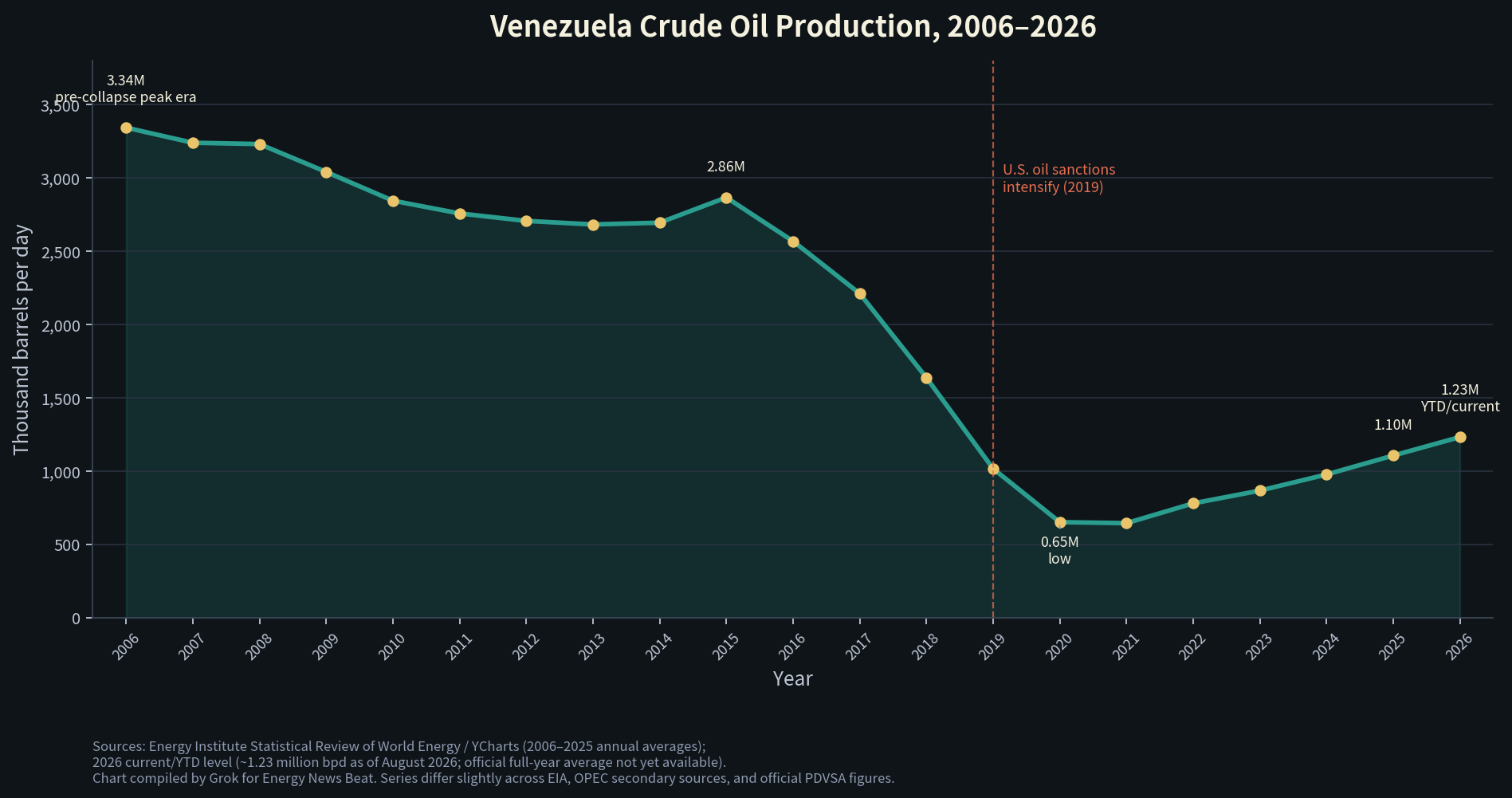
This is the logical next chapter after the January 2026 removal of Nicolás Maduro. Venezuela’s oil sector was wrecked by resource nationalism, expropriations, underinvestment, and corruption under Hugo Chávez and Maduro. Production that once exceeded 3 million barrels per day in the late 1990s collapsed to well under 1 million barrels per day at its low point. Infrastructure rusted. Talent fled. The country with the world’s largest proven reserves became a cautionary tale rather than an energy powerhouse.
Current output has already rebounded to roughly 1.23–1.25 million barrels per day—the highest level since 2019—after sanctions relief, hydrocarbon law reforms, and the return of Western operators. The government targets 1.4 million barrels per day by year-end. Longer-term forecasts see a possible climb toward 2 million barrels per day later this decade if investment materializes. Full recovery to historic peaks would take a decade or more and tens to hundreds of billions of dollars.
Here is the current oil production:
Deal Structure and Immediate Next Steps
Reports describe a structure that could take the form of a long-term lease (some sources mention a 100-year lease discussion) or direct U.S. stake in the 17 fields, which mix greenfield acreage in the Orinoco Belt with mature assets around Lake Maracaibo. A subsequent auction or tender would allocate the fields among U.S. producers. The resulting supply would be guaranteed for the United States.
Venezuela’s January 2026 hydrocarbon reforms slashed the government’s overall take to a combined 20–35 percent for most projects, down from a historical average near 83 percent, and created clearer royalty brackets. Existing joint ventures are migrating to the new terms. Production-sharing agreements are also being used. The broader U.S. reconstruction push has been framed as a $100 billion private-sector investment package for the energy sector.
Next steps include Wright’s possible visit, finalization of individual field awards, continued migration of existing contracts, and work on midstream bottlenecks—ports, pipelines, diluent supply for extra-heavy crude, and power. Constitutional questions and legal challenges remain possible because Venezuelan law has historically reserved core industry activities to the state.
How Investment Can Deliver More Money to Venezuelans Than Socialist Rule Did
Under Chávez and Maduro, oil revenues were redirected toward unsustainable social spending, political patronage, and off-the-books deals rather than reinvestment in wells, facilities, and people. Production fell. The currency collapsed. Millions emigrated. Blackouts became routine. The resource curse was compounded by mismanagement.
The new model is designed to reverse that. Private operators bring capital, technology, and operational discipline. Lower government take plus higher volumes can generate more total revenue for Caracas than the old high-tax, low-output system. Oil sales have already been audited, and proceeds tracked. Officials emphasize that development by private firms, including American companies, will return more oil revenue to the country. Local employment in drilling, services, construction, and supporting industries follows the rigs and workovers. That is a different economic circuit than the one that operated when PDVSA was treated as a political piggy bank.
None of this is automatic. Rule of law, contract sanctity, and a credible political transition still matter. But the direction of travel—from expropriation and decay toward investment and production growth—is the opposite of the 1999–2025 experience.U.S. Drillers, Oilfield Services, and JobsIndependents have moved faster than the supermajors. Hunt Oil signed one of the first production agreements with PDVSA. Other smaller U.S. producers have been lining up contracts in Houston. Chevron, already the largest international operator, has grown output from its joint ventures to around 260,000–280,000 barrels per day and has talked about a further 50 percent increase using cash flow from existing operations. ExxonMobil and ConocoPhillips have been more cautious, still working through legal and commercial issues after earlier expropriations.
Oilfield services companies are already on the ground. SLB (Schlumberger) signed agreements covering AI software for drilling, access to oilfield data, and plans to import rigs. The company has been preparing to restart idle rigs. Halliburton, Baker Hughes, and Weatherford stand to benefit from workovers, infill drilling, and the need for dozens more active rigs—Venezuela’s oil ministry has cited a requirement for 93 rigs by 2028 versus far lower current activity. GE Vernova has a separate deal to help rebuild the electricity grid.
These contracts create U.S. jobs in Houston, Midland, and service-company hubs as well as Venezuelan jobs at the wellsite, in camps, and in local supply chains. Independents can often move faster on smaller, lower-risk increments while majors wait for political and legal clarity.
Stabilizing the Global Oil Market Away from Choke Points
Wars in Iran and Ukraine, plus disruption through the Strait of Hormuz, have tightened global supply and raised prices. Venezuelan extra-heavy crude is a preferred feedstock for U.S. Gulf Coast refiners configured for heavy barrels. Roughly half of Venezuela’s current output is already moving to the United States. A locked-in Western Hemisphere supply reduces exposure to Middle East chokepoints and tanker-route risk.
Adding reliable barrels from the Orinoco Belt and Lake Maracaibo does not instantly replace lost Middle East volumes, but it diversifies the slate, supports U.S. refining utilization, and strengthens energy security in the Americas.
That is the strategic logic behind “energy dominance in the Western Hemisphere.”Grid, Economy, and Infrastructure
Venezuela’s national electric system is fragile. Rolling blackouts, voltage swings, and earthquake damage in June 2026 have hampered ports, refineries, and oilfield operations. Analysts have noted that each additional million barrels per day of oil production requires roughly 1,000 MW of reliable power. The government has told operators they may need to bring their own generation in oil zones.
Reforms opening generation, transmission, and distribution to private investment, plus the GE Vernova grid-rebuild agreement targeting restoration of gigawatts of capacity over several years, are intended to break that bottleneck. Reliable power is a prerequisite for sustained oil growth, industrial activity, and daily life. Ports and loading terminals also need upgrades; tankers have waited weeks because of aging infrastructure and outages. Midstream investment must travel with upstream dollars.
If the capital arrives and is spent on wells, power, and logistics rather than siphoned off, more of the resource rent can flow into wages, services, and public finances instead of disappearing into a closed political economy.
David Blackmon’s first assessment and post on X are correct. “Trump’s Biggest Energy Deal Yet Is Taking Shape in Venezuela,” and I hope we can get more money to the Venezuelan people for their natural resources and help increase their quality of life with freedoms. Having people learn from this that all forms of communism don’t work, nor will the path that we were on with Blue States and no free elections migrating to a communist state. We will revert to a bigger, corrupt form of Venezuela if we don’t get rid of communism, Blue State Net Zero overreach, and RINOs. We will be covering this with David on some podcasts in the works.
The next 12–24 months will show whether talks become signed contracts, whether rigs and workover crews actually mobilize at scale, and whether power and port constraints ease. The geology was never the problem. The next steps are commercial, legal, and operational: award the fields, get steel in the ground, keep the lights on, and let production—and the revenue that follows it—rise.
Appendix: Sources and Links
- David Blackmon (@EnergyAbsurdity) thread, August 28, 2026: https://x.com/EnergyAbsurdity/status/2093291380793597995
- Blackmon Substack summary: https://blackmon.substack.com/p/5-big-energy-stories-8282026-trump
Deal talks and structure
- Axios (Marc Caputo): https://www.axios.com/2026/08/27/trump-venezuela-oil-deal-talks
- Wall Street Journal (Colin Eaton): https://www.wsj.com/business/energy-oil/trump-administration-in-advanced-talks-for-stake-in-venezuelan-oil-fields-819546d3
- Reuters: https://www.reuters.com/business/energy/us-nears-deal-secure-long-term-access-venezuelas-oil-reserves-sources-say-2026-08-27/
- World Oil / Bloomberg: https://worldoil.com/news/2026/8/27/u-s-venezuela-discuss-major-oil-field-stake-potential-100-year-lease/
Production, reforms, and company activity
- Kpler: https://www.kpler.com/blog/can-venezuela-hit-its-ambitious-1-4-mbd-target-by-year-end
- Reuters on contract migration: https://www.reuters.com/business/energy/oil-companies-signing-agreements-venezuela-delays-persist-2026-07-30/
- Politico on independents: https://www.politico.com/news/2026/08/18/us-oil-producers-production-deals-venezuela-01040437
- Semafor on SLB and Hunt Oil: https://www.semafor.com/article/08/20/2026/us-oil-companies-lock-in-venezuela-deals
- OilPrice.com revival coverage: https://oilprice.com/Energy/Energy-General/The-Race-to-Revive-Venezuelas-Vast-Oil-Wealth-Is-Underway.html
- Rystad Energy: https://www.rystadenergy.com/insights/venezuelas-upstream-revival-turning-policy-momentum-into-production-growth
- Columbia CGEP on new fiscal terms: https://www.energypolicy.columbia.edu/new-venezuelan-oil-regulations-offer-promise-but-politics-and-quake-recovery-threaten-investment/
Grid, power, and infrastructure
- Reuters on post-earthquake outages: https://www.reuters.com/business/energy/power-outage-slows-operations-key-port-plants-after-earthquakes-venezuela-2026-06-26/
- Reuters on tanker delays: https://www.reuters.com/business/energy/tankers-stack-up-venezuela-sells-oil-faster-than-its-ports-can-handle-2026-08-21/
- GE Vernova grid deal reporting: https://constructionreviewonline.com/venezuela-national-electricity-grid-rebuild-to-restore-5gw-capacity-by-2030-through-ge-vernova-deal/
- Cleary Gottlieb on electricity reform: https://www.clearygottlieb.com/news-and-insights/publication-listing/venezuelas-electricity-reform-takeaways-for-investors
- Rio Times on self-generation requirements: https://www.riotimesonline.com/venezuela-oil-power-self-generation-grid-blackouts-june-2026/
Historical context and investment needs
- Rystad special update on returning to 3 million bpd: https://www.ajot.com/news/what-would-it-take-to-bring-venezuelas-oil-output-back-to-3-million-bpd-rystad-energy-special-market-update
- OilPrice.com historical decline: https://oilprice.com/Energy/Crude-Oil/Venezuelas-Oil-Production-Grows-at-a-Crucial-Time-Despite-Challenges.html
Additional contemporaneous coverage appeared in U.S. News, The Independent, Business Standard, NPR, El País, and official Venezuelan announcements of 50 strategic agreements and 1.23 million bpd output. All figures and deal terms remain subject to confirmation as negotiations continue.
The post What Are the Next Steps for Venezuela’s Oil Production? appeared first on Energy News Beat.