
The United Kingdom’s vaunted renewable energy fleet delivered a stark reality check over the recent weekend. Despite boasting approximately 32 GW of installed wind capacity—onshore and offshore combined—actual output plummeted to just 0.6 GW, less than 2% of nameplate capacity. This collapse occurred overnight, when solar generation was zero, leaving Britain functionally reliant on dispatchable sources like natural gas to keep the lights on. For hours, wind stayed below 10% of capacity.
One key point often overlooked is nameplate capacity. Look at the Texas ERCOT system. They have 180 GW name plate capacity, but only had a peak demand of 84 GW last year. How much people are overpaying for wind and solar power is rarely discussed.
This is not an anomaly. It is the predictable consequence of weather-dependent power in a system increasingly built around intermittent sources. As one widely shared analysis put it: “Britain had a renewable fleet on paper, but functionally nothing arriving on the grid.”
Billions Spent, Yet No Reliability
The UK has poured enormous sums into wind and solar. According to the Renewable Energy Foundation (REF), direct subsidies to renewable electricity generation from 2002 to 2024 totaled roughly £93.5 billion in nominal terms—or about £113 billion in 2024 prices. This includes the Renewables Obligation (RO) at £67 billion, Feed-in Tariffs (FiT) at £15.3 billion, Contracts for Difference (CfD) at £7.8 billion through 2024, plus constraint payments and other support.
CfD subsidies alone hit a record £2.6 billion in 2025, with offshore wind claiming the lion’s share.
Annual renewable support costs now run into the tens of billions when including legacy schemes still paying out. Yet these massive investments have not delivered a reliable, dispatchable grid. Wind and solar require full backup capacity because they cannot be turned on when needed—they only generate when the weather cooperates.
Storage Cannot Solve Grid Resiliency Issues
Proponents often point to battery storage as the fix. But batteries smooth out short-term gaps of minutes to a few hours. They cannot bridge multi-day or multi-week “wind droughts” or prolonged low-renewable periods common in the UK’s climate.
Studies show the UK would need anywhere from 109 GWh to as much as 9 TWh of storage under various net-zero pathways—depending on the level of dispatchable generation retained. Some analyses, including from the Royal Society, project up to 100 TWh of long-duration storage required by 2050 for true interseasonal reliability.
Current UK battery deployments are tiny by comparison—on the order of 5–10 GWh total. Even aggressive scaling cannot economically replace the need for gas peakers or other firm power during extended lulls.
The Electroverse post nails it: “Batteries do not fix that. They smooth short gaps. They cannot carry a country through long wind droughts. So the real system still needs gas—ready, paid for, and able to run immediately at 100% capacity whenever weather-based power drops out.”
We found this graphic interesting and applicable. “Green Energy” is built on coal, natural gas, critical minerals, and oil. Not sure who asked AI to create the image, but we would like to give them credit.
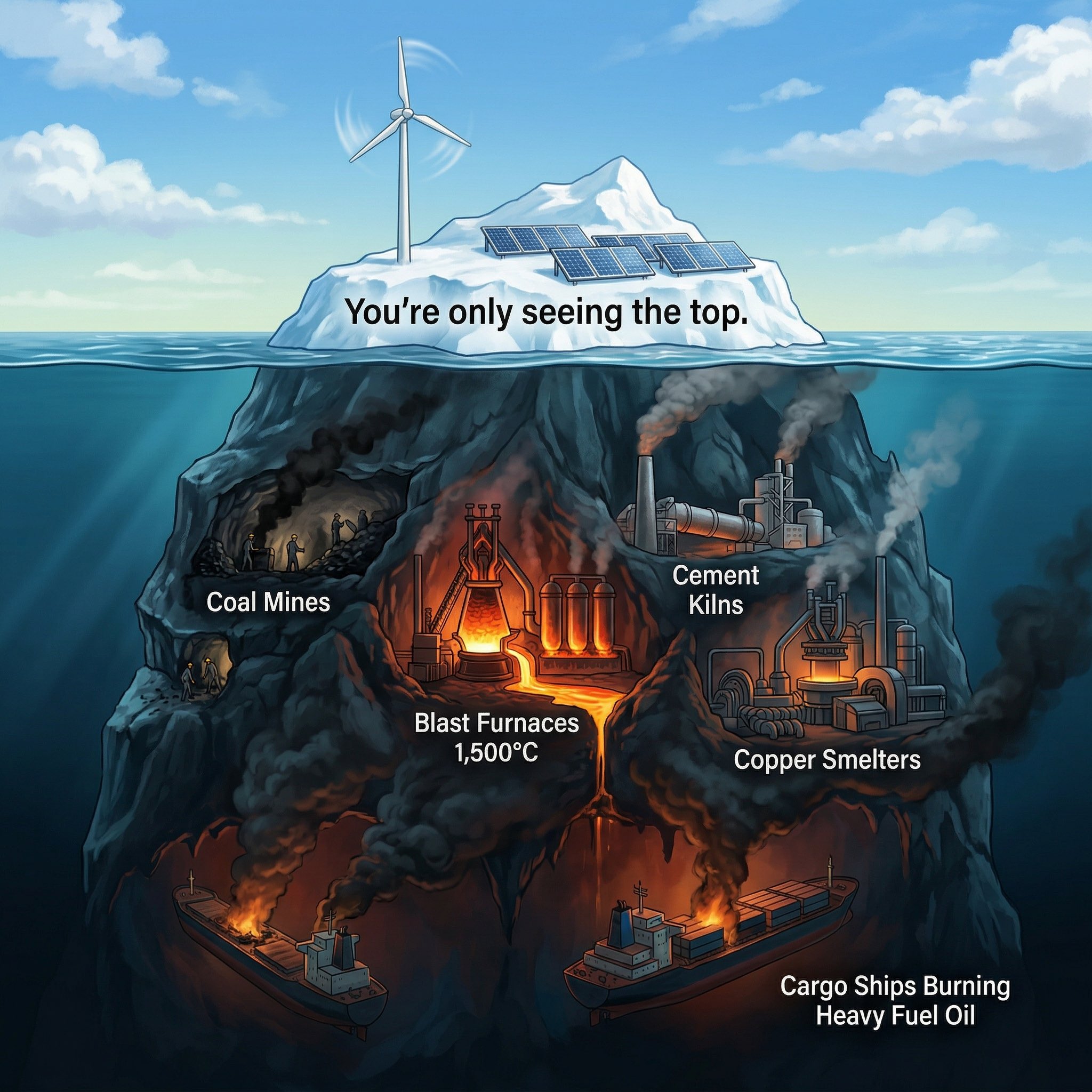
The Hidden Cost: Paying for Two Systems
This is the unspoken reality of the UK’s energy policy. Policymakers build an expensive renewable fleet, then build (or retain) an equally expensive backup system of gas plants that must sit idle much of the time but ramp instantly when renewables fail. Consumers pay for both—through subsidies, constraint payments, and higher wholesale prices during shortages.
Curtailment costs illustrate the inefficiency. In 2025 alone, the UK spent approximately £1.5 billion on wind curtailment and replacement generation—paying wind farms to switch off while firing up gas plants elsewhere because the grid could not handle the power. Projections warn this could balloon to £8 billion annually by 2030 without major grid upgrades.
The result? Higher energy costs for households and especially industry. UK industrial electricity prices remain among the highest in Europe and far above competitors like the US or Canada. Energy-intensive manufacturing output has fallen by roughly one-third since 2021, contributing to plant closures and deindustrialization.
Net Zero: The Path to Deindustrialization
The UK’s aggressive Net Zero trajectory—pursued through subsidies, mandates, and grid rules that prioritize renewables—has created a system that is more expensive and less resilient. High power prices are now a documented barrier to industrial competitiveness and even to further renewable buildout itself. As energy costs rise, factories shutter, jobs move overseas (often to higher-emission jurisdictions), and the grid grows more fragile during calm, cold periods.
The weekend wind collapse is a microcosm of the larger problem. Without abundant, affordable, dispatchable power, the UK cannot maintain its industrial base or energy security. Continuing down the current path will only compound costs while eroding resiliency.
Energy News Beat will continue tracking these developments. Reliable, affordable energy is not optional—it is the foundation of a modern economy.
Appendix: Sources and Links
- Electroverse X post (April 28, 2026): https://x.com/Electroversenet/status/2049141587419013184
- UK Wind Energy Database (RenewableUK): https://www.renewableuk.com/energypulse/ukwed/
- Renewable Energy Foundation – UK Renewable Electricity Subsidy Totals 2002–2024: https://www.ref.org.uk/ref-blog/390-uk-renewable-electricity-subsidy-totals-2002-to-the-present-day
- CfD Subsidies 2025 analysis: https://davidturver.substack.com/p/another-record-year-cfd-subsidies-2025
- Curtailment costs 2025: Multiple reports including Telegraph, Times, and Octopus Energy Wasted Wind tracker.
- Storage requirements: ScienceDirect study on UK decarbonization storage needs; Royal Society LDES report.
- Industrial output decline: ONS data on energy-intensive industries 2021–2024.
All data current as of late April 2026. Figures are drawn from official and independent analyses cited above.
The post UK Wind Falls to 0.6 GW Over Weekend appeared first on Energy News Beat.