
The Oct. 21 action hit a Greek-Panamanian law firm, two shipping agents and nine vessels. It squeezes Tehran’s revenue, but it will not lower your $4.29 gallon of gas or $6.32 diesel by itself.
Washington took another swing at Iran’s oil money this week. On Wednesday, Oct. 21, the U.S. Treasury sanctioned Karnakis and Karnakis, a law firm based in Panama and Greece that Treasury says registered shipping companies owning shadow fleet vessels that moved “hundreds of millions of dollars’ worth” of Iranian steel, petroleum and petrochemicals. Five people tied to the firm were also designated.
Treasury also hit two shipping agents, Singapore-based Amigoz Singapore and Dubai-based Whales Shipping Line, and identified nine vessels as blocked property: seven cargo ships run by Roxette Maritime, which was also sanctioned, and two small UAE-flagged support vessels owned by Whales (Treasury; OFAC). FinCEN made its first use of an administrative subpoena under Section 5318(k) of the Bank Secrecy Act to probe an unnamed Greek bank’s potential ties to Iran (Treasury).
“Whether you are conducting illegal oil transfers at sea or sitting in the corner office of a law firm, if you are supporting the Iranian regime, we will find you and sanction you,” Treasury Secretary Scott Bessent said (Treasury).
Why this one matters
This is part of Operation Economic Outcast, the campaign Bessent launched Aug. 24. Two weeks earlier, on Oct. 8, Treasury targeted 17 shadow fleet tankers and said that action “effectively neutralizes the vast majority” of Iran’s remaining shadow fleet (Treasury). The new round goes after the plumbing behind the ships: the lawyers who set up front companies and the agents who get cargo through ports. OFAC issued General License HH to allow wind-down and cargo offloading involving the newly blocked persons and vessels (OFAC).
What it means for consumers: gas, diesel and bills
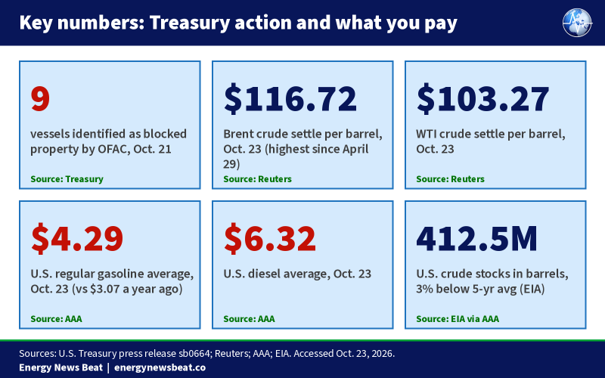
Honestly, not much relief soon. The oil market barely flinched. Brent settled at $108.82 a barrel on Oct. 21, up 3 cents, and WTI fell 67 cents to $97.15, as traders weighed attacks on ships around the Strait of Hormuz and a lack of U.S.-Iran talks against possible progress toward Russia-Ukraine talks (Reuters). Brent then jumped to $113.17 on Oct. 22 and settled at $116.72 on Friday, Oct. 23, its highest since April 29, with WTI at $103.27, after Houthi attacks in Saudi Arabia (CNBC). Sanctions on a law firm do not add or subtract barrels the way a tanker strike does.
At the pump, AAA’s national average for regular was $4.29 on Oct. 23, versus $3.07 a year ago (AAA). In its Oct. 22 report AAA said prices fell 6 cents in a week thanks to cheaper winter-blend gasoline. AAA says October is on track to be the most expensive October ever (AAA). Diesel averaged $6.32 nationally on Oct. 23, up from $3.63 a year ago (AAA), and that is what drives what you pay for groceries, freight and heating oil. The Energy Department is offering to loan up to nearly a third of the 1-million-barrel emergency heating oil reserve to ease diesel shortages (Reuters).
What it means for investors
For oil traders, this is a squeeze on Iran’s cash, not a new supply shock: Treasury itself says the bulk of the shadow fleet was already hit on Oct. 8 (Treasury). The bigger price drivers remain Hormuz security, U.S. inventories (crude stocks fell 3.1 million barrels to 412.5 million, about 3% below the five-year average, per EIA data cited by AAA; distillate stocks rose 1.7 million barrels to 104.3 million, per EIA data reported by Reuters) and any diplomacy. Shipping, insurance and banking firms with Gulf exposure face rising compliance risk, as FinCEN’s Greek bank probe shows (Treasury). On the same day, OFAC also updated Russia-related General License 131K on the possible sale of Lukoil International GmbH (OFAC).
Caveats
Treasury’s figures on cargo values are its own allegations, and the named parties have not been proven guilty in court. Sanctions can push trade into other channels rather than end it. Pump prices reflect crude, refining and seasonal factors, not one sanctions action.
| Stu’s Take (opinion)
Treasury blocked 9 more vessels and went after the lawyers and port agents, and I like going after the plumbing. But let’s be straight with families: Brent at $116.72, gas at $4.29 and diesel at $6.32 are a Hormuz problem, not a law-firm problem. Squeezing Tehran’s cash is the right goal. Lower prices come from more barrels moving safely and more U.S. refining. Until then, watch diesel, because that is what hits every grocery bill. |
Sources (accessed Oct. 23, 2026)
- S. Treasury: Operation Economic Outcast Targets Iran’s Shadow Fleet Networks (Oct. 21, 2026)
- OFAC Recent Actions: Iran-related Designations; General Licenses GG, HH, 131K (Oct. 21, 2026)
- S. Treasury: Operation Economic Outcast Neutralizes Iranian Regime’s Remaining Shadow Fleet Network (Oct. 8, 2026)
- Reuters via Yahoo Finance: Oil prices steady as investors weigh geopolitics, lower US stockpiles (Oct. 21, 2026)
- AAA: National Average Falls 6 Cents, But Crude Oil Nears $100/Barrel (Oct. 22, 2026)
- AAA: National average gas and diesel prices (Oct. 23, 2026)
- CNBC: Brent crude oil tops $116, a six-month high (Oct. 23, 2026)
- EIA: Weekly Petroleum Status Report (week ending Oct. 16, 2026)
- gCaptain: U.S. Sanctions Law Firm, Shipping Agents and Nine Vessels (Oct. 2026)
The post Treasury Blocks 9 More Ships in Iran Shadow-Fleet Crackdown as Brent Tops $110 appeared first on Energy News Beat.