
An in-depth look at the July 2026 brief by the National Center for Energy Analytics (NCEA), Dr. Lars Schernikau, and Portia Roberts, with updates on U.S. policy and global fleet management. Dr. Schernikau has been on the Energy News Beat Podcast, and we highly recommend buying his book.
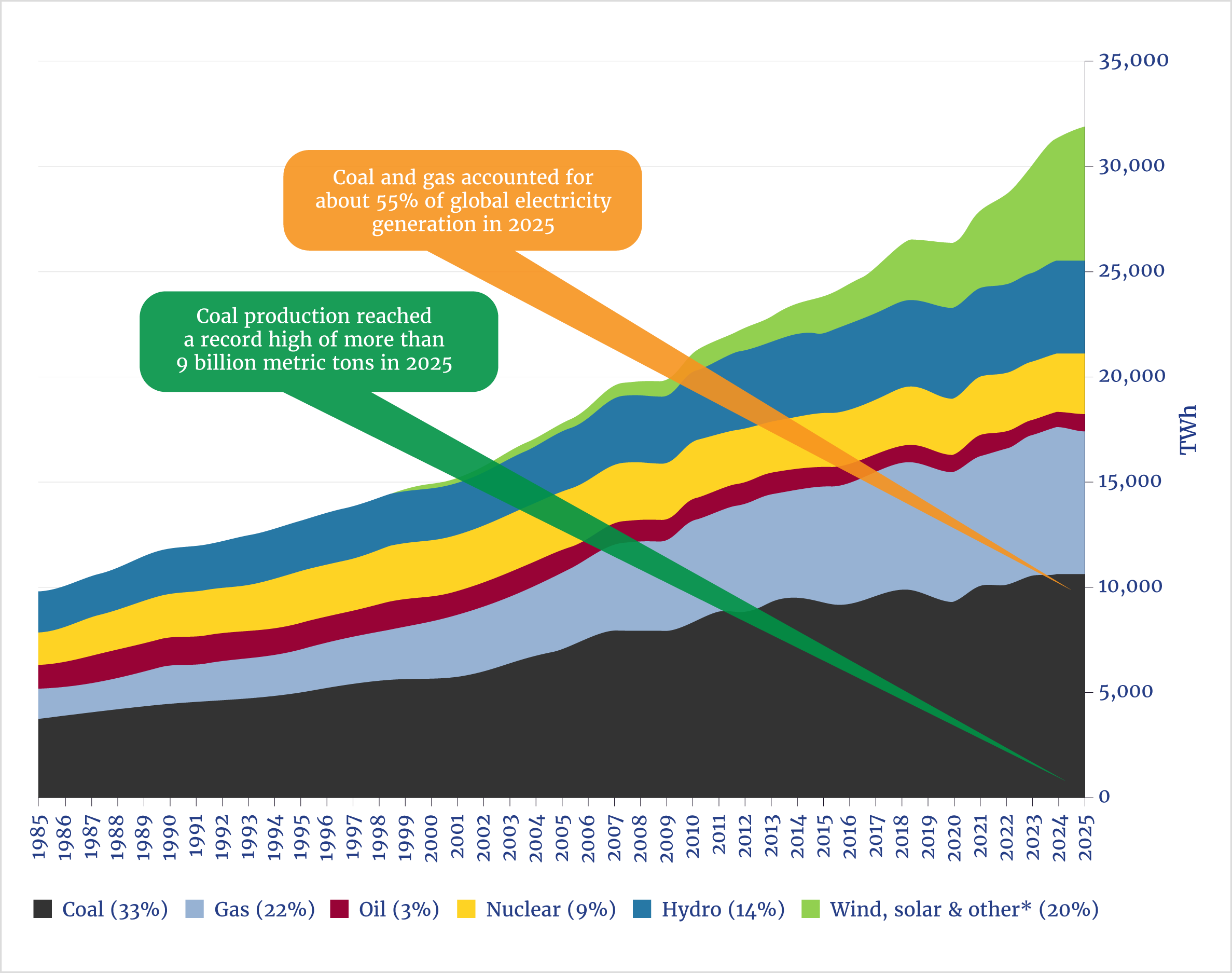
In a world racing toward ambitious net-zero targets, one fuel continues to defy forecasts of its demise: coal. Despite decades of Western policies aimed at phasing it out, global coal consumption hit a record high of approximately 9 billion metric tons (Bt) in 2025, powering over one-third of the world’s electricity and underpinning critical industries. This is the core message of the excellent July 7, 2026, issue brief “The Coal Reality That Western Policy Ignores” from the National Center for Energy Analytics (NCEA), expanding on Dr. Lars Schernikau’s March 18, 2026, analysis.
The brief, co-authored with Portia Roberts, lays out hard data showing that markets — not ideology — are driving coal’s enduring role in energy security, affordability, reliability, and industrial production. Western policymakers, the authors argue, ignore this reality at the peril of blackouts, higher costs, and economic vulnerability.
There is No Transition, only Addition. And after the Iran war, we are seeing an explosion in oil and gas domestic growth and storage globally.
Global Coal: Not in Decline, But in Renaissance
Coal consumption has grown from over 6 Bt in 2008 to nearly 9 Bt in 2025. Seaborne trade (thermal and metallurgical) has nearly doubled to about 1.5 Bt annually — the second-largest bulk commodity after iron ore.
Coal is not just for electricity (roughly 6 Bt for power generation). Over half ultimately supports industry: steel (~1.1 Bt coal equivalent), cement, chemicals, metals, and fertilizers. Coal-derived hydrogen via the Haber-Bosch process supports roughly 50% of global food production through synthetic nitrogen fertilizers. China alone derives over 75% of its hydrogen for ammonia from coal.
Reserves are enormous: proven reserves last 130–150 years at current rates, with resources suggesting 2,000+ years for hard coal and 3,000+ for lignite — far outlasting oil or gas. Modern High-Efficiency, Low-Emissions (HELE) plants and pollution controls have dramatically cut local pollutants. China, for example, reduced urban air pollutants by about 50% since 2013 despite rising coal use, with Beijing enjoying blue skies on 95%+ of days in 2025.
Modern HELE coal plants demonstrate how technology can significantly improve efficiency and reduce emissions.Coal also provides critical grid inertia through synchronous generators — essential for voltage, frequency, and stability that inverter-based renewables lack. The April 2025 Iberian Peninsula blackout, affecting 50 million people, highlighted the risks of over-reliance on intermittent sources without adequate firm capacity.
Asia Builds While the West Retreats
Asia drives the global story. China commissioned around 80 GW of new coal capacity in 2025 alone — equivalent to about 70% of Europe’s remaining coal fleet — to ensure grid stability amid massive renewable additions. India plans roughly 100 GW of new plants, with consumption projected to rise from 1.2 Bt to 2.6 Bt by 2047.
Southeast Asian nations (Vietnam, Philippines, Bangladesh, etc.) have seen dramatic increases, with Vietnam’s consumption up 750% in two decades. An ASEAN Center for Energy report notes that coal “currently outperforms other energy sources in terms of supply security, reliability, affordability and — to some extent — sustainability” in the region, with any shift only when viable alternatives exist.
How Other Countries Manage Their Coal Fleets
Countries are managing coal pragmatically based on energy security needs:
- China: Aggressively expanding capacity while retrofitting its existing fleet for flexibility. The goal is full flexibility retrofits by 2027 to better integrate variable renewables, shifting coal from pure baseload toward peaking and balancing support. New plants are also designed with ramping capabilities.
- India: Continuing to add substantial new capacity to meet surging electricity demand from economic growth, with no near-term phase-out plans.
- Japan: In response to LNG supply risks from Middle East disruptions (including Hormuz Strait issues tied to regional conflicts), Japan relaxed utilization caps on inefficient coal plants for fiscal year 2026, explicitly to conserve LNG and maintain stable supply. Coal generation increased notably in mid-2026 as gas use dropped.
- Europe/Germany: Pledged phase-outs (Germany by 2038, with lignite targeted earlier) but faced reality checks during energy crises. Some capacity was reactivated or retirements delayed/postponed amid gas volatility. Germany still operates significant coal capacity (around 28 GW in 2025), with many units having retirement dates after 2030 or none at all. Market forces and reviews (including in 2026) influence the pace.
Other examples: South Korea, Taiwan, and others have shifted back toward coal imports when LNG prices spiked. Italy delayed coal plant closures.
In short, non-Western and even some Western nations treat coal as a strategic asset for reliability and security, often modernizing or flexibly operating fleets rather than rushing retirements.
The Trump Administration’s Pro-Coal Actions
The United States under President Trump has taken concrete steps to extend and support coal capacity, aligning with the brief’s call for pragmatic policy.’
The Department of Energy (DOE) issued multiple emergency orders under Section 202(c) of the Federal Power Act to prevent premature retirements of coal plants, citing grid reliability risks amid rising demand from AI data centers, EVs, and electrification. Examples include repeated extensions for the J.H. Campbell plant in Michigan (totaling over a year past original retirement), Craig Station in Colorado, Schahfer and Culley units in Indiana, and Centralia in Washington. These actions helped save or support over 17 GW of coal capacity in 2025 alone.
In June 2026, the administration announced major funding — up to $850 million (including Defense Production Act support) — for coal infrastructure. This includes:
- Modernizing and extending the life of more than a dozen existing plants across multiple states.
- Supporting the first new U.S. coal-fired power plants since 2013: a 1.25 GW plant in Anchorage, Alaska, and a 1.6 GW plant at the West Virginia Energy Campus.
- Recommissioning the shuttered Warrior Run plant in Maryland.
- Boosting coal export terminals.
Executive orders have directed agencies to remove regulatory barriers, accelerate coal technology development (including for steel, batteries, and other uses), and prioritize domestic coal for energy dominance and reliability.
These moves respond to surging electricity demand and aim to protect ratepayers from higher costs associated with premature closures.
The Path Forward: Technology Over Elimination
The NCEA brief and Schernikau’s analysis do not deny environmental challenges but emphasize working with coal through modernization. HELE technologies can cut fuel use by up to one-third and emissions dramatically when paired with proven controls (99% particulate, 95–99% SOx, 80–90% NOx reduction).
Coal ash (~1 Bt/year) is largely inert and reusable in construction, contrasting with more complex waste from some renewable supply chains. The authors advocate targeted investment in clean coal tech, realistic timelines for alternatives, and recognition that coal remains essential for the physical materials of modern civilization — steel, cement, fertilizers, and reliable power.
Western policies that constrain financing, accelerate retirements without adequate replacements, or ignore global market signals risk energy poverty, industrial decline, and vulnerability — as Europe has experienced.
Conclusion
The coal reality is clear: it is not disappearing. Global demand is rising, driven by Asia’s growth and universal needs for affordable, reliable, dispatchable energy. Countries that manage their coal fleets pragmatically — expanding where needed, retrofitting for flexibility, or extending life for security — are adapting to reality. The United States under the current administration is following a similar pragmatic path.Western policymakers would do well to heed the data in the NCEA brief rather than ideology.
Energy policy must prioritize what works: security, affordability, reliability, and sustainability through technology — not wishful elimination of a fuel that continues to keep the lights on and build the modern world.
Appendix: Sources and Links
- National Center for Energy Analytics (NCEA), “The Coal Reality That Western Policy Ignores” (July 7, 2026): https://energyanalytics.org/research/coal-reality
- Expands on: Lars Schernikau, “Coal keeps the lights on… Are We Experiencing a ‘New’ Renaissance of Coal?” (March 18, 2026): https://unpopular-truth.com/2026/03/18/the-new-renaissance-of-coal/
Key Data Sources Cited in Brief/Blog
- IEA Coal 2025 – Analysis and Forecast to 2030
- Energy Institute Statistical Review of World Energy 2025
- Ember Electricity Data Explorer
- ASEAN Centre for Energy reports
- BGR Energiestudie
Trump Administration / U.S. Coal Policy
- U.S. Department of Energy fact sheets and announcements (2025–2026): https://www.energy.gov/
- Emergency orders under Federal Power Act Section 202(c)
- June 2026 funding announcements for coal modernization and new plants (multiple reports including Utility Dive, AP, NYT)
Other Countries
- Ember: China coal fleet flexibility retrofits (Feb 2026)
- Reuters, Bloomberg, METI (Japan): Coal utilization increases and policy relaxations (2026)
- Global Energy Monitor / Bloomberg Global Coal Countdown: Germany and global fleet data
- Various 2025–2026 reports on India, China capacity additions
All facts are drawn from publicly available reports, government announcements, and analyses as of July 2026. Readers are encouraged to review the original NCEA brief for full charts and references. This article is written for the Energy News Beat Channel to highlight data-driven perspectives on global energy realities.
The post The Coal Reality that Western Policy Ignores appeared first on Energy News Beat.