
Supertankers are racing into the Persian Gulf for record fees, and that single migration is redrawing how crude moves. More than 40 percent of the world’s roughly 850 very large crude carriers are now inside the Gulf or within a couple of days’ sail of it, according to Signal Ocean data cited by Bloomberg. Empty ships that would normally ballast toward the U.S. Gulf, West Africa, or Brazil have been cut roughly in half in a month. The result is a two-speed market: Gulf barrels are moving again, Atlantic barrels are harder to lift, and producers are cutting official prices so the freight spike does not fully land in the Brent screen.
Brent was trading around $104–105 a barrel on October 8, roughly 40 percent above pre-war levels. Persian Gulf-to-East Asia VLCC earnings, by contrast, hit an all-time high near $1.4 million a day on October 7—almost a 540 percent jump since before the conflict. One U.S. Gulf-to-Japan VLCC was offered this week at $82 million, more than $40 a barrel, up more than 50 percent in three weeks. Freight has outrun the crude price by an order of magnitude. That gap is why distribution routes are changing faster than the headline oil price.
The ship crunch is a logistics problem, not a simple shortage of hulls
Crude flows through the Strait of Hormuz have recovered to near pre-war levels in recent weeks even as attacks on ships continue. Bloomberg, citing the same Signal Ocean tracking, reports that moving oil from the Gulf to East Asia now costs more than six times the pre-conflict rate. Kpler puts recent Hormuz crude exports near 12 million barrels a day, about 80 percent of the pre-war pace. When Saudi Red Sea loadings and UAE Fujairah exports are added, total Middle East crude shipments briefly exceeded the old 18 million barrel-a-day average in the week ending October 3.
The recovery is inefficient. A large share of barrels that still cross Hormuz move on shuttle VLCCs, then transfer ship-to-ship in the Gulf of Oman or at newer points off the west coast of India onto vessels whose owners will not enter the strait. Georgios Sakellariou of Signal Ocean told Bloomberg the STS system outside Hormuz is inefficient and is stretching vessel supply both inside the region and everywhere else. Clarksons and other brokers have previously estimated that a substantial slice of the VLCC fleet has been tied up on these short shuttle loops or waiting off Oman. Each shuttle cycle ties a ship for days that a normal long-haul voyage would have used once.
That concentration is the rebalancing. Owners are ballasting empty VLCCs toward the Middle East because the day rate there dwarfs Atlantic alternatives. The number of empty VLCCs heading for Atlantic ports has halved in a month. With fewer large ships available west of Suez, charterers are splitting 2-million-barrel stems onto Suezmaxes and Aframaxes. Fearnleys noted this week that those smaller sisters are also showing no sign of slowing, so there is nowhere to hide. A U.S. Gulf-to-Asia cargo that once moved on one VLCC at a modest freight differential can now cost more than $40 a barrel on the rare VLCC that is still offered, or it moves on two smaller ships at rates that have themselves gone to records.
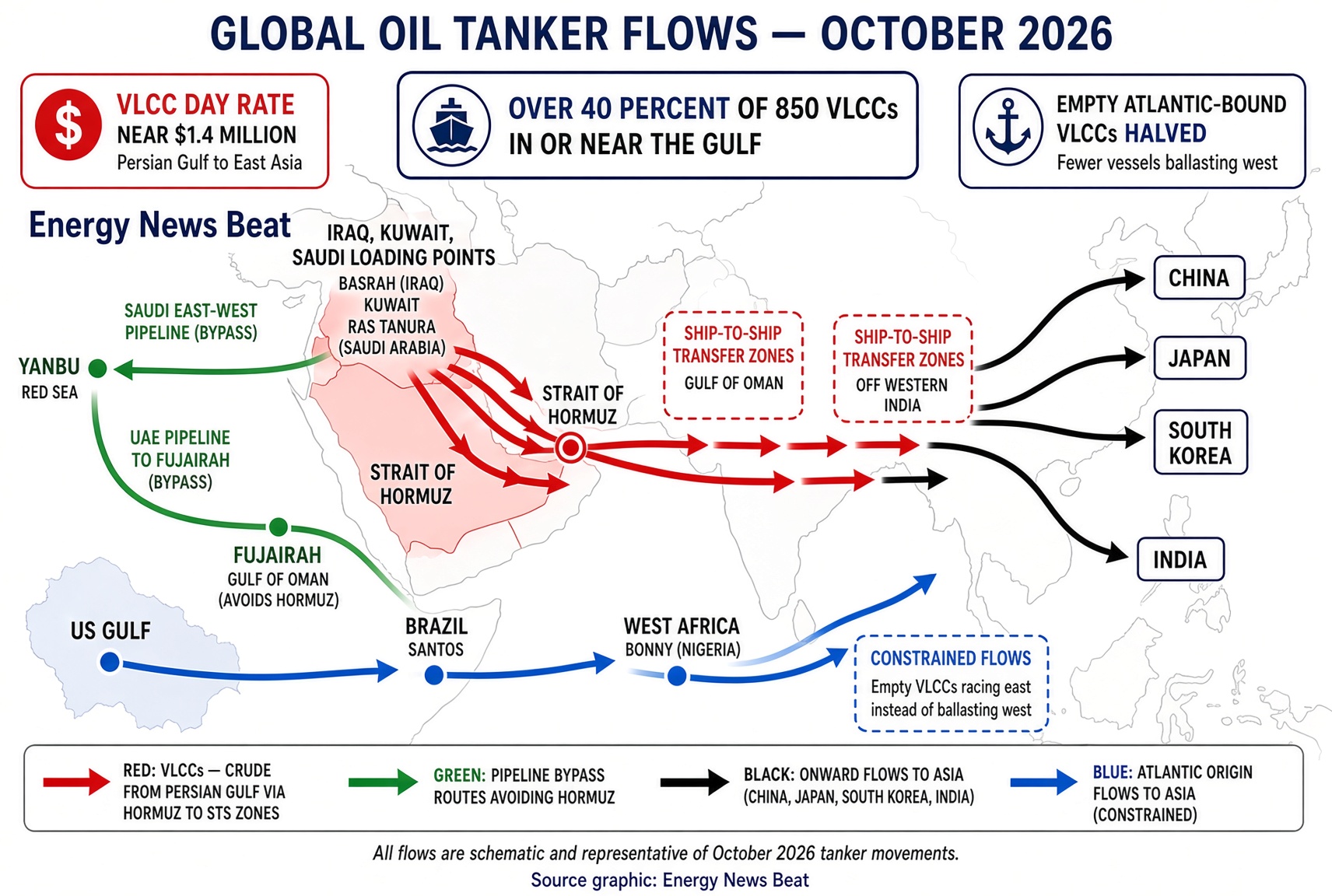
The practical map now looks like this. Gulf producers that can bypass Hormuz—Saudi Arabia via the East-West pipeline to Yanbu, the UAE via its line to Fujairah—are using those exits for a larger share of exports than before the war. Kpler has estimated that about 40 percent of non-Iranian Middle East crude now leaves without crossing the strait, versus roughly 17 percent pre-war. Barrels that must still transit Hormuz, especially Iraqi and Kuwaiti cargoes with no meaningful bypass, move on the shuttle-and-STS chain. Asian refiners that used to take a straight VLCC from Ras Tanura or Basra now often take a transferred cargo loaded outside the strait, or they bid for Atlantic barrels that have become expensive because the ships have left.
Outside the Gulf, the same vacuum is visible. Americas producers are still running hard, but the ships that would carry those barrels to Asia are in or steaming toward the Middle East. Poten & Partners has described owners choosing a shorter ballast to West Africa or Brazil over a long ballast to the U.S. Gulf when both pay well, further thinning prompt tonnage in the Atlantic. The cascade is already in the indexes: Suezmax routes have printed all-time highs as charterers replace missing VLCCs.
Gulf producers are buying back market share with discounts, not with a price war on the screen
The volume recovery is also a market-share fight. Reuters columnist Ron Bousso noted on October 8 that Saudi Arabia, the UAE, Kuwait, and Iraq have launched a battle to recapture customers lost during the war. Saudi Arabia’s share of Asian crude imports fell from 24 percent in February to a record low of 9 percent in September and is only expected to recover to about 14 percent in October, on Kpler-based calculations. UAE exports have been nearer pre-war levels; Iran’s seaborne share has collapsed under the U.S. naval blockade.
Energy Aspects expects combined Saudi, UAE, Iraqi, and Kuwaiti crude production to average about 17.3 million barrels a day in October, still well below the roughly 21 million barrels a day of the six months before the war. The global supply deficit, on the same firm’s numbers, has narrowed from nearly 4 million barrels a day in May to about 250,000 barrels a day in October. That is a recovery, not a flood.
To move the barrels, sellers are discounting the free-on-board price so buyers will absorb the freight and the war-risk premium. Saudi Aramco set its November Arab Light official selling price to Asia at $5 a barrel below the Oman/Dubai average—the largest discount since the pandemic period, and a cut traders had not expected. Iraq’s SOMO has gone much further for October loadings: Basrah Medium offered around $34.50 a barrel below benchmark and Basrah Heavy around $37 below, versus discounts under $30 in August and September. AGBI and Bloomberg both tie those cuts to buyers who must still send a ship through Hormuz. Saudi barrels can often be collected from lower-risk points or moved on Aramco-controlled tonnage; most Iraqi sales are still at the Basra terminal.
Robin Mills of Qamar Energy has called the discounts a direct measure of how expensive it is to move oil through the Gulf. Charter rates on the Gulf-to-Asia run have been cited around $30 a barrel, about six times pre-war freight. Because most Gulf crude is sold FOB, that cost sits on the buyer unless the producer cuts the headline price. Kpler has noted that freight from the Mideast Gulf recently accounted for about 21 percent of the gross product worth of Basrah Medium, versus about 4 percent in the six months before the war, and that direct-load barrels are discounted more heavily than STS cargoes loaded in the Gulf of Oman, where freight is cheaper by roughly $10 a barrel.
Why the tanker spike is not producing a matching spike in oil prices
The mechanism is straightforward. A refiner in Asia does not pay the Brent futures price plus the old freight differential. The refiner pays the official selling price, or the spot differential, plus insurance, plus the actual ship. When Iraq cuts $35 a barrel off the FOB price and the VLCC freight on a risky Gulf loading is on the order of $30 a barrel, a large part of the shipping shock is absorbed in the producer’s netback, not added on top of a $105 Brent print. Saudi’s smaller $5 cut does less of that work, which is why Saudi barrels that can avoid the worst of the strait are easier to place, and why Iraqi discounts are an order of magnitude deeper.
Three other brakes are visible in the data.
First, freight has already done the demand destruction on long-haul non-Gulf routes. A U.S. Gulf barrel that costs more than $40 a barrel to move to Japan is not competitive with a discounted Basrah or Arab Light cargo unless the Atlantic grade is itself heavily discounted. That keeps incremental Atlantic supply from clearing into Asia and limits how far the flat price can run on pure freight panic.
Second, Asian refining margins have been strong enough to absorb part of the higher delivered cost. Kpler has argued that product cracks insulated refiners even as Gulf freight hit records, which is why barrels kept moving instead of backing up. If cracks cool, freight should ease from the highs, but Hormuz congestion and the shuttle inefficiency keep a high floor.
Third, the supply recovery is real but fragile. Nearly one tanker a day has been hit in the Hormuz area over recent two-week stretches, insurance remains elevated, and the STS chain can seize up if attacks intensify. That risk premium is why Brent is still above $100 and about 40 percent above pre-war levels even while OSPs are being cut. It is also why a classic OPEC market-share war has not collapsed the screen price: the extra barrels are expensive and operationally unreliable, so they do not behave like a clean surplus.
The distribution system is therefore doing what the futures market is not. Ships are clustering where the day rate is highest. Producers who need those ships are paying for them with FOB discounts. Atlantic exporters are losing tonnage and, in places, losing Asian buyers. The oil price stays elevated because the war-risk premium and the incomplete production recovery have not gone away. It is not spiking in line with the $1.4 million-a-day VLCC market because the people who want the barrels back are cutting the price at the dock to offset the fee at the ship.
Check out the World’s Greatest Podcast Show Notes at EnergyNewsBeat.co or EnergyNewsBeat.com. And subscribe to: The Energy News Beat Substack.
- Bloomberg, “Supertankers Racing to Middle East Worsen Global Ships Crunch,” Weilun Soon and Yongchang Chin, October 8, 2026. Fleet concentration above 40 percent of about 850 VLCCs, rates near $1.4 million a day, sixfold Gulf-to-Asia cost increase, U.S. Gulf–Japan offer of $82 million. https://www.bloomberg.com/news/articles/2026-10-08/supertankers-racing-to-middle-east-worsen-global-ships-crunch
- Moneyweb syndication of the same Bloomberg report. https://www.moneyweb.co.za/news/international/supertankers-racing-to-middle-east-worsen-global-ship-crunch/
- Reuters Open Interest, Ron Bousso, “Battle for Mideast oil market share has already begun,” October 8, 2026. Hormuz flows near 12 million b/d, total Middle East exports versus the 18 million b/d pre-war average, Asian market-share shifts. https://www.reuters.com/commentary/reuters-open-interest/battle-mideast-oil-market-share-has-already-begun-2026-10-08/
- AGBI, “Gulf sellers discount oil to win back buyers,” October 2026. Saudi November discount of $5 to Oman/Dubai; Iraq Basrah Medium and Heavy discounts of $34.50 and $37; freight cited near $30 a barrel. https://www.agbi.com/analysis/oil-and-gas/2026/10/gulf-sellers-discount-oil-to-win-back-buyers/
- AGBI, “Tanker frenzy has brokers chasing deal of a lifetime,” October 8, 2026. Gulf purchases of VLCCs and Suezmaxes; discount context. https://www.agbi.com/analysis/shipping/2026/10/tanker-frenzy-has-brokers-chasing-deal-of-a-lifetime/
- Bloomberg via Rigzone, “Iraq Deepens October Crude Price Discounts,” Alex Longley and Yongchang Chin, September 30, 2026. SOMO October OSPs. https://www.rigzone.com/news/wire/iraq_deepens_october_crude_price_discounts-30-sep-2026-184740-article/
- Kpler, “VLCC freight may have peaked, but Hormuz keeps the floor high,” October 2026. Freight as a share of Basrah Medium gross product worth; STS versus direct-load economics. https://www.kpler.com/blog/vlcc-freight-may-have-peaked-but-hormuz-keeps-the-floor-high
- Kpler, “EXPLAINER: How Mideast Gulf crude exports returned to pre-war levels,” October 2026. Bypass share and shuttle system. https://www.kpler.com/blog/explainer-how-mideast-gulf-crude-exports-returned-to-pre-war-levels
- Poten & Partners via Maritime Executive, Erik Broekhuizen, “Sky-High Tanker Rates are Driving Refiners’ Oil Buying Decisions,” October 2026. Freight as a share of delivered cost; owner ballast choices. https://maritime-executive.com/editorials/poten-sky-high-tanker-rates-are-driving-refiners-oil-buying-decisions
- ING Think, “Record-breaking tanker rates pile pressure on already high fuel prices,” October 2026. Global crude tanker earnings and Ras Tanura–Rotterdam freight comparison. https://think.ing.com/articles/record-breaking-tanker-rates-pile-pressure-on-high-fuel-prices/
- Brent front-month reference levels near $100–105 on October 7–8, 2026, from exchange-reported futures (Investing.com / FT market pages).
The post Tanker Rates Are Redefining Oil Distribution Routes appeared first on Energy News Beat.