
We checked all six claims against EIA, DOE, EPA and IEA records. Three are moving real barrels today, but only one at scale. The rest are small, slow, disputed or not about gasoline at all.
By Energy News Beat
If you filled up this weekend, you paid about $4.29 a gallon for regular and $6.35 for diesel, according to AAA. A year ago, regular was about $3.05. So when the White House said on Oct. 25 that “gas and diesel prices will soon drop rapidly,” we wanted to know which of its deals can actually get that done.
We checked each claim against the agencies’ own records. Here’s what we found.
What’s real and moving barrels now
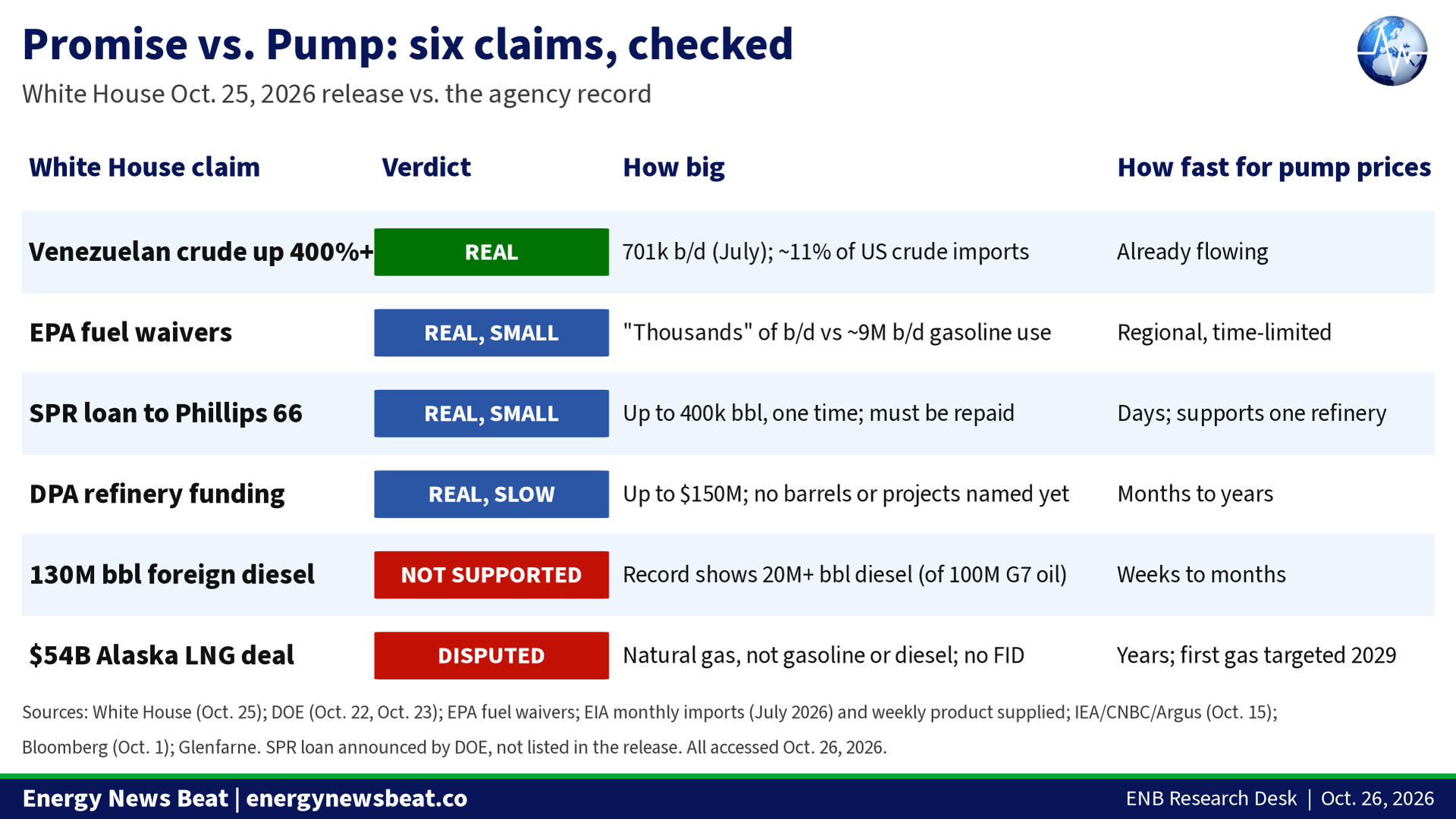
- Venezuelan crude. The release says imports are up “over 400%.” EIA data back that up. Imports rose from 137,000 barrels a day in December 2025 to 701,000 in July 2026, up 412%. That’s the most since May 2017. It’s about 11% of the 2 million barrels a day of crude the U.S. imported in July. These barrels are already flowing.
- EPA fuel waivers. These are real. EPA has renewed waivers for higher-sulfur diesel in Texas (through Nov. 13), Arctic diesel in Alaska, and state gasoline rules in Arizona and California. It also moved the national switch to winter gasoline up to Sept. 1. The White House says the waivers added “thousands of barrels per day.” EPA gives no figure. For scale, Americans use about 9 million barrels of gasoline a day. EPA lists them as regional and time-limited.
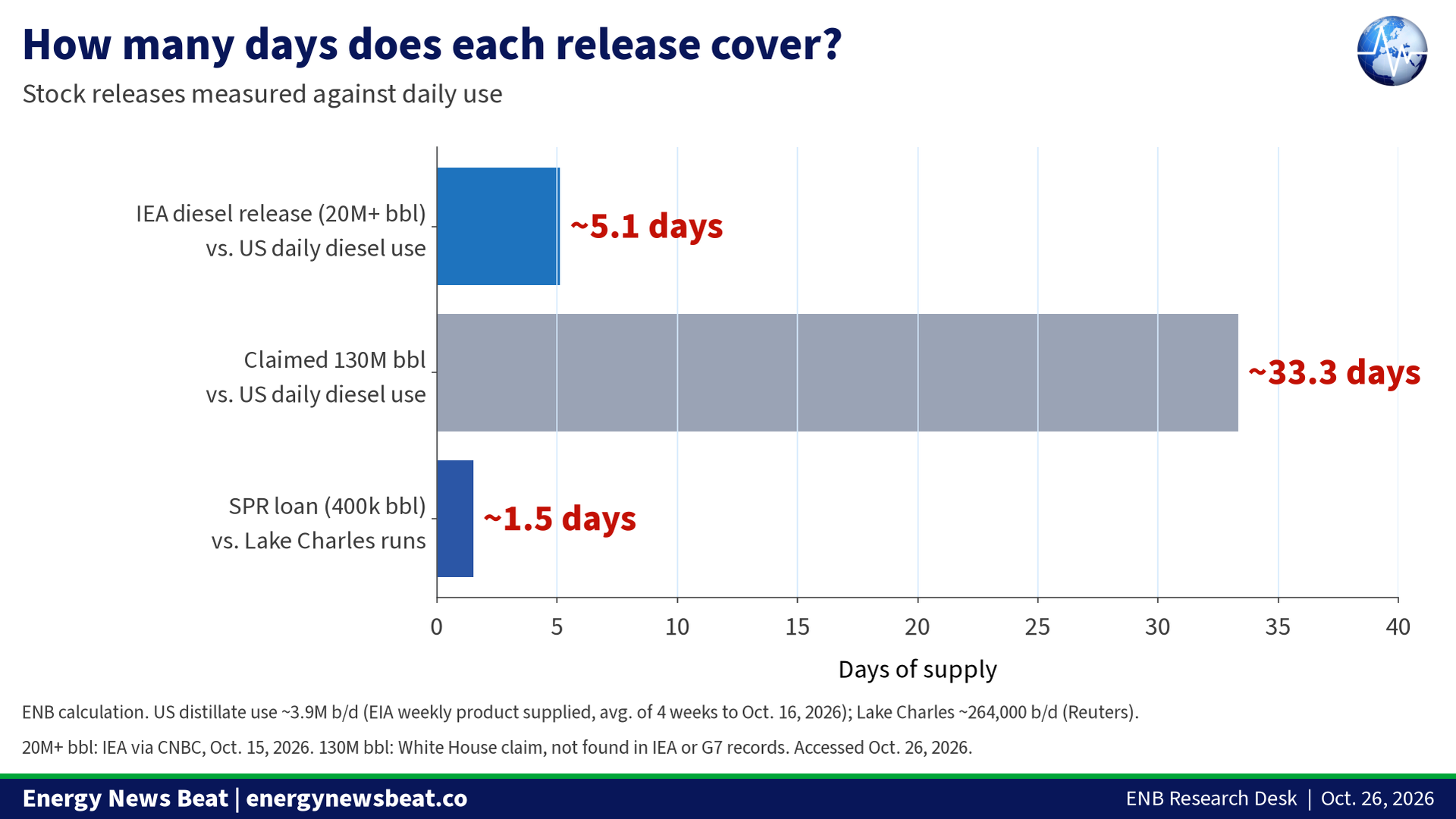
- The SPR loan. DOE authorized Phillips 66 to borrow up to 400,000 barrels of crude for its Lake Charles, Louisiana, refinery after a supply disruption. Reuters puts the plant at about 264,000 barrels a day, so the loan covers roughly a day and a half of crude. It keeps one refinery running and has to be paid back with premium barrels. Its 400,000 barrels equal about 1.5 days of one refinery’s runs. It also isn’t in the White House release. DOE announced it separately on Oct. 23.
What’s real but slow
The Defense Production Act money is real: up to $150 million. DOE says it will raise refining output “by millions of gallons per day.” One million gallons is about 24,000 barrels. But DOE hasn’t said how many barrels, and it hasn’t picked any projects yet. “The selection process is ongoing.”
In Houston, Energy Secretary Chris Wright said: “We are talking about reopening every refinery we can,” he said, according to Reuters. “There are dialogues there, and that’s a tough challenge. I’m not saying all these are going to happen.” API’s Mike Sommers told Reuters that U.S. refiners are already running at 95% to 100% of capacity. Reuters also notes that expansions “take months, if not years.”
What doesn’t hold up
- “Over 130 million barrels of diesel.” We couldn’t find this number anywhere. The G7 pledged 100 million barrels of oil from stocks over four months, crude and products combined. The IEA said Oct. 15 that more than 20 million barrels of it is diesel, released “as soon as possible” (CNBC, Argus). CNBC calculates that’s a little over five days of U.S. diesel use. Argus adds that record tanker rates make it hard to move.
- The $54 billion Alaska LNG deal. South Korea pushed back. Seoul says it agreed to invest only if the project is commercially viable. Anchorage Daily News reports the $54 billion splits into roughly $50 billion from Korea and $4.5 billion from Taiwan. The project has no final investment decision. First gas is targeted for 2029 (Glenfarne, January 2026). It is natural gas, not gasoline or diesel.
What the pump data says
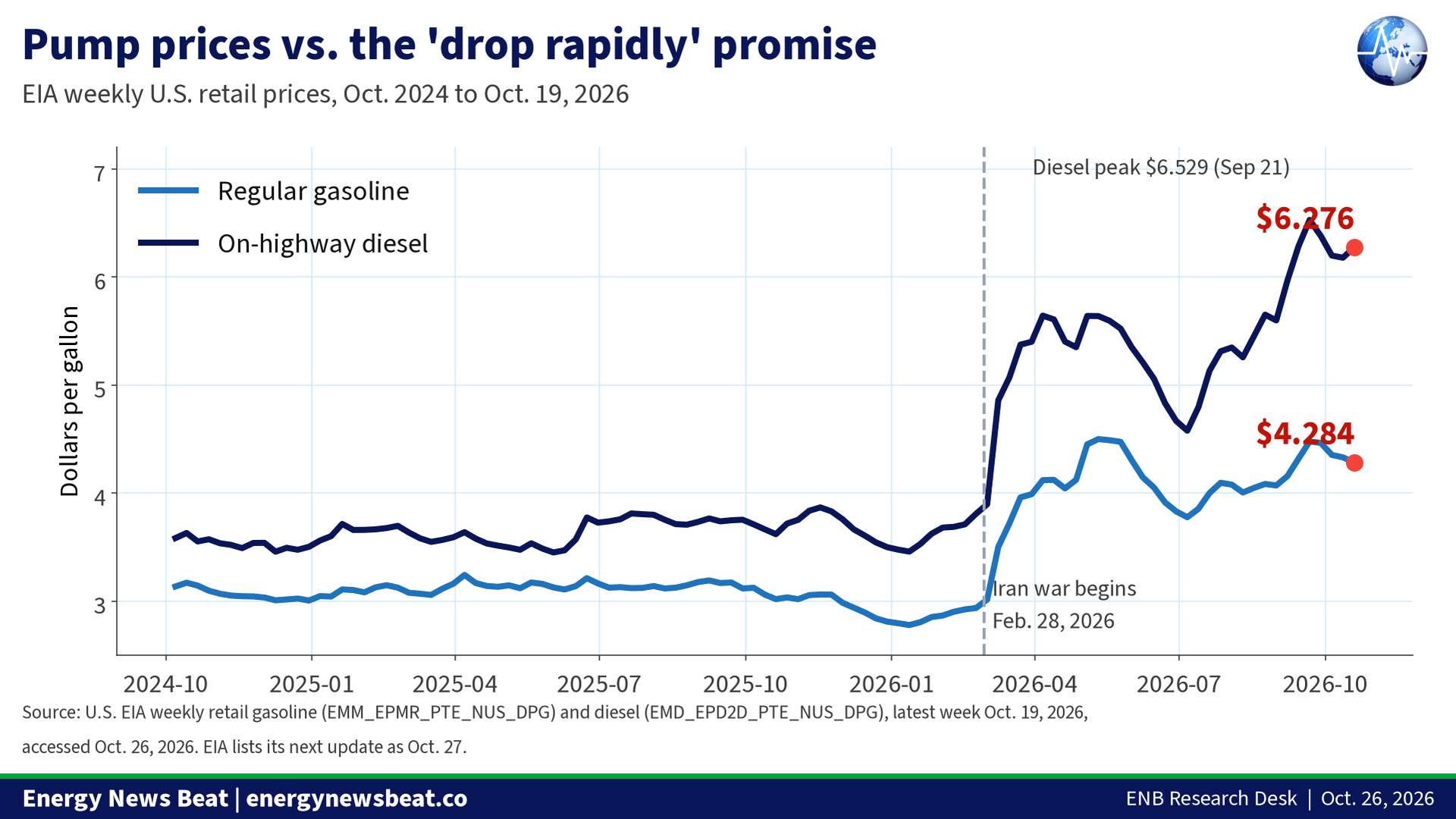
EIA’s weekly survey has regular at $4.284 on Oct. 19. That’s down from $4.50 in May and from $4.478 on Sept. 21 (EIA). Diesel is at $6.276. It’s off its Sept. 21 high of $6.529, but it rose almost 10 cents in the latest week. EIA’s next update is dated Oct. 27. As of this morning, today’s Monday figures weren’t posted.
At a rally in Perry, Ga., on Oct. 24, Trump said his advisers told him, “Please don’t mention that, sir,” because “people are paying a little higher” (Factba.se transcript). He then imagined the “fake headlines” about people “suffering at the pump” and said: “I don’t give a damn. I’m gonna say it. We’re making a freaking fortune.” The Hill and The Daily Beast reported the remark. Newsweek reported he was saying he did not care about criticism of his remarks; critics read it as indifference to pump prices. He also said oil prices “will be falling dramatically in a short period of time, as soon as that war’s over.”
Why it matters to you
Waivers and stock releases can trim prices for a few weeks, and some areas get more help than others. Lasting relief depends on crude prices and on how much diesel refiners can make. Neither of those changes fast. Diesel, used by truckers and farmers, is $6.276, up from $3.620 a year ago (EIA).
The investor angle
Argus puts diesel refining margins above $100 a barrel, and API says U.S. plants are running at 95% to 100%. Watch which projects DOE picks for DPA money, whether Korea and Taiwan sign binding Alaska LNG contracts, and whether Venezuelan imports keep climbing in EIA’s August data.
| Stu’s Take
Credit where it’s due: Venezuelan crude is up to 701,000 barrels a day, and the EPA waivers and 400,000-barrel SPR loan are real. But $150 million has no barrels attached yet. The 130 million barrels of diesel shrinks to 20 million-plus in the IEA record, and Alaska LNG is a 2029 gas project. Regular is $4.284 and diesel is $6.276, against $3.019 and $3.620 a year ago. Prices are drifting down, not dropping rapidly. I have been saying there is only two ways to lower gasoline, diesel and jet fuel prices: 1 Demand Destruction or 2: Increasing refining capacity. The Russian diesel on the way is good as it is a carrot to get Putin to the table to end the horrible war. It by itself will not solve our diesel problem, but invoking the DPA quickly and heavily will solve the problem sooner, as soon as middle of 2027 in some areas.
|
Caveats
Reuters ties the price surge to the Iran war and Ukrainian attacks on Russian refineries. None of these six policies controls those. Monthly EIA import data run through July 2026. The White House didn’t say how it measured the 400%, or what it counted in the 130 million barrels. We didn’t contact the White House, DOE or Phillips 66 for this piece. We found no video of Wright’s remarks and are relying on Reuters’ text. A full video (YouTube) and a Factba.se transcript of the Perry rally are available; ENB quotes from the transcript, the clip and The Hill’s account.
The post Promise vs. Pump: The White House Says Fuel Prices Will ‘Soon Drop Rapidly.’ Here’s What Each Deal Can Actually Deliver appeared first on Energy News Beat.