
Duke Energy (NYSE: DUK) is navigating a critical juncture that could define its earnings trajectory and investor appeal for years to come. On April 15, 2026, the utility filed with the North Carolina Utilities Commission (NCUC) to recover approximately $809 million in extraordinary fuel and purchased power costs incurred during an extreme winter cold snap in late January and early February 2026.
At the same time, the company continues executing ambitious plans for more than 19,000 MW of new generation capacity over the next decade to meet surging demand from data centers, manufacturing, and population growth.
With shares closing at $128.03 on April 17 (up 9.0% year-to-date and 55.7% over five years), these developments are putting Duke’s regulatory agility, capital discipline, and long-term growth story to the test—especially as the broader energy sector draws fresh investor capital amid AI-driven load growth and defensive plays.
Duke Energy Carolinas and Duke Energy Progress together faced record winter demand that exceeded on-system generation and storage. To keep the lights on, the company purchased power at elevated market prices and ramped up fuel use. The filing seeks recovery of roughly $500 million (Carolinas) and $309 million (Progress) in actual costs—no markup or profit for the utility, as fuel is a classic pass-through expense under regulation.
The 19,000 MW Plan: Powering the AI Boom
Duke’s long-term resource plans call for 19,600 MW of new generation capacity over the next decade, part of a record $103 billion capital expenditure program for 2026–2030 (up 18% from the prior outlook).
- Regulatory approval timelines and allowed returns on equity (ROE).
- Project execution and cost containment—interest coverage is already stretched with rising capex.
- Fuel mix impacts on future bills (gas provides dispatchable reliability; solar and storage add renewables).
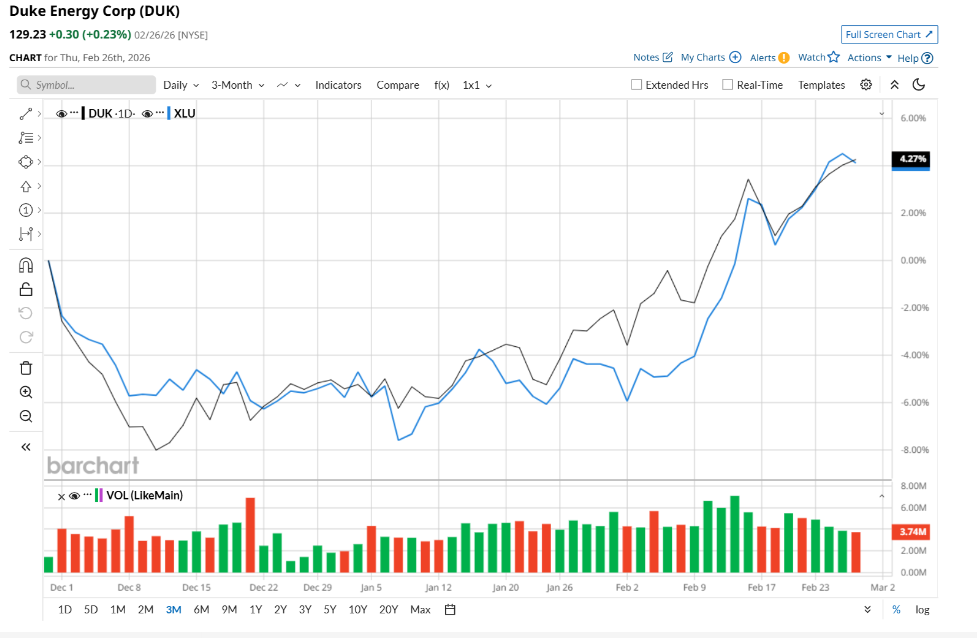
How Duke Stacks Up Against Other Utilities
The energy sector is a 2026 investor favorite. U.S. utilities posted their strongest Q1 start since 2019, driven by defensive dividends, stable cash flows, and contracted AI/data-center demand.
Forward-Looking Statements and Guidance
Duke provided explicit forward guidance in its latest outlook: 2026 adjusted EPS: $6.55–$6.80 (versus $6.31 in 2025).
Long-term growth: 5%–7% adjusted EPS CAGR through 2030, backed by the $103 billion capex plan and contracted load from AI/advanced manufacturing.
CEO Harry Sideris emphasized the company’s “incredible momentum” entering 2026, with a strong balance sheet and a constructive regulatory environment in key states.
These statements are qualified by typical regulatory, weather, and execution risks.
Stock Impact Amid Monday Volatility
Monday’s trading (April 20, 2026) could prove choppy. The ongoing Strait of Hormuz closure—now in its second month—has tightened global oil and LNG markets, raising fuel prices and energy-sector volatility.
For Duke, higher commodity costs are ultimately recoverable via fuel clauses, but prolonged spikes could pressure near-term cash flow and regulatory optics. Separately, China’s continued selling of U.S. Treasuries (nine straight months through late 2025/early 2026) has contributed to upward pressure on yields.
Higher borrowing costs are a headwind for capital-intensive utilities like Duke, which must finance tens of billions in new infrastructure. Net impact on DUK shares: Positive regulatory outcomes on the $809 million recovery would bolster earnings stability and support the valuation. Successful execution of the 19,000 MW plan could drive the stock toward analyst targets around $140.
However, any delays, higher financing costs, or customer pushback on bills could weigh on sentiment. Duke’s strong dividend yield and defensive profile should limit downside in a volatile macro backdrop.
Bottom Line for Investors
Duke Energy’s dual focus—recovering legitimate winter costs while building the generation fleet of the future—tests its ability to balance customer affordability with reliability and growth. Investors should monitor: NCUC approval of the fuel filing (expected timeline: summer 2026).
Progress on the $103 billion capex plan and ROE outcomes.
Quarterly updates on load growth from data centers.
As the energy sector remains a magnet for capital, Duke’s regulated scale, nuclear fleet, and clear 5–7% growth path position it as a core holding for income-oriented and infrastructure-focused portfolios—provided regulators continue to support timely cost recovery and reasonable returns on new investment.
Appendix: Sources and Links
- Duke Energy Press Release on Winter Cost Recovery (April 15, 2026): https://investors.duke-energy.com/news/news-details/2026/Duke-Energy-outlines-steps-to-reliably-serve-record-customer-demand-resulting-from-extreme-winter-weather/default.aspx
- Reuters coverage of filing: https://www.reuters.com/business/energy/duke-energy-seeks-price-increase-north-carolina-recoup-winter-power-costs-2026-04-15/
- Yahoo Finance / Simply Wall St analysis (April 17, 2026): https://finance.yahoo.com/sectors/energy/articles/duke-energy-cost-recovery-bid-230444113.html
- Duke Energy 2026 EPS Guidance and $103B Capex: Multiple reports including Seeking Alpha (Feb 10, 2026) and company releases.
- Strait of Hormuz crisis updates: World Economic Forum, UNCTAD, and Reuters (April 2026).
- China Treasuries sales: Barron’s, Atlantic Council, and Treasury data (Jan–Feb 2026).
- Utility sector performance: Reuters (April 10, 2026).
- All stock data as of April 17 close via Yahoo Finance and company filings.
This article is for informational purposes only and does not constitute investment advice. Always conduct your own due diligence.
The post Duke Energy Cost Recovery Bid and 19,000 MW Plan Test Valuation appeared first on Energy News Beat.