
The global diesel market is no longer just tight. It is rationing by price.
This week the ICE gasoil crack — the difference between a barrel of crude and the diesel refined from it — hit a record $79 a barrel. In the United States, the diesel crack is trading well above $100 a barrel and hovering near the all-time highs set last month, after an intraday peak above $106. Timespreads tell the same story: the ICE gasoil September/November spread is in a backwardation of $80 a tonne, meaning prompt barrels are far more valuable than later ones. That is the market’s way of saying supply is missing now.
Diesel prices have outrun crude since mid-June. The squeeze is not a crude-oil story first. It is a refining-capacity and product-export story.
Drones, Hormuz, and a Russian export ban
Three supply shocks are stacked on top of a refining system that already had little spare capacity.
Ukrainian drone strikes have hammered Russian refining. Throughput has been reported as low as under 60% of capacity in recent months — the weakest in two decades. Moscow responded by banning diesel exports, with the restriction extended at least through September 30 and officials already talking about keeping it longer. Russia was one of the world’s largest diesel exporters. That barrel is gone from the seaborne market.
At the same time, the re-escalation around the Strait of Hormuz and damage to Middle East refining and shipping have kept product flows below pre-war levels. Chinese fuel exports have not meaningfully rebounded after months of restrictions meant to protect the domestic market. ING’s Warren Patterson and Ewa Manthey put it bluntly: the global refining system has little slack to make up for the disruptions now in play, and middle-distillate cracks are likely to stay highly elevated and volatile as seasonal demand strengthens.
Goldman Sachs more than doubled its diesel-margin forecasts. The bank now sees U.S. diesel refining margins averaging $63 a barrel next year and European margins $49 — up from prior forecasts of $27 and $19. That is a profit supercycle for anyone who can still run a hydrocracker.
Europe and the UK: the shortage is already at the pump
Europe closed roughly 30 refineries between 2009 and 2024. It now depends on imported diesel. When Middle East and Russian barrels disappear, Northwest Europe feels it first. Gasoil cracks in the region have been at record highs; inventories are expected to grind toward multi-year lows into year-end. Heating oil, road diesel, and jet fuel all compete for the same slice of the barrel.
In the United Kingdom, the structural problem is worse. Net-zero policy has closed or constrained refining capacity while the vehicle fleet still leans heavily on diesel for freight. Official and pump-tracker data show UK diesel averaging about 183–186 pence per litre in late August and early September — roughly £1.83–£1.86/L nationally, with rural and Scottish stations often higher. That is a large premium to petrol and far above pre-conflict levels.
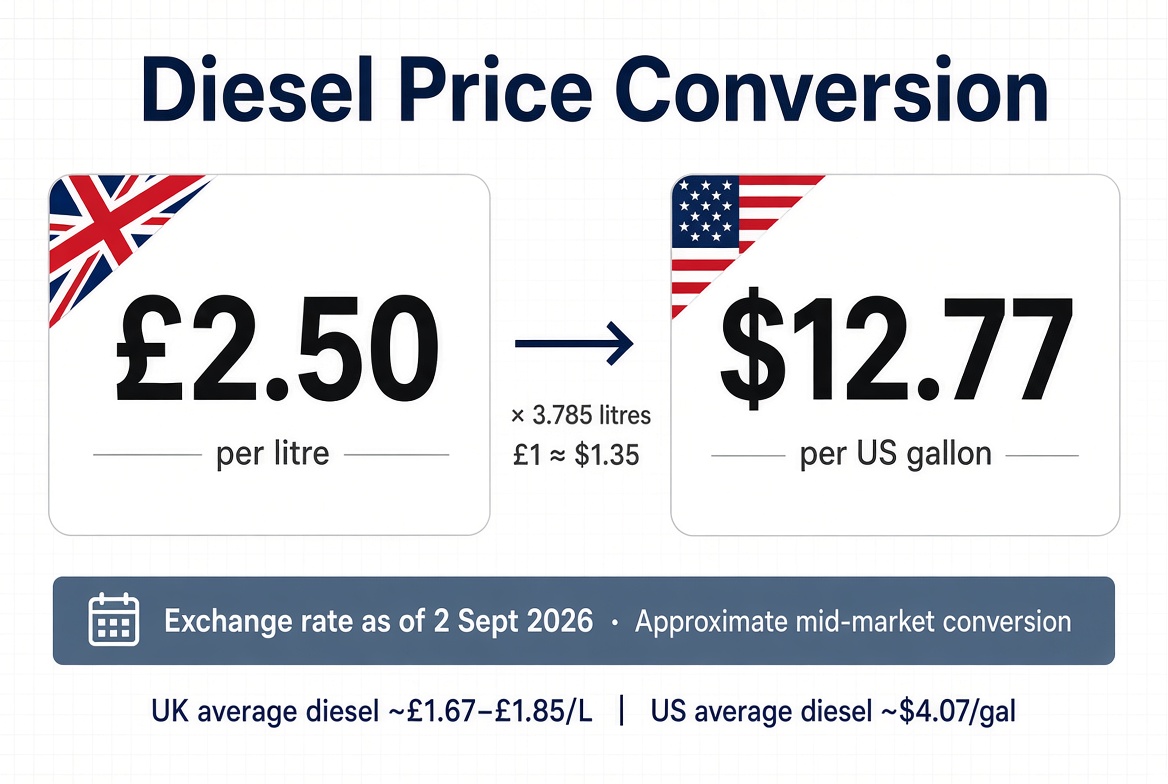
That is not an abstraction. On Conversations in Energy with Stu Turley, podcast guest Joe Leather (host of Wind, Waves and Wells), alongside Mark LaCour, described filling his truck in Scotland at £1.84 per liter — cited on the show as about $12.77 per U.S. gallon equivalent. The episode, “Energy Addition, Not Transition: Why Politics Is Failing the World,” frames the price as the predictable result of politics that shut down refining while demand for middle distillates never left. Listen here: Energy Addition, Not Transition: Why Politics Is Failing the World.
(At the current ~1.35 GBP/USD rate, £1.84/L converts closer to about $9.40 per U.S. gallon — still roughly double recent U.S. Gulf Coast wholesale ULSD near $4.70/gal. The $12.77 figure is the conversion used on the podcast.)
The same conversation makes the larger point Energy News Beat has argued for years: the world is in energy addition, not a tidy transition. Demand grows. Grids lag. Hydrocarbons still move freight, harvests, and militaries. When policy subtracts refining capacity, and geopolitics subtracts more, diesel is the first product to scream.
How long can the United States keep this pace?
Refiners processed about 17.5 million barrels per day in the latest EIA week and ran at 98% utilization — the highest since August 2018. Midwest plants have been above 100% of listed operable capacity. Distillate inventories sit near 104 million barrels, still about 14% below the five-year seasonal average, with East Coast stocks at record lows even after a small national build. U.S. diesel and gasoil exports hit a record 54.2 million barrels in August as the Gulf Coast filled gaps left by Russia and the Middle East.
That is the good news for refiners and the bad news for everyone else. There is almost no contingency left. A hurricane in the Gulf, an unplanned outage, a turnaround wave, or another jump in export demand would hit inventories immediately. Analysts keep repeating the same phrase: little slack.
How long can 98% last? Historically, U.S. refiners cannot hold that rate through a full maintenance cycle and a winter heating-oil pull without something breaking. Goldman’s 2027 margin forecast assumes the geopolitical damage does not heal quickly. ING sees no imminent recovery in Middle East or Russian product flows. The U.S. can keep exporting record diesel only while crude stays available, units stay online, and workers and logistics hold together. That is a matter of months of resilience, not years of spare capacity.
What analysts are saying
- ING: Tightness is most visible in diesel. Disruptions to Middle East and Russian exports, plus a refining system with little spare capacity, point to elevated, volatile middle-distillate cracks into stronger seasonal demand.
- Goldman Sachs: Diesel is the epicenter. Outages are running about 60% above seasonal norms. The bank more than doubled 2027 diesel-margin forecasts to $63/bbl in the U.S. and $49/bbl in Europe and sees refiners reaping a second year of outsized profits.
- Independent traders and research shops: This is a capacity problem, not an incentive problem. U.S. plants are already making more diesel and still cannot rebuild stocks because the rest of the world is short.
The consensus is not that cracks stay at $100 forever. It is that they stay historically wide until either drones stop hitting stills, Hormuz normalizes, Russia resumes exports, or demand is destroyed by price.
What investors can look at: five U.S. refining names
Independent U.S. refiners are the cleanest way to own the crack. Integrated majors (XOM, CVX) capture some of it, but their earnings are diluted by upstream and chemicals. The names that live and die on the 3-2-1 and diesel cracks are:
- Marathon Petroleum (MPC) — Largest independent by capacity (~3.0 million b/d), Gulf Coast and Mid-Continent footprint, aggressive buybacks, and MPLX midstream. Highest-utilization capture vehicle when diesel is the scarce barrel.
- Valero Energy (VLO) — Most diesel- and distillate-levered large-cap refiner, plus Diamond Green Diesel. Historically the strongest performer across full crack cycles.
- Phillips 66 (PSX) — Smaller refining system than MPC/VLO but paired with midstream and chemicals. Slightly less “pure crack” beta, more sum-of-the-parts and dividend support.
- HF Sinclair (DINO) — Mid-cap, Mid-Continent/Rockies/Southwest. Higher yield, more torque to inland cracks and heavy/sour differentials.
- PBF Energy (PBF) — Highest operational torque of the group. Little midstream cushion; when cracks explode, earnings and the stock move hardest in both directions.
These five have already been among 2026’s quiet winners while the tape obsessed over AI. The investment case from here is not “cracks go to $150.” It is that Goldman-style $50–$63 diesel margins, if they persist into 2027, still produce cash flow far above mid-cycle, fund buybacks, and keep the group in a seller’s market for refined product. Risks are the usual ones: a sudden ceasefire and export restart, a U.S. recession that kills freight demand, a Gulf hurricane that takes U.S. capacity offline, and policy that taxes the windfall.
Energy addition is what the data show. Drones and export bans are what the prices show. The United States is running its downstream system like a wartime factory. Europe is paying the import bill. Investors who understand the crack spread are watching the same five tickers the trucker in Scotland is already living with at the pump.
Appendix: Sources and links
At Energy News Beat, we Make Appendices Great Again.
Primary market and news
- Tsvetana Paraskova, “Diesel Cracks Hit Record Highs as Global Fuel Squeeze Deepens,” OilPrice.com, September 2, 2026. https://oilprice.com/Latest-Energy-News/World-News/Diesel-Cracks-Hit-Record-Highs-as-Global-Fuel-Squeeze-Deepens.html
- “Diesel crack spread surges to record $106 a barrel,” Transport Topics / Bloomberg, September 1, 2026. https://www.ttnews.com/articles/diesel-crack-spread-record
- “US Gulf Coast diesel prices hit all-time high amid global supply disruptions,” S&P Global, September 1, 2026. https://www.spglobal.com/energy/en/news-research/latest-news/refined-products/090126-us-gulf-coast-diesel-prices-hit-all-time-high-amid-global-supply-disruptions
- “US diesel crack surpasses $100 a barrel for the first time on supply disruptions,” Reuters, August 17, 2026. https://www.reuters.com/business/energy/us-diesel-crack-surpasses-100-barrel-first-time-supply-disruptions-2026-08-17/
- “Diesel jumps to 4-month high with supply squeeze worsening,” Bloomberg / Seattle Times, September 1, 2026.
Podcast and UK pump anecdote
- “Energy Addition, Not Transition: Why Politics Is Failing the World,” Conversations in Energy with Stu Turley (guests Mark LaCour and Joe Leather), Energy News Beat. https://energynewsbeat.co/conversations-in-energy-with-stu-turley/energy-addition-not-transition-why-politics-is-failing-the-world/
U.S. inventories, runs, and utilization
- EIA Weekly Petroleum Status Report, data for week ended August 28, 2026, released September 2, 2026. https://www.eia.gov/petroleum/supply/weekly/
- EIA refiner operable capacity percent utilization. https://www.eia.gov/dnav/pet/PET_PNP_WIUP_A_(NA)_YUP_PCT_4.htm
- “US crude stocks fall on strong refining activity and exports, EIA says,” Reuters, September 2, 2026. https://www.reuters.com/business/energy/us-crude-gasoline-inventories-fell-last-week-distillates-rose-eia-says-2026-09-02/
Analyst notes
- Goldman Sachs diesel-margin revisions (U.S. $63/bbl, Europe $49/bbl for next year), reported August 31–September 1, 2026. https://finance.yahoo.com/energy/articles/goldman-sachs-sees-major-shift-191600936.html
- ING commodities note as cited in OilPrice.com, September 2, 2026.
- Morgan Stanley on the European diesel squeeze, July 2026. https://www.energyconnects.com/news/oil/2026/july/diesel-squeeze-in-europe-set-to-deepen-morgan-stanley-says/
UK / EU prices
- UK diesel ~GBP 1.83–1.86/L early September 2026 (Fuelo, GlobalPetrolPrices, DESNZ-linked trackers). https://www.globalpetrolprices.com/United-Kingdom/diesel_prices/ and https://gb.fuelo.net/prices/date/2026-09-02
- IRU European diesel pump survey (summer 2026 EU averages above EUR 1.90/L in many states).
Refining stocks context
- Independent refiner market-cap and capacity rankings: Marathon Petroleum (MPC), Valero (VLO), Phillips 66 (PSX), HF Sinclair (DINO), PBF Energy (PBF). Industry lists updated September 2026.
This article is for informational purposes and is not investment advice. Crack spreads, utilization, and geopolitics can reverse quickly.
The post Diesel Crack Spread Hits Record Highs as the Global Downstream Market Is Hit by Drones and Oil Shortages appeared first on Energy News Beat.