
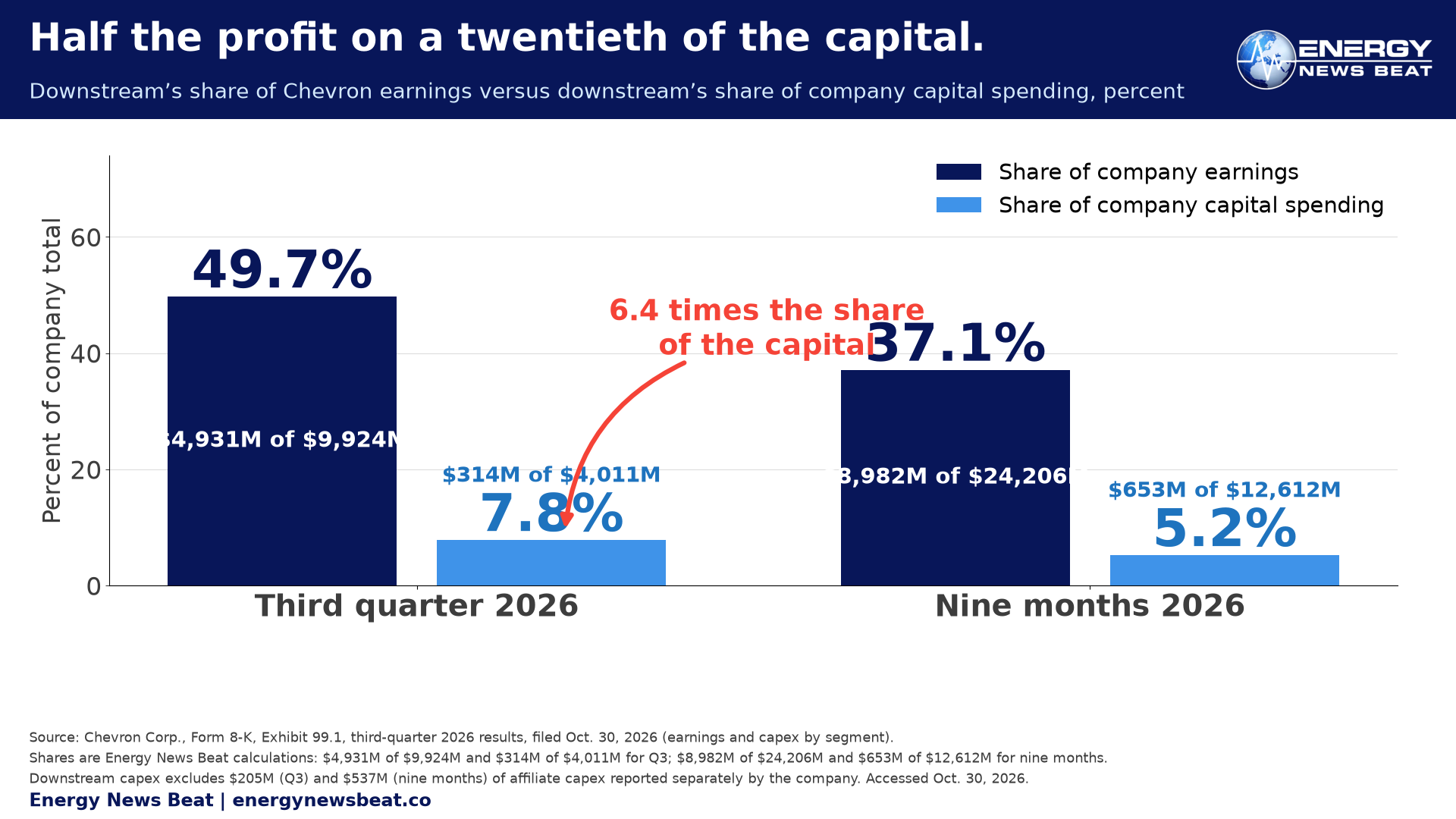
Downstream produced 49.7% of Chevron’s third-quarter earnings on 7.8% of its capital spending. The refineries ran at 98% of capacity to do it, and nobody will say what the maintenance bill is.
By Energy News Beat | Oct. 30, 2026 | Chevron Q3 2026 earnings release, read Oct. 30, 2026; EIA monthly data through August 2026; IIR Energy schedule comparison of Sept. 17, 2026
Chevron’s refineries earned $4,931 million in the third quarter, 49.7% of the $9,924 million the whole company made, on $314 million of downstream capital spending, 7.8% of the $4,011 million invested. Over nine months: $8,982 million from downstream, 37.1% of $24,206 million, on $653 million of capital, 5.2% of $12,612 million.
Half the profit on a twentieth of the investment.
A blowout quarter, and where it came from
Chevron reported adjusted earnings of $10,361 million, or $5.28 a share, against the $4.89 LSEG consensus. Downstream earned $4,931 million versus $1,137 million a year earlier: U.S. $3,585 million and international $1,346 million, the U.S. figure up from $638 million.
The quarter was violent underneath. Brent traded as low as $68 and as high as $132, a $64 spread, Bonner said. International refined product sales fell 9% on Middle East supply disruptions. Chevron made money anyway, because margins on the barrels it sold were extraordinary.
Half the profit on a twentieth of the capital
Run it the other way. Downstream capital spending of $653 million came to 7.3% of the $8,982 million of downstream earnings it produced. Add the $537 million of affiliate capex outside the consolidated total and it still absorbs $1,190 million. A business that spends almost nothing on its refineries and earns half its profit there has little room between a good year and an expensive one.
Ninety-eight percent is not a normal number
Chevron set a record for U.S. refinery crude unit throughput at 1.09 million barrels a day, at utilization of nearly 98%. International crude inputs were 665,000 barrels a day.
Nationally, EIA put U.S. operable refinery utilization at 97.6% in August 2026, after 94.0% in May, 96.5% in June and 96.5% in July. EIA wrote Oct. 22 that utilization averaged more than 95% from May through September, the highest for those months since 1998, and output was only the highest since 2019 because capacity has fallen 4% since then.
Name the scope every time. The 97.6% is an EIA monthly national average; the 92.8% weekly figure is a noisier series for the week to Oct. 23; the 98% is Chevron’s U.S. crude units; ExxonMobil reported U.S. Gulf Coast crude unit utilization at 100%. Four numbers, four scopes.
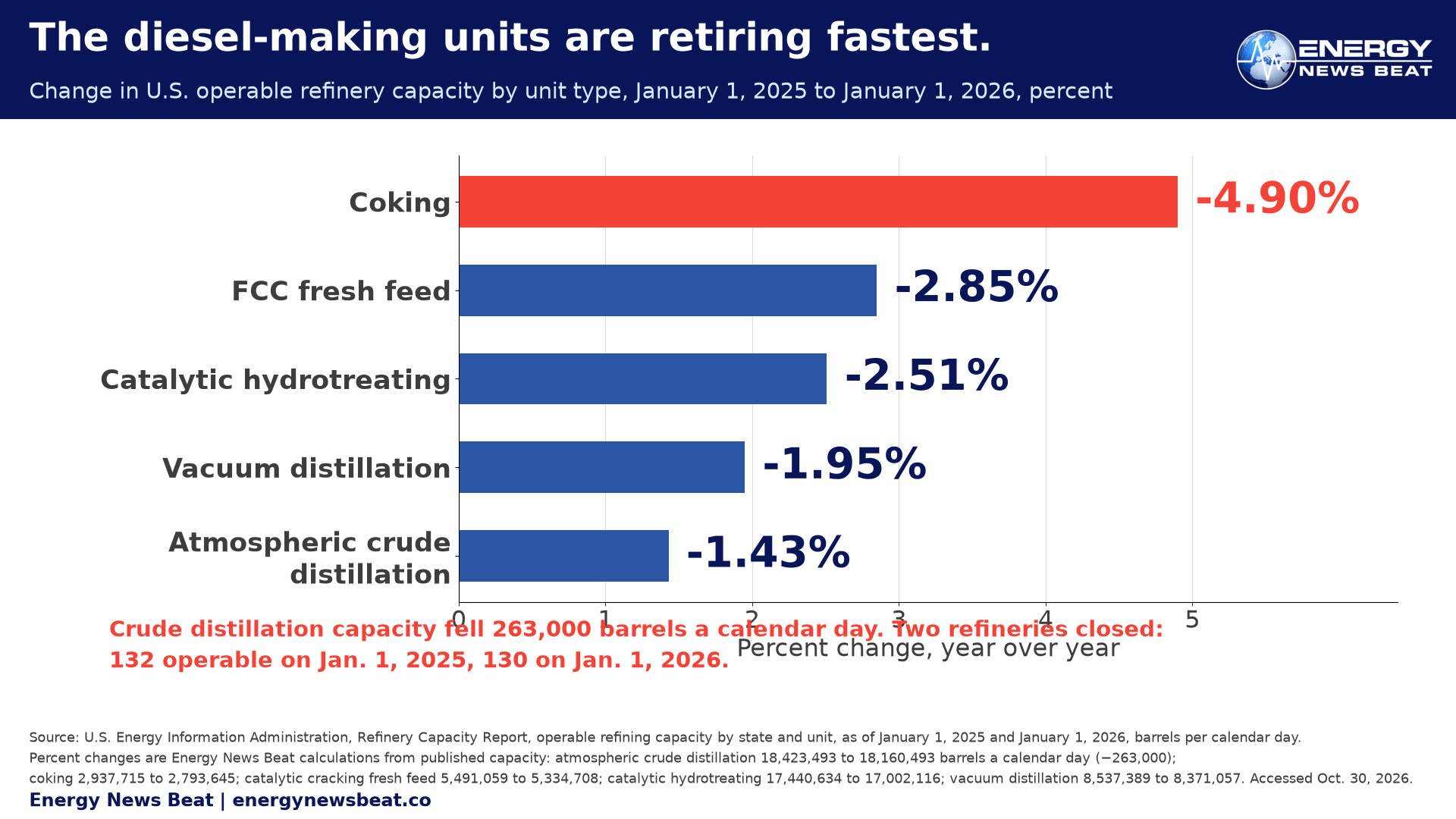
The strain shows in the hardware. EIA has atmospheric crude distillation down 263,000 barrels a calendar day, or 1.43%, in the year to Jan. 1, 2026, with two refineries closed. Coking fell 4.90%, hydrotreating 2.51%, FCC fresh feed 2.85%: the units that make diesel are retiring faster than the stills.
There is a precedent, and it is uncomfortable. After a 24-week run above 95% in 1998, U.S. utilization fell to about 86% by mid-October as plants went into emergency maintenance. A precedent, not a forecast: the last time it ran this hard this long, it broke.
The cuts came before the boom
Chevron spent $928 million on downstream capital in 2025, 45.2% below 2024’s $1,694 million and 47.7% below 2023’s $1,773 million. It halved refining investment before the biggest margin environment in a generation.
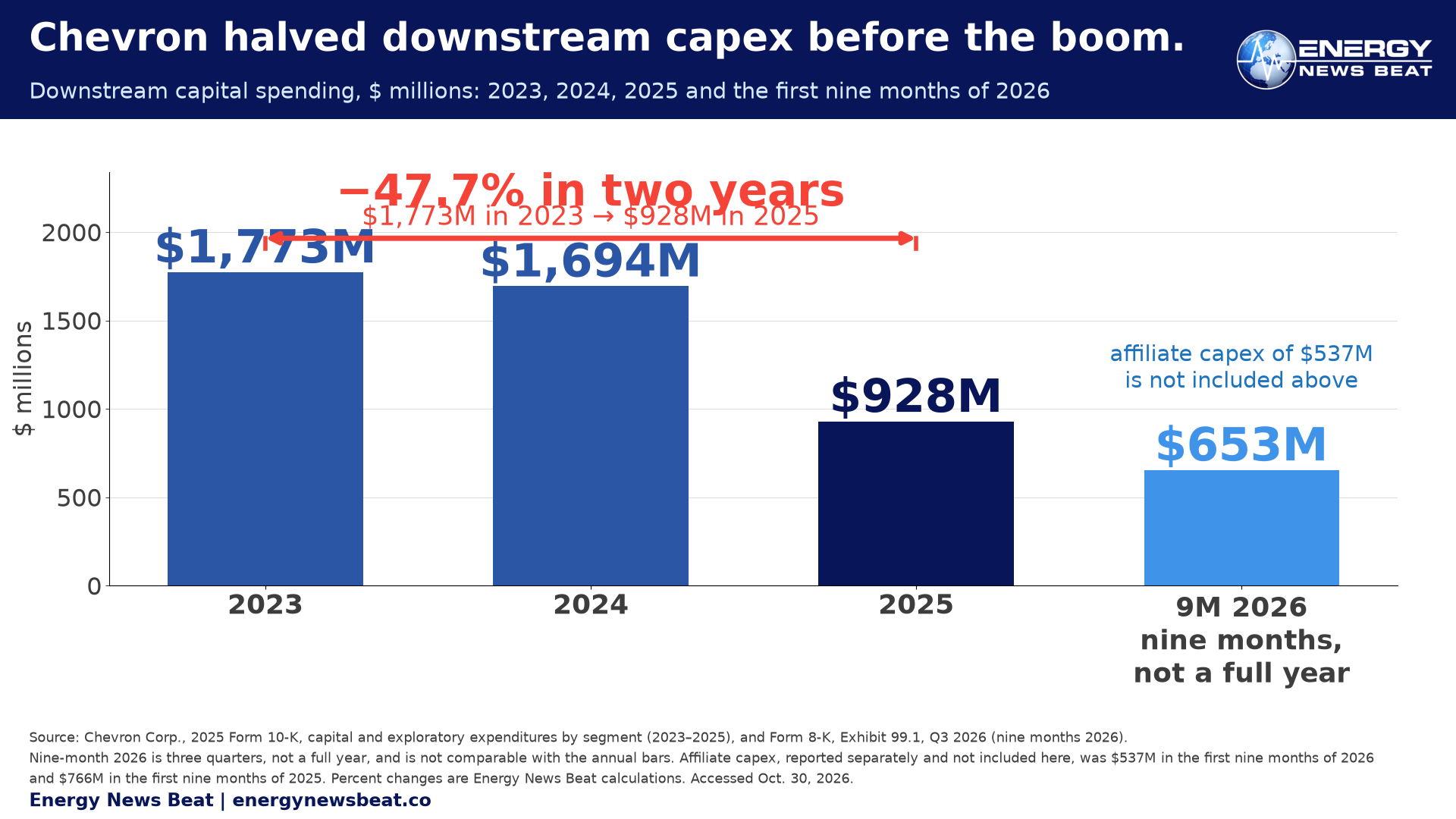
The 10-K says where it went: 2025 capex was $17.3 billion, 5 percent higher than 2024, as Hess and data center power spending “more than offset lower spend in the downstream segment”. ExxonMobil cut Energy Products capex 23.0% in 2025, to $1,707 million.
The February 10-K projected 2026 downstream capex of about $1 billion, nearly three-fourths in the U.S., not re-confirmed since. The only capital guidance restated was company-wide: Bonner put organic capex at $3.9 billion in the quarter and expects fourth-quarter capex to rise while “still finishing the year at the low end of our annual capex guidance”, the $18 billion to $19 billion range.
Nobody will put a number on maintenance
The disclosure gap is simple. The words maintenance and turnaround do not appear anywhere in Chevron’s third-quarter release, an Energy News Beat count of the Exhibit 99.1 filed Oct. 30. ExxonMobil quantifies turnaround costs down about 30% without saying what a turnaround costs.
The closest Chevron has come is an earnings impact, not spending. In July, covering the second-quarter call, Reuters reported that Chevron expected third-quarter maintenance to reduce downstream earnings by $175 million to $225 million. Profit forgone while units are down, not cash spent bringing them back, and not repeated this quarter.
Valero reported Q3 capital investments of $432 million, $371 million for sustaining operations, or 86%: a company telling you what it costs to stand still. Marathon’s 2026 turnaround at its 133,000 barrel a day El Paso refinery cost about $130 million over 45 days, per trade coverage, not a filing.
Globally, the IEA puts refining investment at just over $40 billion in 2026, about 15% below 2025, with “about half of spending” on maintenance at existing plants: roughly $20 billion a year worldwide to keep the fleet running, mid-shock.
The bill moves to 2027
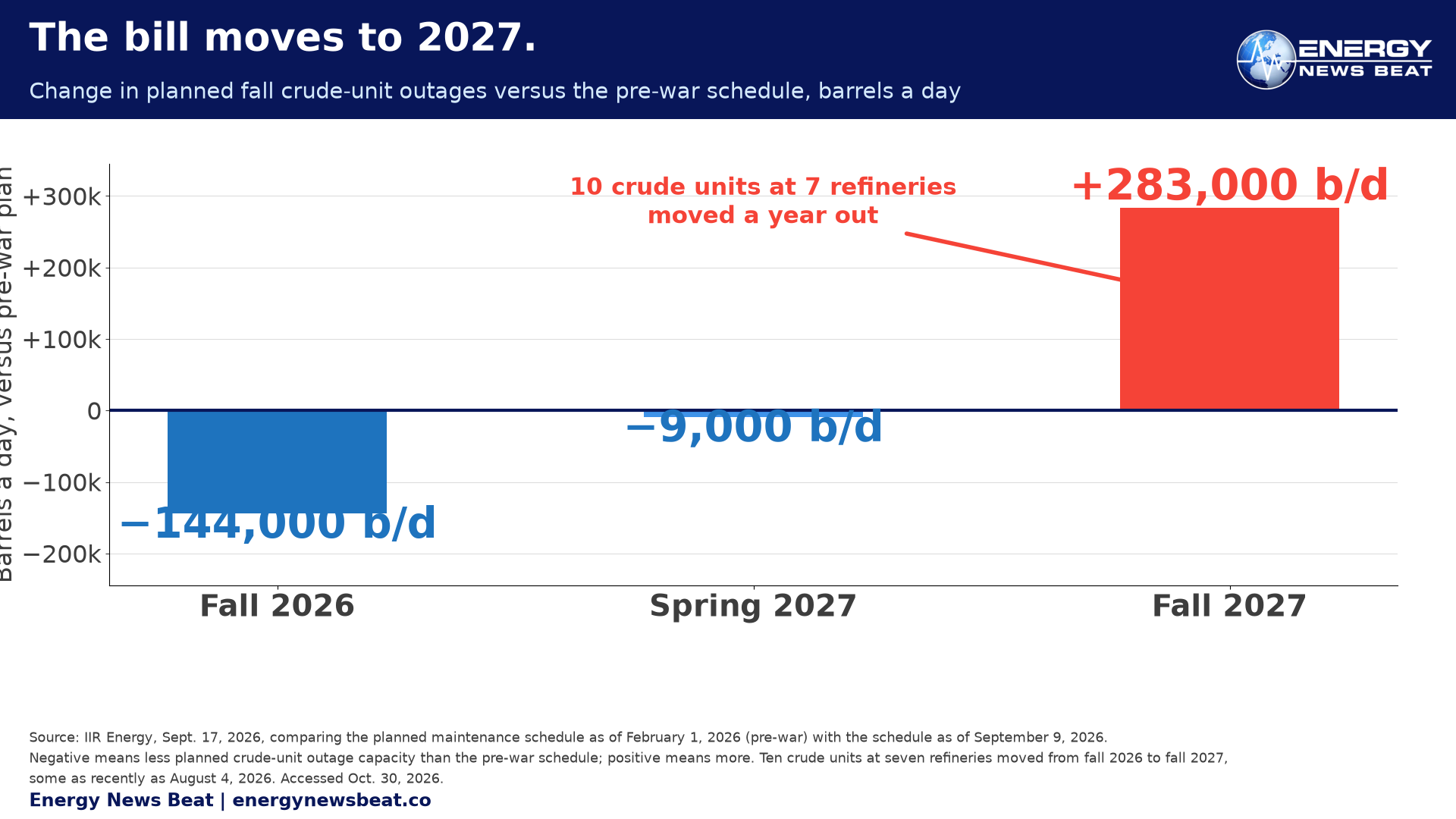
Third-party trackers already show the deferral. IIR Energy compared the pre-war schedule of Feb. 1 with Sept. 9: fall 2026 planned crude outages down 144,000 barrels a day, spring 2027 down 9,000, fall 2027 up 283,000, with 10 crude units across seven refineries moved a year out. Morgan Stanley projects sidelined capacity 3.4 million barrels a day higher by 2Q27.
Valero’s Gary Simmons put a global number on it, citing consultants who estimate about 1.5 million barrels a day of turnarounds were deferred worldwide, which would point to a heavier 2027 season. He added that Valero itself does not defer maintenance. That is the tell: a refiner with exactly the same incentive to run flat out said plainly that it was not taking it.
Neither major has changed its spending plan since the war began. As Reuters’ Ron Bousso wrote Oct. 30, “it is telling that the majors’ dividend policies and capital spending plans have remained largely unchanged since the start of the war”. Chevron’s answer on 2027 is a date, not a number: “We will give you some additional color on the 2027 capital program in December after we meet with our board”.
Energy Intelligence reported Oct. 29 that refiners insist this is transitory, and that “for most, any gains in output will come from squeezing more out of existing kit”. More output, same steel, later upkeep.
Consumer and investor views
For a household, the refinery bill is not an abstraction. When plants run flat out and still cannot build distillate stocks, diesel stays dear, and diesel is under every grocery truck. Chevron’s U.S. distillate yield was 46% in the third quarter, genuinely high, and still not enough to break the margin. Prices are set by spare capacity, and there is almost none, so one outage now moves the pump more than it used to.
For an investor, the numbers cut two ways. Chevron generated free cash flow of $12,003 million and cut net debt by $7.8 billion in the quarter to $20,730 million, nearly $14 billion below end-2025. Return on capital employed was 17.7%; the dividend is $1.78. The risk is that 7.3% capex-to-earnings is a phase and the catch-up lands in a lower-margin year. Company-wide capex ran at 0.69 times depreciation, distorted by Hess accounting and equity affiliates outside the consolidated total. Context, not verdict.
The honest counter-case, and what we do not know
The skeptical reading is not the only reading. Chevron says more than 80% of its U.S. refinery turnarounds over the last two years finished with first-quartile duration. At Pasadena it added approximately 15% of capacity “at nominal cost”. At Pascagoula it expects another 7% by 2030, “over the next two turnaround cycles”. A proprietary catalyst lifted distillate yields more than 10% at its largest U.S. refineries. ExxonMobil reports turnaround costs down about 30% and work 50% faster, against the prior cycle for the same asset.
Those are real gains, and the strongest argument that the industry is getting better rather than borrowing. Both companies may simply be more competent at maintenance than the average refiner, longer run lengths may be engineering rather than deferral, and the 2027 bulge may be a planned cycle, not a backlog.
The honest finding is that public disclosure cannot distinguish between those stories. No maintenance line exists for either downstream business, and no turnaround schedule is published by site. What is left is third-party schedules, one earnings-impact range and a lot of inference. Readers should know that is what this rests on.
- Chevron’s third-quarter Form 10-Q was not on file at publication. Its most recent 10-Q was filed Aug. 6, 2026; the Oct. 30 filing was an 8-K carrying the release.
- EIA publishes no average age for U.S. refineries. The “50-plus years” figure in circulation is trade press and is not used here.
- Utilization is never blended here: EIA monthly national, EIA weekly, Chevron U.S. crude unit and ExxonMobil U.S. Gulf Coast crude unit are four measurements.
- The $175 million to $225 million is an earnings impact, not a spending figure, and it was July guidance reported in August.
- The 1998 episode is a precedent, not a forecast.
- No summed annual maintenance figure appears here; any would be an Energy News Beat calculation.
| STU’S TAKE
Opinion. Every number is linked to its source. Half the profit on a twentieth of the capital. Read that twice, because it is the whole story of American refining in 2026 and almost nobody is saying it out loud. Chevron took $8,982 million out of downstream in nine months and put $653 million back in. That is 7.3 cents of capital for every dollar of refining profit. You cannot run a 98% utilized system on that indefinitely. Steel does not care how good your quarter was. I am not accusing anyone of negligence. Chevron’s turnaround execution looks genuinely excellent, more than 80% first-quartile, and Pasadena’s 15% capacity gain at nominal cost is the kind of engineering I admire. But excellent execution and deferred scope can look identical from outside, and the outside is all we get. Neither company publishes a maintenance number. Not one. The market is telling you where the work went. Fall 2026 outages down 144,000 barrels a day, fall 2027 up 283,000. Three point four million barrels a day of planned work stacked up by the second quarter of 2027 on Morgan Stanley’s count. That is not a schedule. That is a bill with a due date. Watch December. Wirth says the 2027 capital program comes after the board meets, and that is the first honest test of whether any of this gets funded. If the number comes in flat while margins are this wide, you have your answer about what management thinks the maintenance actually needs.
|
Check out the World’s Greatest Podcast Show Notes at EnergyNewsBeat.co or EnergyNewsBeat.com. And subscribe to: The Energy News Beat Substack.
Appendix
Sources, verbatim excerpts, data tables and methodology notes for “Chevron’s Refineries Earned Half the Profit on a Twentieth of the Capital”.
A. Sources (all accessed Oct. 30, 2026)
- Chevron Corp., Form 8-K, Exhibit 99.1: “Chevron Reports Third Quarter 2026 Results,” filed Oct. 30, 2026
- Chevron Corp., 2025 Form 10-K, filed Feb. 24, 2026
- S. Securities and Exchange Commission, EDGAR submissions index for Chevron Corp. (CIK 0000093410)
- Chevron Corp., third-quarter 2026 earnings conference call transcript, Oct. 30, 2026 (Roic.ai)
- ExxonMobil, third-quarter 2026 earnings call prepared remarks, Oct. 30, 2026
- ExxonMobil, third-quarter 2026 earnings presentation, Oct. 30, 2026
- ExxonMobil, 2025 Form 10-K, filed Feb. 2026
- S. Energy Information Administration, Refinery Utilization and Capacity, monthly, through August 2026
- S. Energy Information Administration, Weekly U.S. Refinery Utilization, week ended Oct. 23, 2026
- S. Energy Information Administration, Today in Energy, U.S. refinery utilization and output, Oct. 22, 2026
- S. Energy Information Administration, Refinery Capacity Report, operable capacity by state and unit, Jan. 1, 2026
- S. Energy Information Administration, Frequently Asked Questions, refinery capacity
- IIR Energy, “Some U.S. refiners deferring maintenance from 2026 to 2027,” Sept. 17, 2026
- EconoTimes, reporting Morgan Stanley’s Oct. 20, 2026 refining outlook, Oct. 22, 2026
- Valero Energy, third-quarter 2026 earnings call, Oct. 22, 2026 (transcript summary via Biggo Finance)
- Mansfield Energy, “Is the U.S. refining system being pushed too hard?” Sept. 3, 2026
- Energy Intelligence, U.S. Gulf Coast refining margins, Oct. 29, 2026
- Reuters (Ron Bousso), “Big Oil’s spending caution speaks louder than its profits,” Oct. 30, 2026, via BOE Report
- CNBC, “Chevron, Exxon post quarterly results as war-driven refining surge lifts profit,” Oct. 30, 2026
- Reuters, “Exxon, Chevron see prolonged fuel price pressure,” Aug. 4, 2026, via Phoenix Herald
- El Paso Inc., “Inside Marathon Petroleum’s $130 million El Paso refinery turnaround,” 2026
- Marathon Petroleum Corp., second-quarter 2026 results, investor relations
- International Energy Agency, World Energy Investment 2026
- Gibsons, “No margin for error,” 2026 shipping and refining outlook
- BIC Magazine, “Clock care: crack spreads,” maintenance and reliability
- Apollo Technical, “What is a refinery turnaround?” reference
- Oil & Gas Journal, “2026 capital spending stays disciplined,” 2026
B. Verbatim excerpts
Mike Wirth, chief executive, on the 2027 capital program: “We will give you some additional color on the 2027 capital program in December after we meet with our board.” Link
Eimear Bonner, chief financial officer, on spending: “Organic capex was $3.9 billion in the quarter. In line with historical trends, we expect fourth quarter capex to increase, while still finishing the year at the low end of our annual capex guidance.” Link
Bonner on volatility: “Given the fact that the market dynamics are still very volatile, in third quarter alone, a $64 inter-quarter spread. We saw prices as low as $68, as high as $132 a barrel.” Link
Mark Nelson, vice chairman, on turnarounds: “More than 80% of Chevron’s U.S. refinery turnarounds over the last two years were completed with first-quartile duration.” Link
Nelson on Pasadena: “At Pasadena, we accelerated debottlenecking to increase refinery capacity by approximately 15% at nominal cost.” Link
Nelson on Pascagoula: “for Pascagoula, over the next two turnaround cycles, we’ll increase capacity there by another 7%.” Link
Nelson on yields: “our third quarter distillate yield in the United States was 46%, and across our global portfolio was even higher than that. In fact, Pascagoula hit a diesel production record.” Link
Chevron, 2025 Form 10-K on the capex mix: “Capex for 2025 was $17.3 billion, 5 percent higher than 2024 as spend on legacy Hess assets post-acquisition and increased investments in U.S. data center power solutions more than offset lower spend in the downstream segment.” Link
Chevron, 2025 Form 10-K on 2026 plans: “Downstream Capex is expected to be around $1 billion, with nearly three-fourths allocated to the U.S. operations.” Link
ExxonMobil, third-quarter prepared remarks on turnarounds: “We’ve also improved turnaround performance, reducing costs by approximately 30% and completing work 50% faster than previous turnaround cycles.” Link
EIA, Today in Energy, Oct. 22, 2026: utilization averaged “more than 95% of capacity between May and September, the highest for those months since 1998,” and U.S. refinery output was the highest since 2019 partly because “refining capacity has decreased by 4% since then.” Link
IIR Energy, Sept. 17, 2026: ten crude units at seven refineries were moved from fall 2026 to fall 2027, “some shifting as recently as August 4.” Link
Energy Intelligence, Oct. 29, 2026: “for most, any gains in output will come from squeezing more out of existing kit.” Link
Reuters, Ron Bousso, Oct. 30, 2026: “it is telling that the majors’ dividend policies and capital spending plans have remained largely unchanged since the start of the war.” Link
Valero, Gary Simmons, third-quarter call: consultants estimate that about 1.5 million barrels a day of turnarounds were deferred globally, suggesting a heavier turnaround season in 2027, and that Valero itself does not defer maintenance (attributed from the call as summarized in the transcript record, not a word-for-word quotation). Link
IEA, World Energy Investment 2026: refining investment in 2026 “is set to drop to just over USD 40 billion, about a 15% decrease from 2025. About half of spending is for upgrades and greenfield projects, and the other half is for maintenance at existing facilities.” Link
C. Data tables
C1. Chevron earnings and capital spending by segment ($ millions, as reported)
| Line | Q3 2026 | Q3 2025 | 9M 2026 | 9M 2025 |
| Upstream | 5,698 | 3,302 | 17,789 | 9,787 |
| Downstream | 4,931 | 1,137 | 8,982 | 2,199 |
| All Other | (705) | (900) | (2,565) | (2,457) |
| Total earnings | 9,924 | 3,539 | 24,206 | 9,529 |
| U.S. downstream capex | 250 | 133 | 490 | 442 |
| International downstream capex | 64 | 72 | 163 | 139 |
| Total company capex | 4,011 | 4,444 | 12,612 | 12,083 |
| Downstream affiliate capex (not in capex above) | 205 | 215 | 537 | 766 |
| Depreciation, depletion and amortization | 6,272 | 5,781 | 18,162 | 14,248 |
Source: Chevron Form 8-K, Exhibit 99.1, Oct. 30, 2026, as reported. Upstream, All Other and total earnings are shown for context; the ratios below use downstream earnings, segment capex and total capex only.
C2. Chevron downstream capital spending, annual ($ millions)
| Year | U.S. | International | Total | Year-over-year |
| 2023 | 1,536 | 237 | 1,773 | — |
| 2024 | 1,443 | 251 | 1,694 | −4.5% |
| 2025 | 676 | 252 | 928 | −45.2% |
| Two-year change, 2023 to 2025 | −845 | −47.7% | ||
| 9M 2026 | 490 | 163 | 653 | not a full year |
Source: Chevron 2025 Form 10-K for 2023 to 2025; Chevron Q3 2026 release for the first nine months of 2026. The 2026 figure covers nine months and is not comparable with the annual totals. Percentages are Energy News Beat calculations.
C3. The arithmetic behind the headline ratios (Energy News Beat calculations)
| Ratio | Numerator | Denominator | Result |
| Downstream share of Q3 earnings | $4,931M | $9,924M | 49.7% |
| Downstream share of 9M earnings | $8,982M | $24,206M | 37.1% |
| Downstream share of Q3 capex | $314M (250+64) | $4,011M | 7.8% |
| Downstream share of 9M capex | $653M (490+163) | $12,612M | 5.2% |
| 9M capex as a share of 9M downstream earnings | $653M | $8,982M | 7.3% |
| 9M capex including affiliate capex | $653M + $537M | — | $1,190M |
| Affiliate-inclusive capex, share of company capex | $1,190M | $12,612M | 9.4% |
| Affiliate-inclusive capex, share of downstream earnings | $1,190M | $8,982M | 13.2% |
| Downstream capex change, 2024 to 2025 | $928M ÷ $1,694M | — | −45.2% |
| Downstream capex change, 2023 to 2025 | $928M ÷ $1,773M | — | −47.7% |
| Company capex to DD&A, 9M 2026 | $12,612M | $18,162M | 0.69x |
All inputs are as reported in the Chevron Q3 2026 release. Affiliate capex is disclosed by the company as capital spending of equity affiliates and is excluded from the capex totals above it; it is added here only to show the widest reasonable denominator.
C4. U.S. operable refining capacity by unit, Jan. 1, 2025 versus Jan. 1, 2026 (barrels per calendar day)
| Unit | Jan. 1, 2025 | Jan. 1, 2026 | Change | Percent |
| Atmospheric crude distillation | 18,423,493 | 18,160,493 | −263,000 | −1.43% |
| Vacuum distillation | 8,537,389 | 8,371,057 | −166,332 | −1.95% |
| Coking | 2,937,715 | 2,793,645 | −144,070 | −4.90% |
| Fluid catalytic cracking, fresh feed | 5,491,059 | 5,334,708 | −156,351 | −2.85% |
| Catalytic hydrotreating | 17,440,634 | 17,002,116 | −438,518 | −2.51% |
| Operable refineries (count) | 132 | 130 | −2 | −1.5% |
Source: EIA Refinery Capacity Report, released June 26, 2026, with capacity as of Jan. 1, 2026; downloaded Oct. 30, 2026. Differences and percentages are Energy News Beat calculations; EIA publishes the capacity totals, not the percentage changes.
C5. U.S. refinery utilization, monthly 2026, and the weekly series (percent)
| Month | 2026 | 2025 |
| January | 91.4 | 85.7 |
| February | 89.0 | 85.1 |
| March | 91.6 | 86.9 |
| April | 90.1 | 88.0 |
| May | 94.0 | 90.2 |
| June | 96.5 | 94.3 |
| July | 96.5 | 95.5 |
| August | 97.6 | 95.1 |
Source: EIA refinery utilization, monthly, release of Oct. 30, 2026. A separate weekly series measures a different period and is cited separately in the text. National monthly averages and company crude-unit utilization are different measurements and are never blended here.
C6. Planned crude-unit outages versus the pre-war schedule (change, barrels a day)
| Period | Change versus Feb. 1 schedule | Note |
| Fall 2026 | −144,000 | work pulled out of the current season |
| Spring 2027 | −9,000 | roughly unchanged |
| Fall 2027 | +283,000 | work pushed into next autumn |
Source: IIR Energy, Sept. 17, 2026, comparing the schedule as of Feb. 1, 2026 with the schedule as of Sept. 9, 2026. Ten crude units at seven refineries moved from fall 2026 to fall 2027, some as recently as Aug. 4, 2026. Morgan Stanley separately projects planned-work outages 3.4 million barrels a day higher by the second quarter of 2027.
D. Background and methodology
Scope. This article covers Chevron’s downstream segment, which is refining plus marketing and lubricants, and it uses the company’s own segment definitions. Downstream earnings are not refinery earnings alone. The capital ratios compare downstream capital spending with total company capital spending, which is the cleanest available measure of how much of the company’s investment the refining business absorbs.
Utilization. Five different measures appear in this story and none is blended with another. EIA’s 97.6% is a monthly national average of operable atmospheric crude distillation capacity. The EIA weekly series is a different sample on a different cadence. Chevron’s nearly 98% is its own U.S. crude-unit utilization. ExxonMobil’s 100% is U.S. Gulf Coast crude units only, and its global fuels utilization covers a wider set of units and excludes Middle East impacts. Any comparison across these is a comparison of scopes, not of performance.
Maintenance versus capital. Turnaround spending can land in capital, in operating expense, or in both, and neither company publishes the split. The $175 million to $225 million range for the third quarter is an earnings impact from lost throughput and higher unit costs, disclosed as guidance in July and reported in August; it is not a spending figure and it is not capex. No figure in this article should be read as total industry maintenance spending.
Third-party estimates. IIR Energy, Morgan Stanley and Energy Intelligence are independent trackers and publishers, not company disclosures. The Marathon El Paso turnaround cost of about $130 million over 45 days comes from local trade coverage, not from a filing. The IEA figure is a global refining investment estimate, not a U.S. or Chevron-specific number. Percentages of change and every ratio in Chart 1, Chart 2 and Table C3 are Energy News Beat calculations from the company’s published figures.
What could not be verified
- Any company-disclosed figure for downstream maintenance or turnaround spending, for either Chevron or ExxonMobil, in any year. Neither company publishes one and neither was asked for one on the third-quarter call in a way that produced a number.
- Chevron’s third-quarter 2026 Form 10-Q. It was not on EDGAR as of the evening of Oct. 30, 2026; the company’s most recent 10-Q was filed Aug. 6, 2026, and the Oct. 30 filing was an 8-K carrying the earnings release as Exhibit 99.1. Cash flow, debt and segment detail in this article therefore come from the release, not from audited or reviewed financial statements.
- Any 2027 capital guidance from Chevron. Management said only that color would come in December after the board meets.
- The cost of the Pasadena debottleneck and of the Pascagoula expansion. Chevron described Pasadena as done at “nominal cost” and did not give a figure.
- Any site-level turnaround schedule from Chevron or ExxonMobil. The 2026-to-2027 shift rests on third-party schedules, principally IIR Energy.
- Any company-specific estimate of deferred-maintenance backlog. The 1.5 million barrel a day global figure is Valero’s citation of unnamed consultants.
- An EIA statistic for the average age of the U.S. refinery fleet. No such statistic exists in EIA’s published data, and the widely repeated “50-plus years” line is trade press and is not used here.
- A downstream-only depreciation figure. Chevron reports DD&A at the company level, so the 0.69x capex-to-DD&A ratio is a company-wide measure and is distorted by Hess purchase accounting and by equity affiliates.
- The ExxonMobil 30% turnaround cost reduction base. The company says costs are down approximately 30% and work is 50% faster than previous turnaround cycles; it does not publish the underlying dollar figures.
- Chevron’s investor relations slide deck, which returned an automated-request block; the call transcript and the 8-K release were used instead. The original Reuters story on the quarter was paywalled at the time of writing and a syndicated copy was used.
The post Chevron’s Refineries Earned Half the Profit on a Twentieth of the Capital appeared first on Energy News Beat.