CALGARY — In a major step toward diversifying Canadian crude exports, Prime Minister Mark Carney and Alberta Premier Danielle Smith announced on July 2, 2026, plans for a new West Coast oil pipeline capable of transporting 1 million barrels per day (bpd) from Alberta’s oil sands to a deep-water terminal on British Columbia’s southwest coast.
The project, submitted to the federal Major Projects Office (MPO) the same day for designation as a Project of National Interest, aims to expand access to fast-growing Asian markets, reduce reliance on U.S. buyers, and support growth in Canada’s oil sector amid shifting global trade dynamics.
The proposed pipeline would move approximately 1 million bpd of crude oil, primarily diluted bitumen from Alberta’s oil sands. This would significantly expand Canada’s tidewater export capacity beyond the existing Trans Mountain system (which reached ~890,000 bpd after its 2024 expansion).
Officials say the new line could help double Alberta’s oilsands production toward 8 million bpd over the next 10–15 years. Construction could begin as early as September 2027, with potential completion around 2034.
Estimated cost: $35.2 billion to $43.7 billion (including contingencies), according to Alberta’s submission.
Pipeline Route and Path
The pipeline would run from a new Bruderheim Receipt Terminal (northeast of Edmonton, Alberta) to a new Roberts Bank Delivery Terminal and Marine Facility in Delta, B.C. (south of Vancouver).
It largely follows the existing Trans Mountain pipeline corridor through Alberta and British Columbia, minimizing new land disturbance. Two main routing options were evaluated:
- Original Corridor: ~92% within 100 meters of existing infrastructure.
- Optimized Corridor: ~82% aligned with existing corridors.
In the Lower Mainland, the route diverges from the current Westridge Terminal in Burnaby to reach the deeper-water Roberts Bank site, which can accommodate larger VLCC (Very Large Crude Carrier) tankers for more efficient exports.
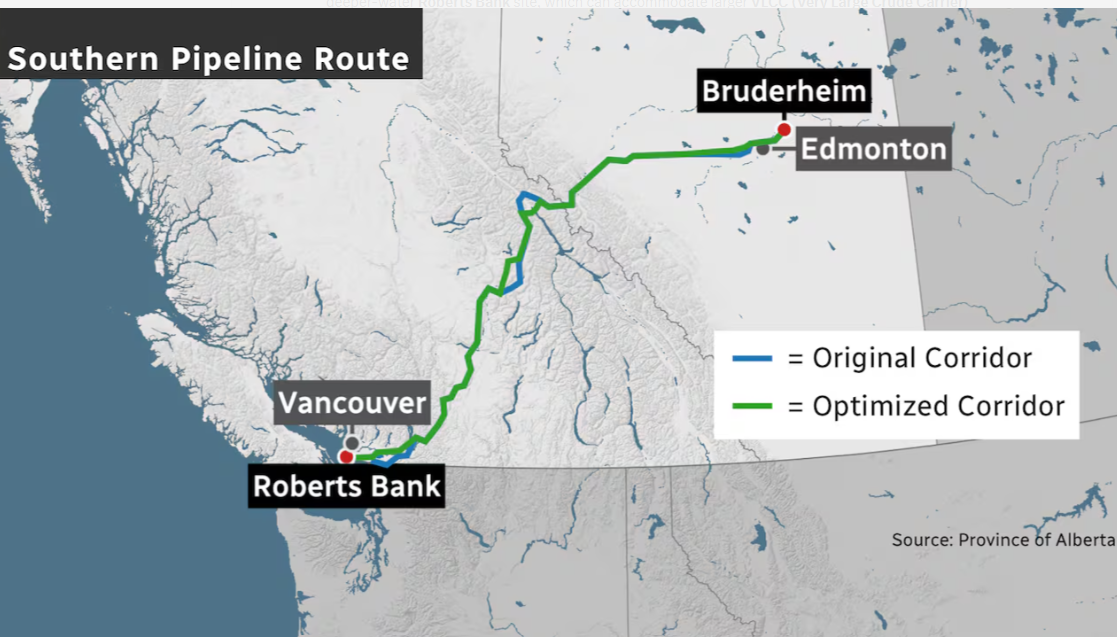
(Above: Proposed West Coast Oil Pipeline corridors — Original (blue) and Optimized (green) — from Bruderheim, Alberta, to Roberts Bank, B.C. Sources: Province of Alberta / CBC and Pipeline Online.)This southern route was selected over northern options (e.g., to Prince Rupert or Kitimat) to leverage existing infrastructure, reduce regulatory hurdles, respect B.C.’s northern tanker moratorium, and accelerate project timelines.
For comparison, here is the existing Trans Mountain pipeline route (Edmonton area to Burnaby/Westridge):timescolonist.com
Ownership, Partners, and Development
The project will be developed as a public-private partnership:
- Majority owners: Federal government (via Trans Mountain Corporation) and Alberta government (via Alberta Petroleum Marketing Corporation — APMC), as equal partners.
- Pembina Pipeline Corp.: 10% stake during construction, with an option for an additional 10% once operational. Pembina brings pipeline development and operational expertise.
- Future Indigenous equity participation is planned, building on engagement with over 100 Indigenous communities.
- Trans Mountain Corporation will lead project development, regulatory processes, construction, and operations.
Expected Exports and Potential Customers
The pipeline targets Asian markets, where demand for Canadian crude is strong as importers seek reliable, non-Middle East sources. Roberts Bank’s VLCC capability will enable larger, more cost-effective shipments compared to the current Westridge limitations.
Potential customers include major refiners and importers in China, Japan, South Korea, India, and other Asian economies. The project builds on the Trans Mountain Expansion’s success in opening Asian markets post-2024.
Canadian Companies That Would Benefit
- Pipeline operators: Trans Mountain Corporation and Pembina Pipeline Corp. (direct ownership/operational roles).
- Oil sands producers: Major beneficiaries include Canadian Natural Resources Ltd (CNRL), Suncor Energy, Cenovus Energy, Imperial Oil, and others. Improved market access typically translates to higher netbacks (better prices) versus discounted U.S. sales.
- Broader sector: Construction contractors, engineering firms, equipment suppliers, and service companies would see significant work during the multi-year build. The project is expected to create thousands of jobs and generate substantial government revenues (hundreds of billions over the project’s life, per similar past estimates).
Related Agreements and Environmental Considerations
A parallel deal with B.C. Premier David Eby includes:
- Retention of the federal northern B.C. tanker ban.
- Federal funding for infrastructure upgrades at Roberts Bank Terminal.
- Acceleration of LNG projects in B.C.
The pipeline must integrate with Alberta’s Pathways carbon capture and storage initiative and include robust Indigenous partnerships and environmental protections.
Next Steps and Challenges
The MPO will conduct initial Indigenous outreach. Listing as a Project of National Interest is targeted for October 1, 2026. Full regulatory approvals, consultations, and permits are required before construction.
Opposition from some environmental groups (concerned about tanker traffic and marine impacts, including southern resident killer whales) and certain B.C. stakeholders remains a factor, though the southern route and national-interest fast-tracking are designed to address past delays experienced by the Trans Mountain Expansion.
Strategic Significance
This announcement marks a significant federal-provincial alignment on energy infrastructure under the Carney government. It positions Canada to capitalize on global demand while supporting economic growth in Alberta and broader Canadian energy security.“We’ve agreed the time for action is now,” Prime Minister Carney stated at the Calgary announcement.
- Reuters: “Canada, Alberta announce new west coast oil pipeline to boost exports” (July 3, 2026) — https://www.reuters.com/business/energy/canada-alberta-announce-new-west-coast-oil-pipeline-boost-exports-2026-07-03/
- CBC: “Alberta pitches new West Coast oil pipeline to B.C.’s South Coast” (live updates, July 2026) — https://www.cbc.ca/news/canada/livestory/energy-proposal-ab-bc-west-coast-july-2-live-updates-9.7251535
- Alberta Government: “West Coast Oil Pipeline” official page — https://www.alberta.ca/west-coast-oil-pipeline
- Pipeline Online: Detailed route analysis and maps — https://pipelineonline.ca/tmx-2-trans-mountain-3-west-coast-pipeline-to-parallel-existing-trans-mountain-route-foregoing-northern-ports/
- Trans Mountain Corporation statement (July 2, 2026) — https://www.transmountain.com/news/trans-mountain-statement-regarding-the-proposed-west-coast-oil-pipeline-project
- Pembina Pipeline Corp. news release on partnership — https://www.pembina.com/media-centre/news/details/75d50590-b6ac-4430-9c70-34fe649288cd
- Global News and other coverage on announcement and partners.
Additional context drawn from official submissions, prior Trans Mountain Expansion data, and related federal/provincial agreements (May–July 2026).This article is based on publicly available information as of July 4, 2026. Developments may evolve as the
The post Canada, Alberta announce new West Coast oil pipeline to boost exports appeared first on Energy News Beat.