
California is escalating its legal and political confrontation with the Trump administration over energy policy. As detailed in a recent OilPrice.com analysis, Governor Gavin Newsom’s administration and state officials are pushing back hard against federal actions favoring fossil fuels, including the reallocation of offshore wind funds, challenges to the California Coastal Commission, and the use of emergency powers to reactivate oil infrastructure.
California frames these moves as federal overreach, undermining its clean energy leadership and sovereignty. The state has added substantial renewable capacity and battery storage, claims to run on high percentages of clean energy on many days, and is pursuing an emission-free grid by 2045. Yet this battle occurs against a backdrop where Newsom-era policies—aggressive renewable mandates, carbon pricing, and stringent fuel regulations—have driven some of the highest energy costs for consumers in the United States, particularly in electricity, gasoline, diesel, and related transportation fuels.
While California wages “lawfare” in the courts and through regulatory fights, the costs are largely passed on to everyday consumers and businesses.
Electricity Prices: California’s Premium Has Widened Dramatically
According to the latest EIA data (April 2026), California’s average residential electricity price stands at approximately 35.25 cents per kWh, compared to the U.S. national average of 18.83 cents per kWh—nearly double and second only to Hawaii.
Over the past 20 years, California’s electricity rates have consistently exceeded the national average and have risen faster in recent periods. Major drivers include:
- Renewable Portfolio Standard (RPS) mandates are pushing high shares of solar, wind, and other intermittent sources, requiring expensive grid upgrades, transmission lines, and backup/storage.
- Wildfire mitigation and grid hardening costs (especially for PG&E and other utilities), with billions passed directly to ratepayers.
- The cap-and-Trade program applies to the power sector.
- Broader infrastructure and renewable integration expenses.
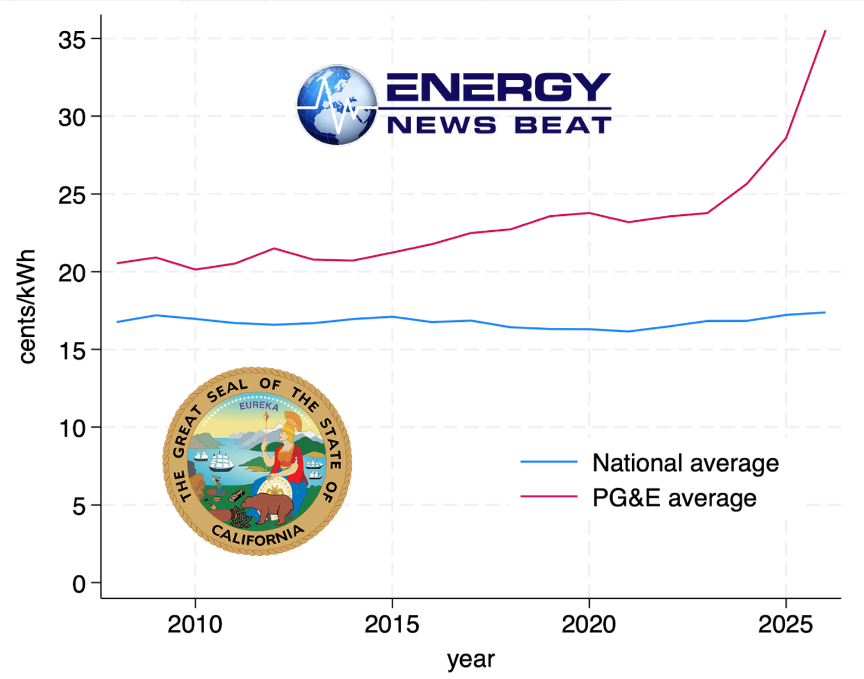
The chart above (PG&E average vs. national average) illustrates the divergence clearly: national residential rates remained relatively stable around 16–17 cents/kWh for much of the period before modest recent increases, while PG&E rates climbed steadily and then surged sharply in recent years toward 35+ cents/kWh.Other analyses show California’s high transmission and distribution costs as a percentage of total electricity expenses compared to other regions, further widening the gap.
These policies prioritize decarbonization and renewables over affordability, resulting in Californians paying a significant premium for electricity.
Gasoline and Diesel: A Growing Premium Driven by Regulations
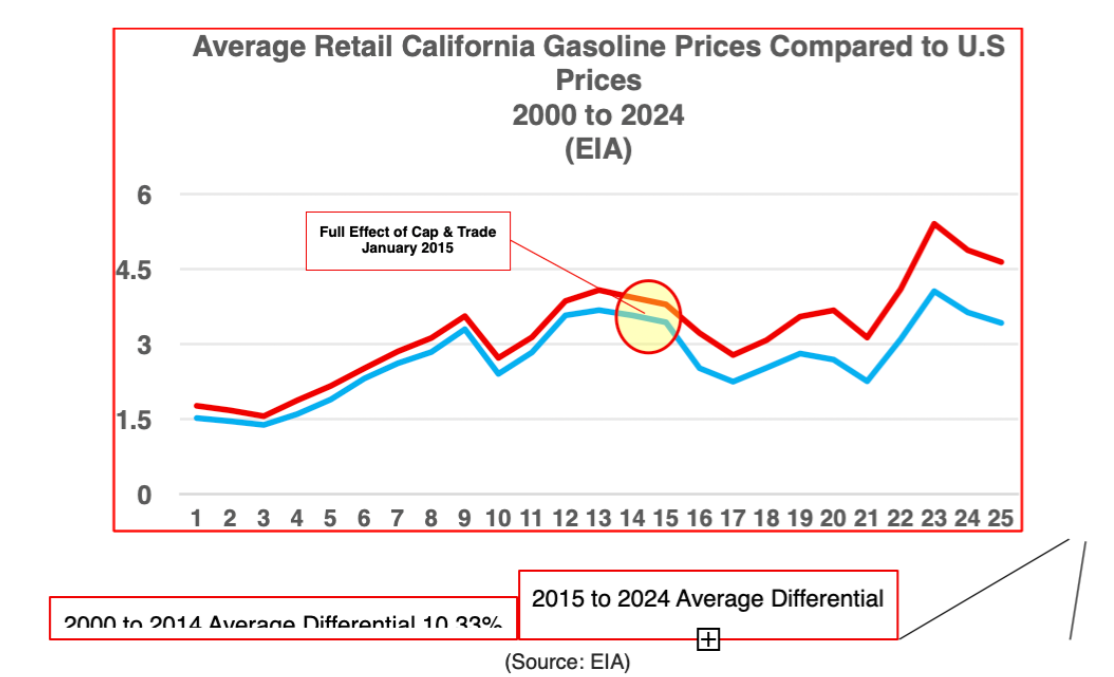
California consistently has the highest gasoline prices in the contiguous United States. The premium over the U.S. average has expanded significantly—from roughly $0.30/gallon in earlier periods (2005–2014) to $1.30/gallon or more in recent years.
The chart above (PG&E average vs. national average) illustrates the divergence clearly: national residential rates remained relatively stable around 16–17 cents/kWh for much of the period before modest recent increases, while PG&E rates climbed steadily and then surged sharply in recent years toward 35+ cents/kWh.Other analyses show California’s high transmission and distribution costs as a percentage of total electricity expenses compared to other regions, further widening the gap.
These policies prioritize decarbonization and renewables over affordability, resulting in Californians paying a significant premium for electricity.
Gasoline and Diesel: A Growing Premium Driven by Regulations
California consistently has the highest gasoline prices in the contiguous United States. The premium over the U.S. average has expanded significantly—from roughly $0.30/gallon in earlier periods (2005–2014) to $1.30/gallon or more in recent years.
The chart above highlights how the gap widened notably after the full implementation of Cap-and-Trade in 2015, with California prices pulling further ahead amid volatility.Key contributors under Newsom’s administration and prior policies include:
- High state taxes: Excise taxes (among the highest nationally, around 70+ cents/gallon combined with sales taxes).
- CARB reformulated gasoline requirements: Unique, costlier blends (especially summer formulations) that increase refining costs and limit supply flexibility.
- Cap-and-Trade (“Cap-and-Invest”): Adds an estimated $0.24/gallon or more to gasoline (and similar for diesel), with projections of higher impacts as allowance prices rise.
- Low Carbon Fuel Standard (LCFS): Requires refiners and fuel providers to meet declining carbon intensity targets, often by purchasing credits. Costs are passed to consumers; tightening targets and higher credit prices are expected to increase impacts significantly in the coming years (historical impacts modest but growing, with potential for 20–65+ cents/gallon or more in aggressive scenarios).
Diesel faces parallel pressures from LCFS and Cap-and-Trade, contributing to elevated prices relative to the rest of the U.S.Critics argue these represent regulatory overreach: they raise compliance costs, discourage new refining investment, and create an isolated California fuel market prone to price spikes, all while the state resists federal efforts to boost domestic production.
Jet Fuel and Broader Transportation Fuels
Similar carbon pricing and low-carbon mandates extend to aviation and other fuels. Cap-and-Trade covers jet fuel emissions in California, adding costs that flow through to airlines and ultimately passengers or freight. LCFS has provisions affecting alternative aviation fuels, further layering regulatory expenses.
Lawfare, Regulatory Overreach, and Costs Passed to Consumers
California’s strategy of aggressive litigation against federal policies (e.g., notices of intent to sue over wind fund reallocations and other actions) and layers of state regulations create ongoing legal and compliance burdens. Energy providers and refiners face uncertainty, higher operational costs, and the need to recover expenses—costs that are ultimately borne by consumers through higher electricity rates and fuel prices.
While the state positions itself as defending clean energy and climate goals against perceived federal interference, the domestic regulatory framework and legal battles add friction and expense without corresponding relief for ratepayers.
What Is at Play: Control or Planning a Narrative?
California’s energy policies reflect a deliberate push for state-level control over the energy mix, prioritizing aggressive decarbonization, renewable mandates, and carbon markets independent of federal direction. This asserts sovereignty and advances a specific vision of the energy future.
At the same time, the escalating “war” with the White House—through lawsuits, public statements, and framing of federal actions as attacks on clean energy—helps construct a political narrative. It portrays California as the climate leader resisting a fossil-fuel-friendly administration, rallying the environmental base, deflecting scrutiny from high domestic energy costs, and potentially advancing broader political positioning.
The tension between these elements is real: consumers pay the price for the regulatory apparatus and legal fights, whether the primary driver is genuine long-term planning for control or short-term narrative-building. Both can coexist, but the affordability impacts on electricity, gasoline, diesel, and jet fuel are measurable and significant.
California’s approach has delivered progress on emissions reductions and renewable deployment in some metrics. However, it has also produced some of the highest energy costs in the nation, with the burdens falling squarely on consumers and businesses as the state ramps up its confrontation with the White House.
Appendix: Links and Sources
- Original referenced article: The Escalating Energy War Between California and the White House – OilPrice.com (July 11, 2026)
oilprice.com
- EIA Electricity data and tables: EIA Electric Power Monthly, Electric Sales, Revenue, and Average Price
- EIA Gasoline/Diesel historical: EIA Petroleum Data
- API analysis on California gasoline premium: California’s gasoline price premium
- Kleinman Center / Penn analyses on LCFS impacts: Multiple reports on price effects and projections
- Energy Institute at Haas (UC Berkeley) charts and analysis on electricity rates and policy costs
- Additional context from CARB, CEC, Chevron statements on regulatory impacts, and related policy extensions of Cap-and-Trade and LCFS
Charts sourced from public analyses by the Energy Institute at Haas and related EIA-derived visualizations. Data current as of mid-2026 reporting periods.
The post California is ramping its war with the White House over Energy appeared first on Energy News Beat.