
Energy News Beat analysis — September 4, 2026
Treasury Secretary Scott Bessent told Steve Bannon’s War Room that once the Iran conflict is behind the market, crude can fall to $50 or even $40 because the world will be “very much oversupplied.” He tied that drop directly to bond yields, arguing the oil–rates correlation is now the tightest it has ever been.
WTI is near $91 and Brent above $95 as of this writing. That is the context. The question for operators, not talk-show guests, is whether $40 oil is a clearing price the physical market can actually live with — or a political signal meant to talk yields down.
The short answer: existing wells can survive $40 for a while. New U.S. shale wells cannot. Associated gas volumes cannot be held at current levels if oil-directed drilling collapses. Bessent is describing a possible overshoot, not a durable equilibrium.
What Bessent actually said
In the Bloomberg readout of the Bannon interview, Bessent said:
“We’re going to get on the other side of this Iran conflict, and I expect that oil will come down. We’re going to be very much oversupplied in the oil market after this. We can see $50, $40 crude maybe, just because there’s so much coming online.”
He is not inventing the supply list. Guyana is still ramping FPSOs. Brazil’s pre-salt is adding low-cost barrels. Canadian oil sands keep running. Iran’s barrels — sanctioned, unsanctioned, floating, or “jiu-jitsu’d” back onto the water — have been a recurring Treasury talking point all year. If Hormuz risk premia vanish and those streams hit the market together, a violent downside move is possible.
The problem is duration. Shale is not a tap you leave open at $40. It is a treadmill.
Will the United States lose more rigs?
Yes — if $40 is more than a two-week headline.
Baker Hughes put the U.S. count at 588 total rigs on September 4, 2026 (449 oil, 130 gas, 9 miscellaneous). That is up 51 from a year ago, with the Permian at 268. Oil-directed activity has recovered with war prices, not with $60 oil.
History is unambiguous. When WTI spent time in the $50s, operators dropped oil rigs by the dozens, cut frac spreads, and still saw production hold only because of longer laterals, DUC inventory, and efficiency gains. Those buffers are thinner now. Dallas Fed executives already say new-well economics sit in the mid-$60s. Private operators, who still swing a large share of the rig count, will park iron first.
Rystad has previously estimated U.S. output could fall on the order of 400,000 b/d if prices dip to $40. Other houses have floated larger declines under a sustained $50–$60 tape. The exact number is less important than the direction: growth dies first, then the decline curve takes the rest.
Permian associated gas is the hidden casualty. EIA has Permian gas running near 29 Bcf/d in 2026, mostly coming out of oil wells, not dry-gas wells. Haynesville can keep drilling if Henry Hub cooperates. Permian gas cannot if oil rigs leave. That is the sub-$50 problem the user flagged, and it is real. Data-center and LNG demand do not care that Waha already spent long stretches negative while WTI was high. Cut the oil program, and you cut the gas that rode along for free.
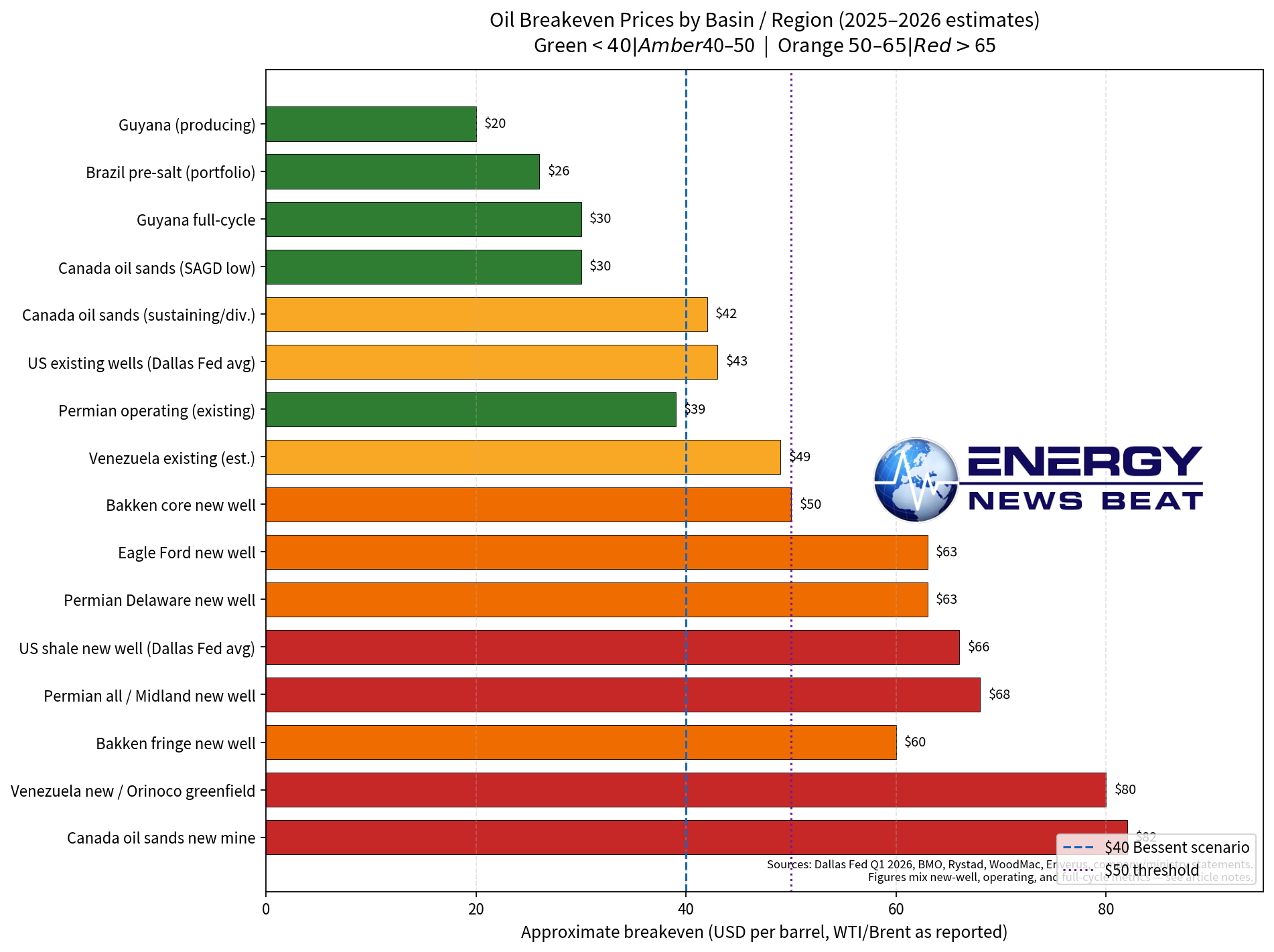
Breakeven prices: the chart that decides whether $40 is possible
Breakevens are not one number. There are at least three:
- Operating / half-cycle — keep an existing well flowing.
- New-well / drill-bit — profitably drill the next well.
- Full-cycle / corporate — land, overhead, dividends, and a return.
Bessent’s $40 sits below U.S. new-well economics and above a large slice of operating costs. That is why production does not vanish on day one and why it cannot be maintained on day 400.
|
Region / basin
|
Metric
|
Approx. breakeven (USD/bbl)
|
|---|---|---|
|
Guyana producing projects
|
Cost of supply / lifting
|
<$20 – $25
|
|
Guyana Stabroek full-cycle
|
Full-cycle / PSA
|
$25 – $36 (often cited ~$28–$30)
|
|
Brazil pre-salt / Petrobras portfolio
|
Project / portfolio
|
$25 – $35 (portfolio claims ~$25–$28)
|
|
Canada oil sands — best SAGD
|
Sustaining / half-cycle
|
<$40 (some facilities far lower)
|
|
Canada oil sands — big 5 sustaining + dividend
|
Corporate sustaining
|
$40.85 – $43.10 WTI
|
|
Canada oil sands — new mine
|
Greenfield full-cycle
|
$80+
|
|
U.S. existing wells (Dallas Fed Q1 2026)
|
Operating
|
$43 avg ($34–$47 by region; Permian ~$39; large firms ~$32)
|
|
U.S. new wells (Dallas Fed Q1 2026)
|
New-well profitable drill
|
$66 avg ($62–$70 by region)
|
|
Permian — all responses
|
New-well
|
$67
|
|
Permian Delaware
|
New-well
|
$63
|
|
Permian Midland
|
New-well (EIA / survey)
|
~$69
|
|
Eagle Ford
|
New-well
|
$63
|
|
Bakken / Williston
|
New-well
|
$40–$65 (core ~$45–$55; fringe ~$55–$60)
|
|
Venezuela existing / Orinoco operating
|
Full-cycle / operating est.
|
$42 – $56 (Orinoco ~$49)
|
|
Venezuela new / refurbished Orinoco
|
Greenfield
|
up to ~$80
|
|
Argentina Vaca Muerta
|
Cash / full-cycle range
|
~$40 – $70 depending on well and year
|
|
Colombia (Ecopetrol-type cash)
|
Cash + capex
|
mid-$50s in recent bank work
|
- Guyana and Brazilian pre-salt keep printing cash.
- Canadian oil sands existing operations mostly keep running and can still cover dividends at the BMO range. They do not sanction new mines.
- U.S. existing wells, especially large-cap Permian, can cover LOE. They stop drilling.
- U.S. private and non-core acreage shut in or go idle.
- Venezuela’s rusty system does not magically add 2 million b/d at $40. Existing barrels can move; greenfield Orinoco cannot.
- OPEC fiscal breakevens (Saudi often modeled near or above $80–$100 when spending is included) make a sustained $40 tape a political event in Riyadh, not just a Houston event.
Dallas Fed Q1 2026 is the cleanest U.S. survey: new-well $66, operating $43, Permian new-well $67, Delaware $63, Eagle Ford $63. Large firms can drill at $59. That is still not $40.
Sub-$50 oil and U.S. natural gas volumes
Haynesville and Appalachia are the swing dry-gas basins. They respond to Henry Hub, LNG feedgas, and power burn — not to WTI. They cannot fully replace a multi-Bcf/d hole in Permian associated gas on a short fuse, especially with takeaway already a chronic Permian headache. Dallas Fed Permian operators still list gas takeaway as a top constraint. Negative Waha pricing and well shut-ins happened while oil was high. They get worse if oil-directed activity is cut.
So the statement “sub-$50 oil means we cannot maintain natural gas volumes” is directionally correct for associated gas, overstated for the entire Lower 48 if dry-gas basins stay economic. The U.S. gas balance in a $40 oil world is tighter, not looser.
Is Bessent correct, or telegraphing the impossible?
- A war-premium unwind plus incremental non-OPEC supply (Guyana, Brazil, Canadian sustaining barrels, any Iranian/Venezuelan volume that actually sails) can smash the front month. Markets overshoot. $40 prints have happened before in glut psychology.
- Lower crude would pull gasoline and diesel, ease CPI, and give the Treasury a story for lower nominal yields. That is the point of saying it on Bannon’s show the same week 10-year yields are at multi-year highs. Bessent said the oil–yield correlation is the highest it has ever been. Treat that as policy communication.
Incorrect, or at least incomplete:
- $40 is not a price at which the United States maintains oil or associated-gas growth. It is a price at which the U.S. harvests existing wells and watches the decline curve work.
- “So much coming online” is not costless. The barrels that keep coming at $40 are the ones already built: oil sands sustaining, pre-salt FPSOs, Guyana FPSOs, Middle East swing if OPEC chooses not to defend. The barrels that do not come are the next 2 million-plus b/d of U.S. shale that must be drilled every year just to stand still.
- Venezuela is being talked about in Washington as a future flood. Wood Mackenzie and Rystad-style work still put new Orinoco barrels toward $80, not $40. Existing output can rise some; a 1990s-style revival at $40 is a press release, not a field development plan.
- OPEC will not sit on its hands at $40 for long if fiscal accounts blow out. A $40 print can be a washout. A $40 average is a different political economy.
The honest forecast is a two-stage path:
- If the Iran war ends cleanly, the risk premium dies, and the market can gap toward $50 and probe $40. Rigs fall. U.S. oil growth reverses. Associated gas flattens or drops. Yields can rally on the inflation print.
- If $40 persists, high-decline shale and underinvested non-OPEC supply tighten the balance again. The same officials celebrating $40 gasoline will be explaining $80 crude 12–18 months later.
That is not a conspiracy. It is the shale decline curve plus the cost stack in the table above.
Bottom line for Energy News Beat readers
- U.S. will lose oil rigs at $40. Not all of them, and not on Monday morning, but enough to matter.
- Existing U.S. wells break even near $43. New wells need ~$66. Permian Delaware is the best of a mid-$60s set.
- Canada’s oil sands are now the low-cost North American sustaining producer near $41–$43 WTI for the big five, with some SAGD lower.
- Guyana and Brazil pre-salt own the $25–$35 world. They are why a glut is even discussable.
- Venezuela and new oil-sands mines do not belong in a $40 supply thesis.
- Associated gas is the quiet casualty of cheap oil. Haynesville is not a perfect substitute on a short clock.
- Bessent can get the print. He cannot get the sustain. $40 is a washout price, not a U.S. energy-dominance operating price.
Oil and gas become like “Renewable Wind and Solar”. – Unsustainable. Why have oil and gas changed over the last 40 years? They have become more responsible, giving returns to investors, providing responsible drilling, and paying for well cleanup. The Wind, solar, and storage market does not have land reclamation, nor is it fiscally sustainable without subsidies.
Secretary Bessent is very talented, but he and President Trump need to read Energy News Beat or talk to boots on the ground before making statements like these.
At Energy News Beat, we Make Appendices Great Again.
Appendix: sources and linksBessent / prices/policy
- Bloomberg: “Bessent Sees Oil as Low as $40 Post-Iran War, Taking Yields Down” (Sept. 4, 2026) — https://www.bloomberg.com/news/articles/2026-09-04/bessent-sees-oil-as-low-as-40-post-iran-war-taking-yields-down
- Yahoo Finance / Bloomberg reprint — https://finance.yahoo.com/energy/articles/bessent-sees-oil-low-40-184252971.html
- NDTV Profit recap of Bannon interview — https://www.ndtvprofit.com/world/oil-could-fall-40-50-as-iran-conflict-ends-supply-surges-bessent-12003383
- CNBC, Aug. 20, 2026, Bessent on economic pressure vs. Iran — https://www.cnbc.com/2026/08/20/oil-prices-brent-wti-hormuz-trump.html
- NY Post, March 22, 2026, “escalate to de-escalate” / 50 days of higher prices — https://nypost.com/2026/03/22/us-news/scott-bessent-suggests-trump-may-escalate-to-de-escalate-iran-war/
U.S. shale breakevens
- Dallas Fed Energy Survey breakeven page (Q1 2026 charts / data download) — https://www.dallasfed.org/research/surveys/des/data/breakeven
- Dallas Fed Q1 2026 survey release language (new-well $66, operating $43, Permian $67) via contemporaneous write-ups — https://www.dallasfed.org/news/releases/2026/nr260624des
- Selborne Research summary of Dallas Fed Q1 2026 by play — https://selborneresearch.com/guides/oil-gas/shale-breakevens-by-basin/
- EIA Today in Energy on 2026 gas production and Permian Midland $69 / Delaware $63 — https://www.eia.gov/todayinenergy/detail.php?id=67944
- Statista compilation of Dallas Fed field breakevens — https://www.statista.com/statistics/748207/breakeven-prices-for-us-oil-producers-by-oilfield/
- North Dakota DMR / Bakken range $40–$65 — https://www.tradingview.com/news/reuters.com%2C2025:newsml_L1N3W50LP:0-north-dakota-oil-output-likely-up-in-september-but-set-for-long-term-downtrend-regulator-says/
- Novi Labs / Ovintiv Midland inventory breakeven example (~$54 median NPV25) — https://novilabs.com/blog/ovintiv-goes-lean-in-the-midland-54-bbl-breakevens-and-a-14-year-runway/
Rigs and production response
- Baker Hughes / OilPrice.com U.S. rig count Sept. 4, 2026 (588 total; 449 oil; Permian 268) — https://oilprice.com/Energy/Crude-Oil/US-Oil-Rig-Count-Rises-as-Gas-Rig-Activity-Declines.html
- Oil & Gas 360 Baker Hughes basin table — https://www.oilandgas360.com/baker-hughes-rig-count-9-4/
- Hart Energy / Reuters: Rystad on ~400 kb/d U.S. drop at $40 — https://www.hartenergy.com/energy-market-transactions/he-us-production-fall-crude-40bbl/
- Wood Mackenzie on U.S. tight-oil stall when prices sag — https://www.woodmac.com/blogs/energy-pulse/us-oil-production-growth-is-stalling/
Canada oil sands
- OilPrice.com / Enverus / BMO: oil sands lowest-cost North American sustaining producer; big-five $40.85–$43.10 WTI — https://oilprice.com/Energy/Crude-Oil/How-the-Oil-Sands-Became-the-Lowest-Cost-North-American-Producer.html
- Oil & Gas 360 / BOE Report on SAGD below $40 vs Permian ~$65 — https://www.oilandgas360.com/lower-costs-see-oil-sands-emerge-as-one-of-north-americas-most-attractive-plays/
- Discovery Alert synthesis of BMO and facility-level SAGD costs — https://discoveryalert.com/canadian-oil-sands-lowest-cost-producer-shale-breakeven/
Guyana
- OilPrice.com on Stabroek ~$30 and 2% royalty — https://oilprice.com/Energy/Crude-Oil/The-30-Barrel-Break-Even-Project-Driving-Exxons-Success.html
- Reuters: Guyana $25–$35 range — https://www.reuters.com/business/energy/tiny-guyana-poised-big-iran-oil-gains-growth-strains-2026-05-30/
- Rystad via Kaieteur News: producing projects <$20; average ~$28 — https://kaieteurnewsonline.com/2025/01/13/exxons-oil-projects-in-operation-costing-less-than-us20-per-barrel-to-produce-rystad-energy/
- Rigzone Guyana snapshot, full-cycle ~$25–$35 — https://www.rigzone.com/insights/global-industry-insights-7/what-makes-guyana-a-rising-star-in-offshore-oil-production-886
Venezuela and broader South America
- OilPrice.com on Venezuela $42–$56 existing / Orinoco ~$49 / new ~$80 — https://oilprice.com/Energy/Energy-General/Can-Foreign-Investment-Save-Venezuelas-Broken-Oil-Sector.html
- Wood Mackenzie via Upstream: operational improvements needed; up to $80 — https://www.upstreamonline.com/production/operational-improvements-required-to-lower-oil-breakeven-costs-in-venezuela-wood-mackenzie/2-1-1925970
- BNEF / BloombergNEF note citing Guyana ~$35, Permian Midland ~$48, Venezuela 2020 Rystad $42–$56 — https://about.bnef.com/insights/commodities/venezuelas-oil-renaissance-faces-several-high-hurdles/
- The National, Sept. 4, 2026: slow Venezuela ramp, infrastructure lag — https://www.thenationalnews.com/business/energy/2026/09/04/us-100bn-venezuela-oil-bet-faces-years-long-wait/
Brazil pre-salt
- OilPrice.com: Buzios <$35; Petrobras portfolio ~$25; pre-salt $30–$40 — https://oilprice.com/Energy/Energy-General/Brazils-Record-Oil-Production-Comes-at-a-Crucial-Moment-for-Global-Markets.html
- Petrobras plan materials / filings on low project breakevens (~$25 underwriting)
- Pré-Sal Petróleo OTC Houston 2026 deck: pre-salt breakeven ~$35 — https://www.presalpetroleo.gov.br/wp-content/uploads/2026/05/PPT_OTC_Houston_2026_att.pdf
Associated gas
- EIA: rising gas share in tight-oil plays — https://www.oilfieldtechnology.com/drilling-and-production/01112024/eia-share-of-natural-gas-production-in-us-tight-oil-plays-increased-over-the-last-decade/
- Bloomberg / TT: Permian gas shut-ins despite high oil, negative Waha — https://www.ttnews.com/articles/texas-gas-drillers-wells
- EIA STEO pages — https://www.eia.gov/outlooks/steo/
Global cost-curve context
- Wood Mackenzie, “Global oil cost curves and pre-FID breakevens – H1 2026” — https://www.woodmac.com/reports/oil-markets-global-oil-cost-curves-and-pre-fid-breakevens-h1-2026-150495725
Note: Breakeven figures mix survey answers (Dallas Fed), bank sustaining-cash models (BMO), consultant full-cycle NPVs (Rystad, Wood Mackenzie, Enverus), and company/ministry statements. They are not perfectly comparable. That is the point of showing ranges rather than a single false-precision number.
The post Bessent Sees Oil as Low as $40 Post Iran War, Lower Yields appeared first on Energy News Beat.