
That is not a talking point. It is the arithmetic of an integrated energy market that Ottawa cannot wish away, and Washington already understands.
Smith’s warning, circulating widely after her CBC Power & Politics appearance and a clip posted by Stephen Taylor, is blunt: Alberta businesses will be hurt more by Canada’s own counter-tariffs than by the U.S. levies now on the table.
A provincial assessment by Jobs Minister Joseph Schow’s office, using a five-year average, put the incoming hit at about $4.8 billion of U.S. materials and goods — roughly 11.1 percent of Alberta’s American imports. The outbound hit from the new U.S. 50 percent tariffs is about $1.5 billion, concentrated in furniture, honey, and other non-energy products. Oil, gas, and cattle — the core of Alberta’s export machine — were largely left off the latest U.S. list.
That is why Smith keeps saying retaliation feels good and still raises costs for the people buying steel, appliances, dairy, and farm equipment. She is urging Ottawa to get back to the table before the Canadian counter-tariffs take effect on September 8.
The trade map is not symmetrical
Canada still sells most of what it makes to one customer. Congressional Research Service data show Canada exported 72 percent of its goods to the United States in 2025 and imported 46 percent of its goods from the United States. BMO Economics put the 2025 U.S. share of Canadian merchandise exports at 71.7 percent, and as low as 67.4 percent in December after firms diverted some cargo. The “70 percent” figure is directionally right.
The U.S. relationship is large on both sides — about $880 billion in goods and services in 2025 — but Canada is more exposed. Energy is the reason the merchandise ledger looks the way it does. The U.S. Energy Information Administration reported $111 billion in U.S. energy imports from Canada in 2025 versus $26 billion in U.S. energy exports to Canada. Canadian Energy Regulator-linked tallies put Canadian hydrocarbon shipments to the U.S. near C$157.5 billion and Canadian hydrocarbon imports from the U.S. near C$34.4 billion. Energy more than accounts for the U.S. goods deficit with Canada. Strip energy out and the surplus story flips.
Alberta’s numbers make the point even sharper. The province exported $151.5 billion of goods to the United States in 2025. Crude petroleum was $110.8 billion, or 73 percent of that total. Smith has said only about 3 percent of Alberta’s U.S.-bound exports sit under the newest tariff list. That is why Alberta looks “spared” in the headlines and still lives inside the blast radius if the fight spreads to energy.
Oil and gas are the real leverage — both ways
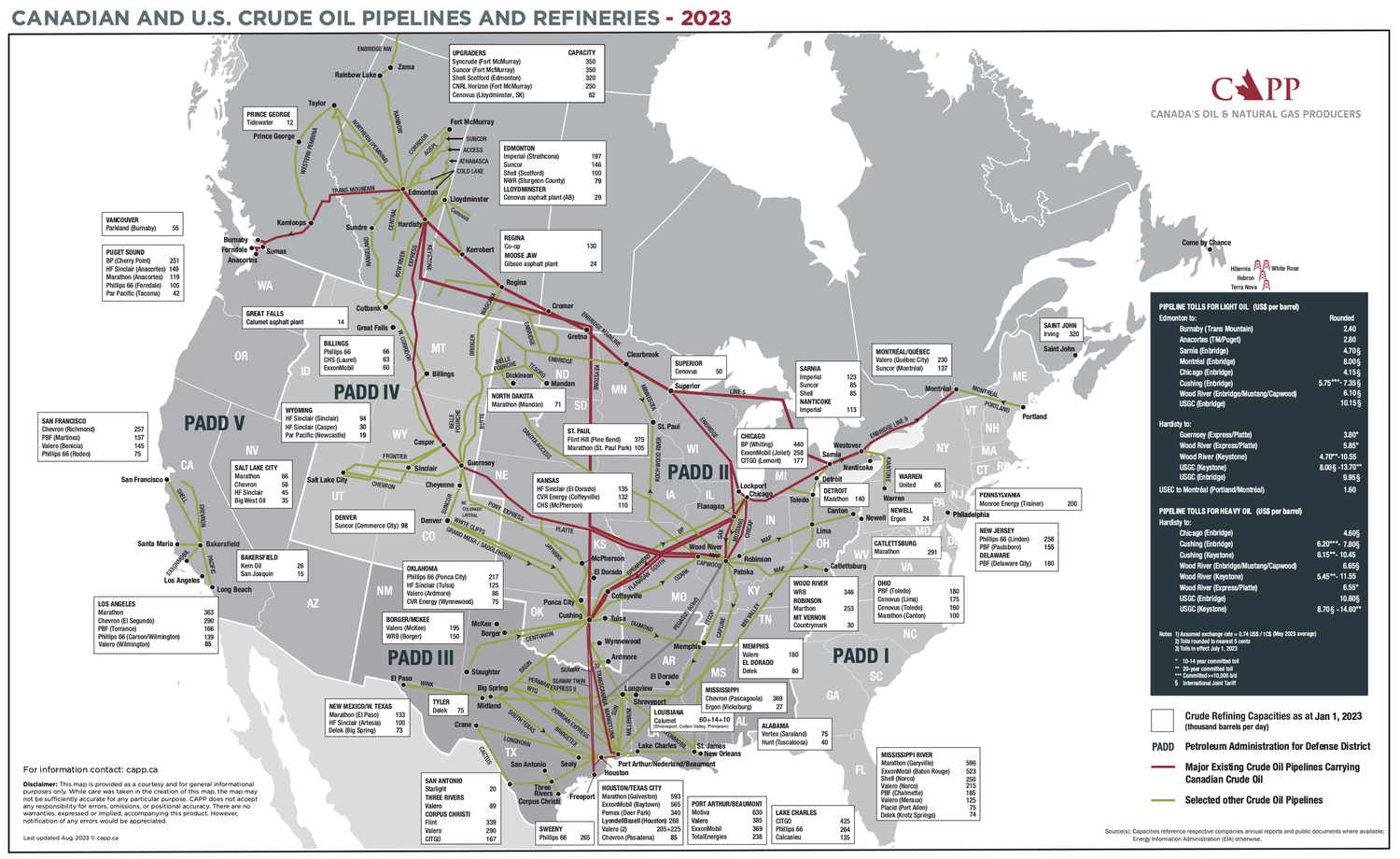
The United States imported an average of 3.9 million barrels per day of Canadian crude in 2025, about 4 percent below 2024 as Trans Mountain moved more barrels to the Pacific. Canada still supplied about 60 to 64 percent of U.S. crude imports by volume. Recent weekly EIA readings have run from the mid-3 million to more than 4 million b/d. Canadian crude exports overall have been running near 4.4 million b/d. Roughly 89 to 90 percent of Canadian crude still goes to the United States, down from about 95 percent before TMX.
The pipeline does not run only south. The United States shipped about 383,000 b/d of crude to Canada in 2025. Canada imported about 506,000 b/d of crude in total, with the U.S. supplying around 73 percent. Eastern Canada also buys large volumes of U.S. gasoline, diesel, and natural gas. Canada exported about 8.6 billion cubic feet per day of pipeline gas to the United States in 2025 — virtually all U.S. gas imports — but that is only about 8 percent of U.S. consumption. Ontario and Quebec, meanwhile, have grown more dependent on U.S. gas because moving western Canadian gas east on the Canadian Mainline is often more expensive. Some Canadian crude is refined in the Midwest and Gulf and comes back north as product. The two systems are one machine.
Smith’s job math follows from that machine. She has said a 50 percent Canadian export tax on the roughly 4 million barrels a day moving south would invite a 50 to 100 percent U.S. response on oil, gas, diesel, and gasoline heading into Ontario and Quebec. Her estimate: at least half a million jobs gone, mostly in Alberta, plus hundreds of thousands in central Canada if fuel and feedstock seize up. That is a political number, not a Statistics Canada table. It is also the reason energy analysts keep repeating the same sentence: once you put oil on the table, you may not get the customer back.
Venezuela is the hedge Washington is already using
Smith’s other warning is no longer theoretical. U.S. refiners have been lifting the most Venezuelan crude in years. Bloomberg reported July cargoes on pace for about 804,000 b/d. Weekly EIA data through August 21, 2026 put Venezuela at 662,000 b/d that week and second place among U.S. crude suppliers for 18 straight weeks, averaging about 575,000 b/d over that stretch. Canada remained first, at 3.53 million b/d that week and about 3.79 million b/d over the same run.
Analysts are not saying Venezuelan barrels replace Alberta tomorrow. They are saying the Gulf Coast is the vulnerable slice. The Globe and Mail estimated that only Canadian oil sold into the Gulf — about 10 percent of exports, or roughly 350,000 b/d — is exposed in the short term. Even a full Gulf Coast switch would be on the order of US$15 billion, or about 2 percent of Canadian exports. Midwest refiners are wired to Canadian pipelines. That is harder to unwind. Energy Intelligence has described the current phase as addition more than substitution: more heavy barrels in the system, weaker Canadian differentials, not an overnight eviction.
The longer-term risk is different. Venezuela and Canada produce similar heavy crude. U.S. Gulf Coast cokers were built for it. If Washington keeps easing Venezuelan flows and companies put real capital back into those fields, Canada’s pricing power in PADD 3 erodes. Rory Johnston of Commodity Context has said the durable answer is optionality: pipes that do not only point at the United States. Smith’s version of the same point is darker. If Canada taxes or cuts oil, she argues, U.S. refiners will look to Venezuela, reverse more northbound product flows, and Canada loses the account “likely forever.”
What analysts are actually saying
The commentariat is split on tactics, not on dependence.
Rod D. Martin’s argument, in a long discussion posted this week, is that Canada has no near-term Plan B and that “China is just a bluff.” Mark Carney and Doug Ford cannot replace the American market on a political timetable, and they cannot escape what Martin calls Ottawa’s self-inflicted energy trap. Trump, in that telling, already knows the leverage. The clip is advocacy, not a forecast model. The trade data do not contradict the core claim: Asia volumes are rising off a tiny base, TMX helped, and the U.S. is still the buyer of last resort for most barrels and almost all pipeline gas.
Energy-market writers have been more measured and more consistent. David Blackmon in Forbes called cross-border crude an “absolute imperative” for both sides. Industrial Info and EIA notes keep repeating that energy was carved out of the latest tariff packages for a reason: U.S. complex refiners need Canadian heavy crude, and Canada has nowhere else to put most of it this year. Taylor MacPherson of the Montreal Economic Institute has pointed to the same integration as the reason oil and gas were treated differently from steel and furniture. CBC’s fact-check on natural gas made the leverage point the other way: Canada supplies nearly all U.S. imports of gas, not 8 percent of U.S. demand. Cutting gas would hurt regional U.S. markets. It would not shut the American economy.
On Venezuela, Larry Hughes and other policy writers have argued that a rebuilt Venezuelan heavy-oil stream is a structural risk to Canada’s Gulf Coast share and a reason to build westbound and eastbound capacity now, not after the barrels are already gone. Carbon Tracker’s more skeptical line is that new Canadian oil and LNG projects carry transition and price risk even if geopolitics argue for them. Those two views can both be true: diversification is insurance, and insurance is not free.
Options for Canada
1. Get back to the table before September 8. Smith’s preferred path is de-escalation and a deal that lowers tariffs rather than matching them. The federal counter-package is $27.6 billion of U.S. goods. Once it lands, every importer of U.S. intermediate goods becomes a domestic lobby against Ottawa’s own list.
2. Do not weaponize oil and gas. Smith has ruled out an oil export tax. Using energy as a bargaining chip invites U.S. tariffs on the refined products and gas that Ontario and Quebec actually burn, and it advertises Canadian barrels as unreliable. Ford and some former Alberta premiers want the card on the table. The energy math is with Smith.
3. Build real optionality, not slogans. TMX already cut the U.S. share of Canadian crude exports from about 95 percent to about 89 percent. Ottawa and Alberta have discussed a new Pacific line on the order of 1 million b/d. LNG Canada is shipping. More LNG and a possible eastbound crude corridor would change the bargaining set in the 2030s, not next month. Europe gas deals and Asian crude cargoes are useful. They are not a substitute for 3.9 million b/d into U.S. refineries.
4. Fix the home market. Interprovincial trade barriers, “buy Canadian” procurement, and relief for firms caught on imported U.S. inputs are the parts of the file Canada controls. Smith has also argued diplomacy with governors and members of Congress beats a contest of brute force.5. Accept the limit Rod Martin named. China is a customer for some TMX barrels.
It is not a replacement for the Midwest refining complex. Talking as if it is one is how a country walks into a tariff war with no off-ramp.
Options for the United States
1. Keep energy off the tariff wall. Washington already did this in the latest 50 percent tranche, which covers only about 5 percent of Canadian exports to the U.S. Midwest refiners cannot retool overnight. A crude shock would raise U.S. product prices just as diesel margins have been strong.
2. Use Venezuela as insurance, not as a full substitute. Gulf Coast plants can swing some heavy barrels. That disciplines Canadian differentials and gives Trump a talking point. It does not replace 3.5-plus million b/d of pipeline-connected Canadian crude into PADD 2.
3. Play the structural advantage. Canada needs the U.S. market more than the U.S. needs any single Canadian non-energy export category now under tariff. That is why last-minute U.S. demands in the talks included limits on Canada’s other trade deals — and why Carney walked. CRS notes those talks collapsed in August and the U.S. then used Section 338, a rarely invoked statute, to hit selected Canadian goods.
4. Deepen the energy relationship instead of breaking it. Canadian gas already supports U.S. LNG export capacity and data-center power demand. A commercial settlement that keeps heavy crude flowing, expands takeaway, and stops using farmers and furniture makers as hostages would be the rational U.S. energy policy. Rational is not always the policy that gets announced.
The bottom line
Smith is not asking Canadians to like the U.S. terms. She called them untenable. She is asking them to count. One-point-five billion dollars of Alberta exports are in the U.S. crosshairs. Four-point-eight billion dollars of Alberta’s own supply chain sits under Ottawa’s reply. Four million barrels a day and 8.6 Bcf of gas still define the relationship. Venezuela can nibble the Gulf Coast. It cannot, this year, replace the Canadian barrel in the Midwest.
Trade wars are easy to start when you sell 70 percent of your goods to one market and import a smaller, but still critical, stream of fuel and equipment the other way. They are hard to win when the commodity that pays the bills is the one you cannot afford to put on the table.
My 2 cents: It seems the Alberta Premier Danielle Smith is the only adult Canadian in the room. I hope they pursue independence and become their own country. Invite the US to have several military bases and charge huge rent for them, and re-negotiate higher oil prices for Albertans for longer stability and look west for other pipelines. Let Mark Carney destroy the remaining part of Canada and follow the UK and the EU into deindustrialization through Net Zero in the “New World Order” that I want nothing to do with. (Mark Carney loves the “New World Order”)
Appendix: sources and linksX posts referenced
- Stephen Taylor, Aug. 28, 2026 — Danielle Smith on $1.5B vs $4.8B: https://x.com/stephen_taylor/status/2093446729815195919
- Rod D. Martin, Aug. 28, 2026 — “Canada Has No Plan B, and China Is Just a Bluff”: https://x.com/RodDMartin/status/2093397709847683120
Smith statements and Alberta numbers
- CBC News, “Alberta premier urges return to trade talks”: https://www.cbc.ca/news/canada/edmonton/alberta-premier-tariffs-reaction-9.7317230
- Edmonton Journal, “Smith admits U.S. demands were ‘too painful’”: https://edmontonjournal.com/news/politics/smith-carney-u-s-retaliatory-tariffs
- The Hub, “Smith rules out oil export tax… $4.8 billion”: https://thehub.ca/2026/08/26/smith-rules-out-oil-export-tax-as-ottawa-unveils-28-billion-in-counter-tariffs/
- The Globe and Mail, premiers and Smith on retaliation: https://www.theglobeandmail.com/canada/alberta/article-as-premiers-rally-behind-carney-in-trade-dispute-albertas-smith/
- Yahoo Finance / Canadian Press, $4.8B import exposure: https://ca.finance.yahoo.com/news/albertas-smith-wants-ottawa-resume-191928466.html
- CTV Edmonton, Smith on $1.5B and diplomacy: https://www.ctvnews.ca/edmonton/article/albertas-smith-urges-de-escalation-of-trade-war-holding-out-hope-for-us-tariff-reversal/
- Edmonton Journal, Grande Prairie / half-million jobs: https://edmontonjournal.com/news/alberta-premier-talks-us-tariff-tussle-oil-gas-export-tax-grande-prairie-visit
- Western Standard, Smith on oil export tax: https://www.westernstandard.news/alberta/smith-says-cutting-or-taxing-oil-exports-to-the-us-would-be-a-disastorous-decision/76374
- CBC, “doubles down on diplomacy”: https://www.cbc.ca/news/canada/edmonton/premier-smith-august-tariff-update-9.7321681
- Edmonton Journal, energy expert backing Smith: https://edmontonjournal.com/news/politics/us-trade-war-premier-smith-carney-oil-exports
Trade structure and energy volumes
- CRS, U.S.-Canada Trade Relations (updated Aug. 28, 2026): https://www.congress.gov/crs-product/IF12595
- EIA, “Lower crude oil prices reduced U.S.-Canada energy trade value in 2025”: https://www.eia.gov/todayinenergy/detail.php?id=67904
- CAPP, Exports & Imports: https://www.capp.ca/en/data-hub/exports-imports/
- EnergyNow, “The Other Side of the Pipeline”: https://energynow.ca/2026/08/the-other-side-of-the-pipeline-canada-needs-u-s-oil-and-gas-too/
- BMO Economics, “Tale of the Trade Tape”: https://economics.bmo.com/en/publications/detail/3710eb52-a3de-41e1-9af2-1004643b1a03/
- Trading Economics, Canada exports to United States: https://tradingeconomics.com/canada/exports/united-states
- OEC, crude petroleum / Canada: https://oec.world/en/profile/bilateral-product/crude-petroleum/reporter/can
- USAFacts, U.S.-Canada trade charts: https://usafacts.org/articles/us-canada-trade-history-in-six-charts/
- Prime Minister of Canada, Carney remarks Aug. 22, 2026: https://www.pm.gc.ca/en/news/speeches/2026/08/22/prime-minister-carney-delivers-remarks-canada-us-trade-negotiations
- Associated Press / TT, Canada supplies ~4 million b/d: https://www.ttnews.com/articles/us-canada-fuel-pickup-trucks
- Yahoo Finance, oil left off the tariff list: https://finance.yahoo.com/energy/article/in-us-canada-trade-spat-washington-left-out-a-key-lever-canadian-oil-090000999.html
- CBC, natural gas leverage fact-check: https://www.cbc.ca/news/world/trade-war-natural-gas-9.7321566
- Forbes, David Blackmon on oil trade: https://www.forbes.com/sites/davidblackmon/2026/08/25/a-uscanada-trade-war-would-bring-dire-impacts-on-oil-trade/
- Industrial Info, energy spared / energy war risk: https://www.industrialinfo.com/iirenergy/industry-news/article/energy-spared-in-us-canadian-trade-war–361843
- The Logic, Alberta tariff exposure: https://thelogic.co/news/analysis/alberta-lower-tariff-impact/
Venezuela and heavy-oil competition
- Bloomberg, U.S. fuelmakers tap Venezuela: https://www.bloomberg.com/news/articles/2026-07-22/us-fuelmakers-tap-venezuela-oil-to-hedge-canada-wildfire-risk
- Rio Times, Venezuela second U.S. crude source for 18 weeks: https://www.riotimesonline.com/venezuela-second-us-crude-supplier-18-weeks-2026/
- Globe and Mail, “Venezuelan oil affects Canada only a little”: https://www.theglobeandmail.com/business/commentary/article-venezuela-oil-canada-trump-maduro-alberta-carney-smith/
- Globe and Mail, Venezuelan oil reset risk: https://www.theglobeandmail.com/business/commentary/article-venezuela-oil-reset-maduro-canada-markets-crude-exports/
- New York Times, revival of Venezuela’s oil industry: https://www.nytimes.com/2026/01/05/world/americas/venezuela-oil-industry-canada.html
- Policy Options, Hughes on Canadian heavy crude risk: https://policyoptions.irpp.org/2026/01/venezuela-oil-seizure-canada-impact/
- Energy Intelligence, Venezuela and Canada’s Gulf Coast bias: https://www.energyintel.com/0000019b-c255-db06-a1bf-f677aa490000
- AP News, Venezuela oil reserves explainer: https://apnews.com/projects/venezuela-oil-exports-explainer/
Canadian options / diversification
- Globe and Mail, Asia and LNG diversification: https://www.theglobeandmail.com/business/article-asia-crucial-to-canadas-diversification-from-us-energy-industry-report/
- The National Interest, pipeline strategy under U.S. tension: https://nationalinterest.org/blog/energy-world/how-us-canada-tensions-are-driving-canadas-oil-and-gas-pipeline-strategy
- Boston Globe, energy deals with Europe: https://www.bostonglobe.com/2026/07/29/business/canadas-answer-to-trumps-tariffs-more-energy-deals-with-europe/
- RBC Thought Leadership, commodity deal with the U.S.: https://www.rbc.com/en/thought-leadership/geopolitics-trade-and-the-economy/resourceful-how-canada-can-strike-a-new-commodity-deal-with-the-u-s-and-others/
- IEDM/MEI, North American energy integration: https://www.iedm.org/canadas-energy-future-lies-in-deeper-north-american-integration/
- Carbon Tracker, “What energy world is Canada betting on?”: https://carbontracker.org/what-energy-world-is-canada-betting-on/
- Financial Post, more Canadian gas to U.S. Gulf Coast LNG: https://financialpost.com/commodities/energy/oil-gas/canada-shipping-gas-us-gulf-coast-lng-exports
Related video
- CBC Power & Politics, “Retaliatory tariffs will hurt Alberta: Premier Smith”: https://www.youtube.com/watch?v=U4jNU69IpBk
The post Alberta Premier Danielle Smith is spot on: the new American tariffs will affect $1.5 billion of Alberta goods. The new Canadian counter-tariffs will affect $4.8 billion of the provincial economy. appeared first on Energy News Beat.