On October 28, 2026, the U.S. Department of Energy’s Office of Energy Dominance Financing closed a $5.1 billion, 30-year loan package to Alliant Energy subsidiaries serving Iowa and Wisconsin. The financing supports new natural gas generation, energy storage, and upgrades that will add more than 2.6 GW of firm or upgraded capacity—enough to power the equivalent of nearly 2 million homes—while projecting more than $1 billion (and up to $1.2 billion) in cumulative electricity cost savings for customers.Energy
This is the Trump administration’s tenth financial close under the Energy Dominance Financing Program and advances the executive order focused on grid reliability and security amid rising demand from data centers, manufacturing, and electrification.Energy
What the Money Funds
Alliant’s operating companies can access the funds (roughly $3.5 billion for Interstate Power and Light in Iowa and $1.63 billion for Wisconsin Power and Light):
- ~1.6 GW of new natural gas-fired generation
- 240 MW of capacity increases at existing natural gas units
- ~1 GW of battery energy storage systems
- 2 billion cubic feet of liquefied natural gas storage
These are firm, dispatchable resources plus flexible storage. The lower-cost federal financing (Treasury rates plus a modest 37.5 basis-point spread, with principal deferred for years) is expected to reduce Alliant’s interest expense by tens of millions annually, savings that flow through to ratepayers under regulated utility models. Construction is projected to support more than 1,600 local jobs.Investors.alliantenergy
Current Energy Mixes: Iowa and Wisconsin
The states have very different generation profiles, which helps explain why adding firm gas capacity and storage makes practical sense.
Iowa (2025 utility-scale generation, EIA/IUC data): Wind dominates at roughly 58–59%, followed by coal (~25–26%), natural gas (~12%), with small shares of solar (~1.7%), hydro (~1.5%), and other. Iowa is a major wind exporter and has seen coal’s share rise modestly in 2025 as demand grew faster than new renewable additions in some periods.Iuc.iowa
Wisconsin (2025 utility-scale generation): Natural gas (~35–36%) and coal (~35%) lead, followed by nuclear (~15%, primarily Point Beach), solar (~6%), hydro (~3%), wind (~3%), and biomass (~1.8%). Wisconsin is a net importer of electricity and has shifted heavily from coal toward gas while growing solar.Wikipedia
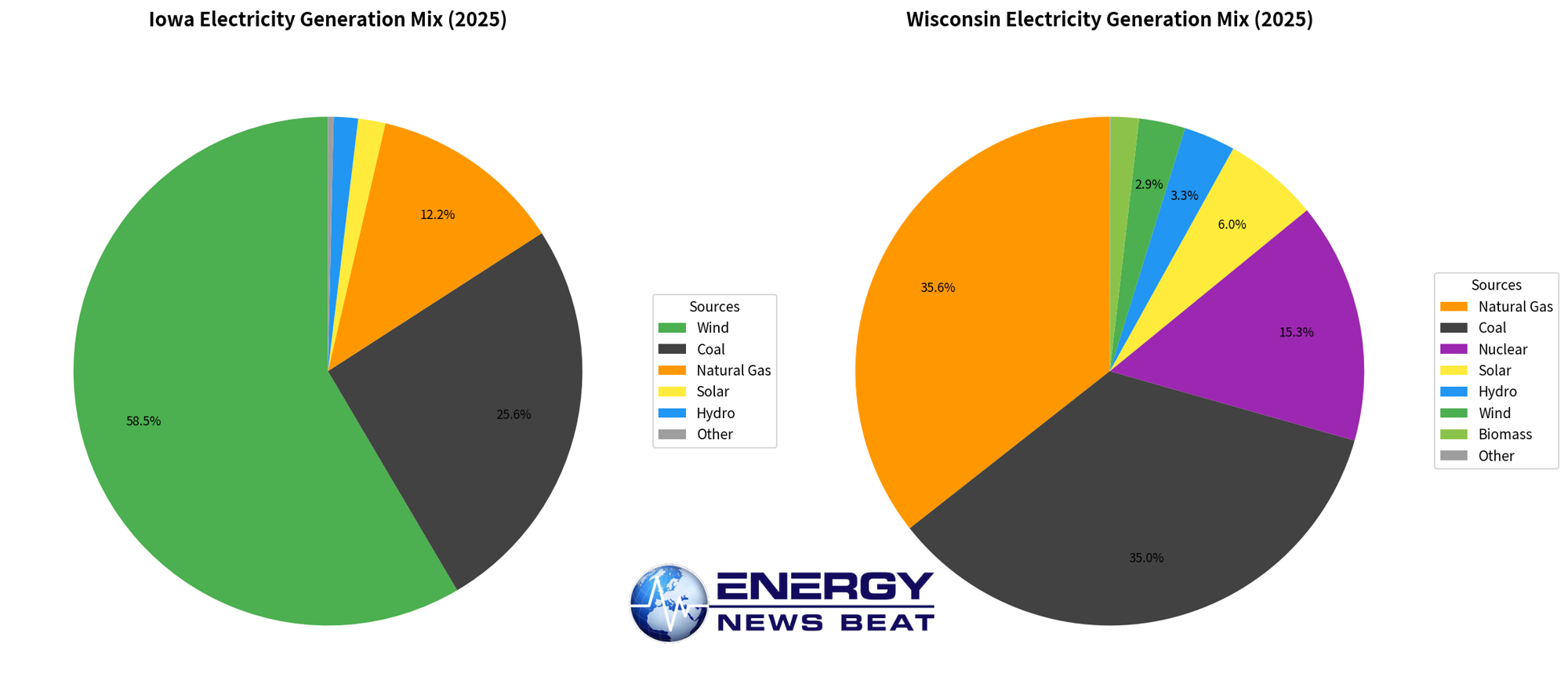
These mixes highlight the reliability challenge: high wind penetration in Iowa is valuable but variable; Wisconsin’s coal-and-gas base plus nuclear provides steadier output but faces rising demand and aging infrastructure. Battery storage and additional firm gas capacity help integrate intermittent resources, cover peaks, and reduce reliance on more expensive or constrained peaking plants.
How This Benefits Consumers
- Lower costs: The core promise is more than $1 billion (Alliant projects up to $1.2 billion) in cumulative savings over the 30-year life of the loans. Lower financing costs mean less interest that must be recovered in rates. Alliant has indicated roughly $800 million in potential Iowa customer savings and $400 million in Wisconsin if the full package is drawn.Kcrg
- Reliability and capacity: Adding dispatchable generation and storage addresses growing load. Firm power reduces the risk of shortages or high-priced emergency purchases during extreme weather or high-demand periods.
- Rate stability: In regulated markets, prudent capital investment with favorable financing supports gradual, predictable rate recovery rather than sharp increases to fund the same projects with more expensive private capital.
- Local economic activity: Construction jobs and longer-term plant operations support communities in both states.
U.S. average is roughly 18.2–18.3¢/kWh in recent monthly data.
Iowa and Wisconsin comparison
Key takeaways:
- Iowa is one of the more affordable states. Recent monthly figures put it in the mid-to-low 20s ranking nationally (cheaper side), well under the national average and dramatically below the high-cost coastal/New England and Hawaii/California group.
- Wisconsin sits closer to the middle-to-upper-middle of the pack—slightly above the U.S. average but nowhere near the top 10. It is more expensive than Iowa but still roughly half the cost of states like Hawaii, California, or Maine.
- Both states remain far more affordable for residential customers than the highest-cost markets, where rates are driven by factors such as high fuel costs (Hawaii), heavy regulatory costs and renewables mandates (California), or constrained supply/transmission in New England.
These are statewide average residential rates from EIA data. Actual bills vary by utility, usage, fixed charges, and local taxes. The $5.1 billion Alliant financing is intended to help keep rates lower over time in both states by reducing financing costs for new generation and storage.
How This Benefits Investors
Alliant Energy (NASDAQ: LNT) is a regulated electric and gas utility serving roughly 1 million electric customers across the two states. Its market capitalization is approximately $18 billion. Access to long-term, low-cost government-backed capital:
- Supports a larger rate base as new assets are placed in service, which is the primary driver of earnings growth for regulated utilities.
- Improves the company’s ability to fund a multi-year capital plan (recent company commentary has referenced elevated capex in the teens of billions) without proportionally higher equity issuance or more expensive debt.
- Provides earnings visibility. Analysts generally rate LNT a Buy with price targets modestly above recent levels; the utility has delivered solid total returns and maintains a dividend yield around 3%.
For equity investors, successful deployment of this capital at allowed returns strengthens the investment case. Bondholders benefit from the enhanced credit profile and long-term fixed-rate funding. As with all utility investments, outcomes still depend on state regulatory treatment of the projects, actual construction costs, load growth, and fuel prices.
Bottom Line
The $5.1 billion package is a practical response to real-world grid conditions in Iowa and Wisconsin: high renewable penetration alongside continued reliance on coal and gas, rising demand, and the need for affordable, reliable power. By pairing new firm generation and storage with cheaper long-term financing, the deal is structured to deliver measurable customer savings while giving Alliant the capital to expand its regulated rate base. Execution risk remains—projects still require permits, interconnection, and regulatory approval—but the financing close itself removes a major capital constraint.
Appendix: Sources and Links
- DOE announcement: https://www.energy.gov/articles/energy-department-closes-51-billion-loan-lower-electricity-costs-and-strengthen-grid
- Alliant Energy press release: https://investors.alliantenergy.com/News–Presentations/news/news-details/2026/Alliant-Energy-Projects-up-to-1-2-Billion-in-Customer-Savings-With-5-1-Billion-Loan-Package/default.aspx
- DOE project page: https://www.energy.gov/edf/alliant
- Reuters coverage: https://www.reuters.com/world/us-closes-51-billion-loan-alliant-energy-new-gas-power-generation-energy-storage-2026-10-28/
- Iowa generation data (Iowa Utilities Commission / EIA 2025): https://iuc.iowa.gov/regulated-industries/electric/iowas-electric-profile
- Wisconsin generation summary (Wikipedia compilation of EIA 2025 data): https://en.wikipedia.org/wiki/List_of_power_stations_in_Wisconsin
- Additional context on loan structure and Biden-era origins: https://reason.com/2026/10/28/trump-hands-alliant-energy-5-1-billion-in-loans-ahead-of-key-midterm-races-in-iowa-and-wisconsin/
- Alliant Energy investor information and LNT market data: company filings and market sources (market cap ~$18B as of late October 2026).
This article draws exclusively from publicly reported figures from the Department of Energy, Alliant Energy, EIA-based state data, and contemporaneous news coverage.
The post DOE Closes $5.1 Billion Loan for Alliant Energy: Adding Firm Power, Cutting Costs, and Strengthening the Grid in Iowa and Wisconsin appeared first on Energy News Beat.