
Yemen’s Houthis say they hit Saudi Arabia’s largest refinery. Saudi Arabia has confirmed interceptions, not damage. Crude fell Tuesday on diplomacy and rose Wednesday on fear, while the national average held at $4.25 a gallon.
By Energy News Beat | Oct. 28, 2026 | AAA read 6:14 a.m. CT
Yemen’s Houthis say they hit Saudi Arabia’s largest refinery with a ballistic missile. Oil fell almost $2 a barrel the day before on peace talks, then rose again Wednesday on the claim, CNBC reporting WTI up 1.42% and Brent up 0.7%. And the price at your corner station barely budged.
That gap, between a frightening headline and a flat pump price, is the story. AAA’s national average for regular was $4.2471 a gallon when we read the page at 6:14 a.m. CT on Oct. 28, down nearly two cents from Tuesday.
What the Houthis claimed, and what Riyadh has said
Houthi military spokesman Yahya Saree said the group was able to target the Ras Tanura refinery in Saudi Arabia’s Eastern Province with a ballistic missile, and, in a separate post carried by AFP, that the strike caused “massive fires.” Ras Tanura is the kingdom’s biggest refinery, with capacity of 550,000 barrels per day, inside a complex that also holds a crude export terminal.
Saudi Arabia has not confirmed a hit on the refinery. The Saudi-led coalition said air defenses intercepted and destroyed three missiles fired toward the Eastern Province and two more toward Riyadh, where debris damaged a building, a construction site and a car (AFP). Bloomberg, citing a person familiar with the matter, reported that Saudi Arabia had contained a fire near the terminal. The World Ports Organization, summarizing the reporting, adds that the source did not confirm a strike on the refinery itself, that the extent of any damage was still unclear, and that NASA FIRMS satellite sensing on Tuesday showed heat signatures indicating a fire at the export terminal.
The distinction matters. A fire near a loading berth is a logistics problem. A wrecked distillation unit at a 550,000 b/d refinery is a supply problem. With the war with Iran still unresolved, the market is pricing the second while the evidence still supports the first. So we will say it plainly, as the Houthis’ own claim, not as established fact: the refinery hit is unconfirmed.
Two days, two directions
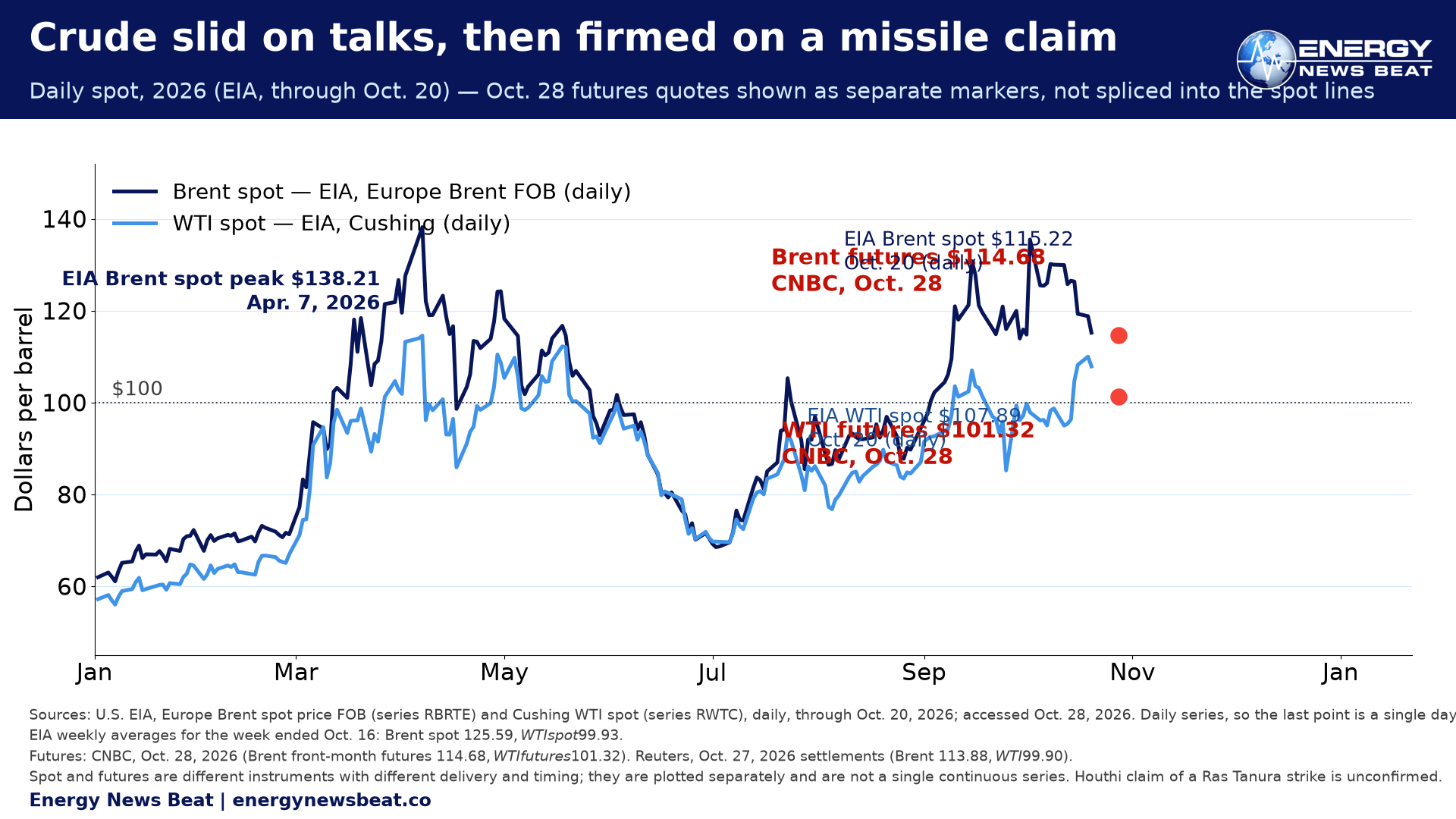
Tuesday belonged to the diplomats. Oil futures settled down almost $2, with Brent falling $1.93 to $113.88 and West Texas Intermediate falling $1.86 to $99.90, Reuters reported. The trigger was talks: Iranian Security Council chief Mohsen Rezaei met Supreme Leader Ayatollah Mojtaba Khamenei a day after meeting representatives of Saudi Arabia, Turkey and Pakistan, and the four countries agreed to keep talking. Reuters also noted that October has been the worst month for attacks on commercial
shipping around the Strait of Hormuz, according to the Washington Institute for Near East Policy. President Trump said at a Texas campaign rally on Tuesday that the war with Iran would end on his terms, while insisting Tehran must be prevented from acquiring a nuclear weapon, CNBC reported.
Wednesday belonged to the missile claim. CNBC reported Brent crude futures up 0.7% at $114.68 a barrel and WTI futures up 1.42% at $101.32. Those are CNBC’s figures from CNBC’s page, and we name them that way because the same morning produced several different prints.
The spread was wide. The Emirates News Agency, WAM, reported Brent futures at $115.36 and WTI at $101.12 as of 01:40 GMT. That is 68 cents apart on Brent and 20 cents on WTI on the same morning, both labeled futures. Neither is wrong. Each is a snapshot of a market in motion. We use CNBC’s numbers throughout and only CNBC’s, so nothing here blends two feeds.
The spot market is calmer than the headlines. The latest EIA Brent spot price is $125.59 for the week ended Oct. 16, and the latest EIA WTI spot price is $99.93 for the same week. Brent spot peaked this year at $138.21 on April 7; WTI spot peaked at $114.58 that day. A year earlier, EIA had Brent at $62.36 and WTI at $58.80.
At the pump: no quick relief
AAA had regular at $4.2471 at 6:14 a.m. CT, down from $4.2661 Tuesday and $4.4768 a month ago, but up from $3.0437 a year ago. That is a 39.5% increase, which we calculated from AAA’s own table. Diesel was $6.3499, against $6.3521 Tuesday and $3.6743 a year ago, up 72.8%.
The federal survey, a day behind, agrees. EIA’s weekly regular average was $4.269 on Oct. 26 versus $3.035 a year earlier, up 40.7%. EIA’s weekly diesel average was $6.352 versus $3.718, up 70.8%. Those are EIA’s prices; the percentages are ours.
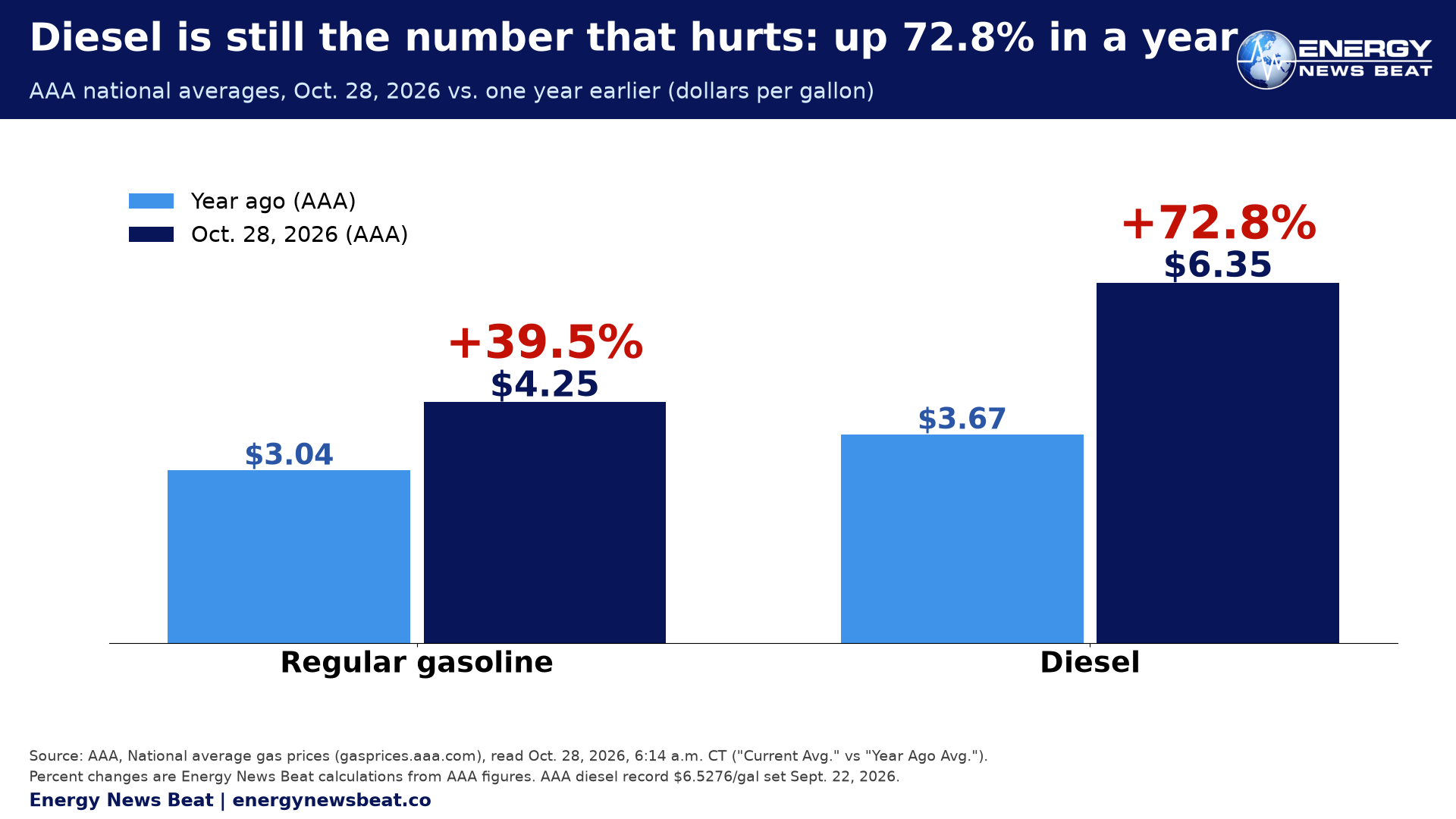
Stations reprice on delivered cost, not headlines. A one-day move in Brent is noise to a station that bought its last load at a rack price set days ago. What matters is whether the fear lasts. A contained fire near a berth bleeds out of the price in a week or two. A refinery genuinely offline changes the arithmetic for products, and diesel feels it first because the world runs its trucks, tractors and ships on it.
A reserve at its lowest since 1982
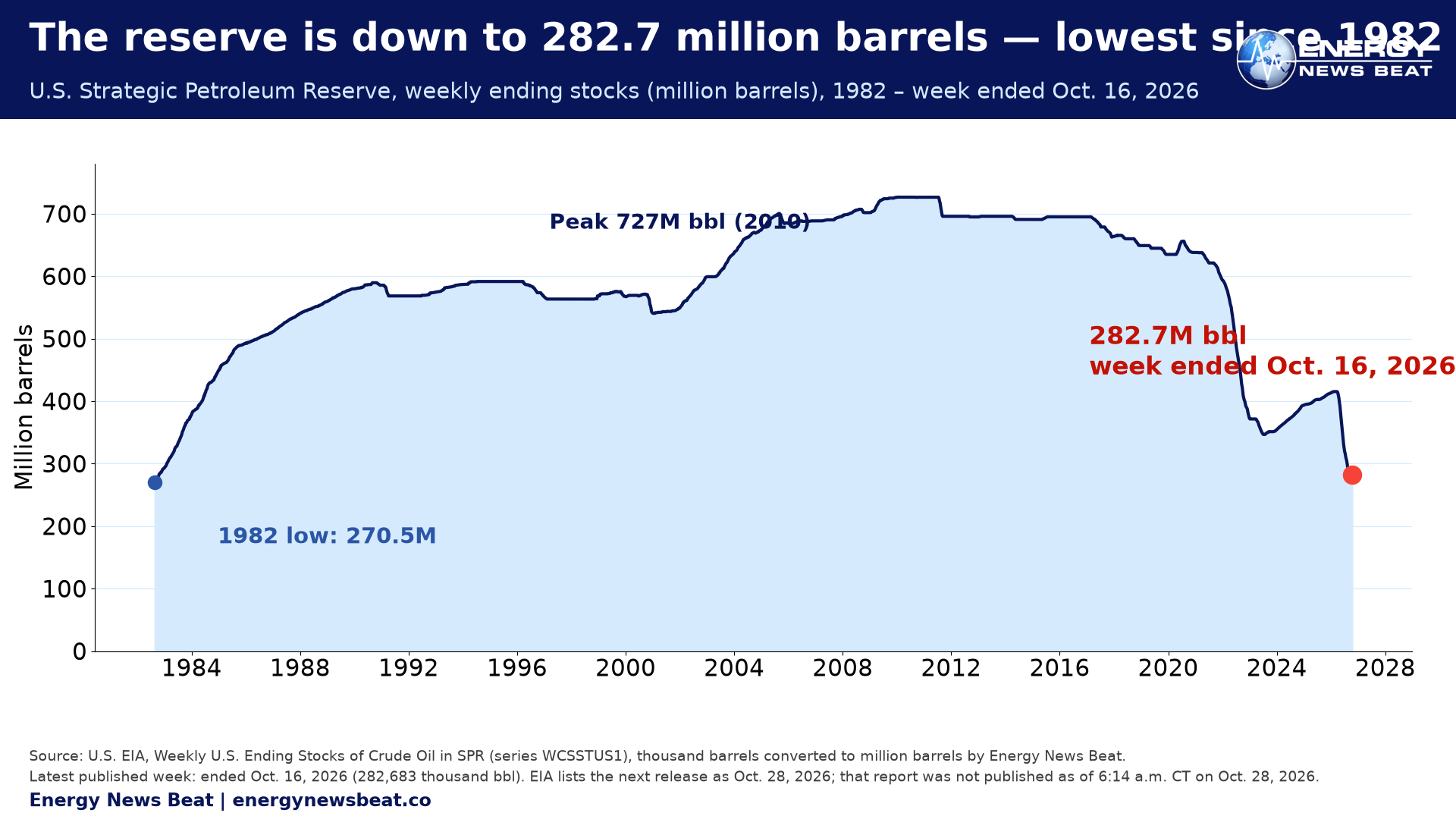
Here is the number that deserves more attention than the missile. The Strategic Petroleum Reserve held 282,683 thousand barrels in the week ended Oct. 16, the most recent week EIA has published. That is the lowest weekly reading since October 1982, when the reserve was still being filled. It was 413,464 thousand barrels on Jan. 2, 2026, and 408,564 thousand barrels a year ago.
Timing matters, so: EIA’s Weekly Petroleum Status Report page lists the next release as Oct. 28, 2026. At 6:14 a.m. CT that report was not yet published. Every SPR figure here comes from the Oct. 21 release covering the week ended Oct. 16. If the new number lands before you read this, it supersedes ours.
Washington is lending from the reserve, not selling. On Oct. 23, DOE authorized an exchange of up to 400,000 barrels from West Hackberry, Louisiana, to address a supply disruption affecting the Phillips 66 Lake Charles refinery. Phillips 66 returns the crude plus premium barrels, so the reserve should end up larger. That structure is sound. It is also small against 282.7 million barrels and a market that trades tens of millions of barrels a day.
Consumer view
- Do not expect this week’s headlines to become savings. The national average moved less than two cents while crude moved a dollar. Watch the weekly direction, not the daily noise.
- Diesel is the number that reaches your grocery bill. At $6.3499 a gallon, up 72.8% in a year, it feeds trucking surcharges, farm costs and shelf prices.
- Fill up on your normal schedule. Panic-buying after a scary headline is how households pay for the spike and miss the fade.
- If you heat with oil, ask your dealer about a budget plan or fixed price now, and get more than one quote. Heating oil and diesel come from the same barrel.
Investor view
- Tuesday’s $2 drop and Wednesday’s rebound are one trade in opposite directions: positioning around diplomacy versus escalation.
- The gap between CNBC’s $114.68 and WAM’s $115.36 is a reminder that intraday quotes are snapshots. Mark a book off one feed and timestamp it.
- A real outage would show up in refining margins and diesel cracks before it showed up in Brent. Watch products, not just the flat price.
- The policy cushion is thinner than the market grew used to after 2022. A reserve at 282,683 thousand barrels is not a deep buffer. Nothing here is investment advice.
Caveats, in fairness
- The refinery hit is a Houthi claim. Saudi Arabia confirmed interceptions, not damage to the refinery. Bloomberg’s source, as summarized by Reuters and the World Ports Organization, said a fire near the terminal had been contained and did not confirm a strike on the refinery. Satellite heat signatures indicate a fire at the export terminal; they do not establish what burned or what it cost.
- We do not know whether any refinery unit is offline, whether loading was affected, or what volume, if any, was lost. We found no detailed public statement from Aramco or the Saudi Energy Ministry on the refinery as of this writing.
- Price sources conflict this morning. CNBC has Brent futures at $114.68 and WTI at $101.32. WAM has Brent at $115.36 and WTI at $101.12 as of 01:40 GMT. Reuters’ Tuesday settlements were $113.88 and $99.90. Different timestamps, and in Reuters’ case a different session. We kept each with its own source and averaged nothing.
- Futures are not spot, and spot is not retail. Our EIA spot series run through Oct. 16 weekly and Oct. 20 daily. Retail lags crude by days to weeks.
- The Oct. 28 SPR release was not out when we wrote this. Our figure is the week ended Oct. 16. Year-over-year percentages are Energy News Beat calculations from AAA and EIA numbers.
| STU’S TAKE
Opinion. Every number is linked to its source. This is my opinion, so take it as such. Look past the missile for a minute. The number that should worry Americans is not Brent at $114.68. It is the refinery system behind it, and the fact that we keep shrinking it. The United States had 130 operable refineries as of Jan. 1, 2026. The newest refinery with significant downstream capacity is Marathon’s Garyville, Louisiana, plant, which came online in 1977. The newest refinery of any kind is a 45,000 b/d plant in Galveston, Texas, that started in 2022. We have not built a major refinery in nearly half a century. Now watch the states. California has already lost 17% of its refinery capacity. Phillips 66’s 139,000 b/d Wilmington plant stopped processing crude in October 2025 and Valero’s 145,000 b/d Benicia plant finished idling all processing units in April 2026. EIA’s Jan. 1, 2026 count shows California at 12 operable refineries and 1,499,171 b/cd, down 138,700 from a year earlier — Wilmington’s capacity; Benicia drops out of the next annual count. Together the two were less than 2% of national capacity but 17% of California’s, and EIA says the shortfall cannot easily be filled from other U.S. hubs because the West Coast is poorly connected to them. Replacement barrels arrive by tanker from Asia. So here is the chain, in my view. Blue-state policy makes refining expensive and unwelcome, plants close, and the country has less ability to turn crude into the fuel people actually buy. Then a missile lands on the other side of the world, and because we have less slack the shock reaches an American pump faster and stays longer. A reserve at 282,683 thousand barrels, the lowest since 1982, does not fix that. A 400,000-barrel exchange for one Louisiana refinery does not fix it either. You cannot drill your way to cheaper diesel if nobody will build the plant that makes the diesel. Watch the missile this week. Watch the refinery count for the next decade, and vote like your pocket book depends on it. The simple proven fact that Blue States are 38% to 42% higher than Red States is a fact. De-industrialization follows the Green New Deal and Net Zero like the Grim Reaper.
|
Check out the World’s Greatest Podcast Show Notes at EnergyNewsBeat.co or EnergyNewsBeat.com. And subscribe to: The Energy News Beat Substack.
A. Sources (all accessed Oct. 28, 2026)
- CNBC, “Oil prices rise as Houthi attacks on Saudi refinery raise supply worries,” published Oct. 28, 2026, 1:52 a.m. EDT
- Reuters via Al-Monitor, “Yemen’s Houthis say they hit Saudi Ras Tanura oil refinery with missile,” Oct. 27, 2026
- Reuters via Investing.com, “Oil eases on Middle East diplomacy hopes, Saudi attacks keep supply worries alive,” Oct. 27, 2026
- Emirates News Agency (WAM), “Oil prices rise; Brent tops US$115 per barrel,” Oct. 28, 2026, 08:37 GST
- Agence France-Presse via Dawn, “Houthis claim strikes on Saudi refinery, ministry,” Oct. 28, 2026
- World Ports Organization, “Yemen’s Houthi rebels strike Saudi Aramco’s Ras Tanura oil terminal,” Oct. 28, 2026
- AAA, National average gas prices, read live Oct. 28, 2026, 6:14 a.m. CT
- S. Department of Energy, “Energy Department Authorizes Strategic Petroleum Reserve Exchange to Support Fuel Supply,” Oct. 23, 2026
- S. EIA, Weekly U.S. Ending Stocks of Crude Oil in the Strategic Petroleum Reserve (series WCSSTUS1), week ended Oct. 16, 2026
- S. EIA, Weekly Petroleum Status Report index (next release listed as Oct. 28, 2026)
- S. EIA, Weekly U.S. Regular All Formulations Retail Gasoline Prices (EMM_EPMR_PTE_NUS_DPG), week of Oct. 26, 2026
- S. EIA, Weekly U.S. No. 2 Diesel Retail Prices (EMD_EPD2D_PTE_NUS_DPG), week of Oct. 26, 2026
- S. EIA, Europe Brent Spot Price FOB, daily (RBRTE), through Oct. 20, 2026; weekly average through Oct. 16, 2026
- S. EIA, Cushing, OK WTI Spot Price FOB, daily (RWTC), through Oct. 20, 2026; weekly average through Oct. 16, 2026
- S. EIA, New York Harbor No. 2 Heating Oil Spot Price FOB, daily (EER_EPD2F_PF4_Y35NY_DPGd), through Oct. 20, 2026
- S. EIA, Today in Energy, “Refinery closures present risk for higher gasoline prices on the West Coast,” July 9, 2025
- S. EIA, FAQ: When was the last refinery built in the United States?
- S. EIA, Refinery Capacity Report (data as of Jan. 1, 2026)
B. Key primary-document excerpts
“International benchmark Brent crude futures rose 0.7% to $114.68 per barrel, while U.S. West Texas Intermediate crude futures gained 1.42%, to $101.32 per barrel.” (CNBC, Oct. 28, 2026, published 1:52 a.m. EDT) Link
“Oil prices climbed Wednesday as investors weighed the prospect of a prolonged and widening Middle East conflict after Tehran-backed Houthis attacked Saudi Arabia’s largest refinery.” (CNBC, Oct. 28, 2026) Link
“Yemen’s Iran-aligned Houthis said on Tuesday they had hit Saudi Arabia’s Ras Tanura oil refinery, the biggest in the kingdom, with a ballistic missile.” (Reuters via Al-Monitor, Oct. 27, 2026) Link
“The Houthis’ military spokesperson, Yahya Saree, said the strike on the Ras Tanura refinery had caused a fire at the complex, which also includes a shipping terminal and is located on the Gulf, west of the Strait of Hormuz.” (Reuters via Al-Monitor, Oct. 27, 2026) Link
“Bloomberg News cited a person familiar with the matter as saying Saudi Arabia had contained a fire near Ras Tanura’s terminal.” (Reuters via Al-Monitor, Oct. 27, 2026) Link
“Ras Tanura, which has a capacity of 550,000 barrels per day, was shut for a period in the early months of the Iran war as a precautionary measure.” (Reuters via Al-Monitor, Oct. 27, 2026) Link
“Brent crude futures settled down $1.93, or 1.67%, at $113.88 a barrel. US West Texas Intermediate crude settled down $1.86, or 1.83%, at $99.90.” (Reuters via Investing.com, Oct. 27, 2026) Link
“Oil prices rose on Wednesday, with Brent crude futures climbing US$1.48, or 1.3 percent, to US$115.36 per barrel by 01:40 GMT.” (WAM, Oct. 28, 2026) Link
“The Houthis were also ‘able to target the Ras Tanura refinery in the Eastern Province with a ballistic missile’, he said in a separate post, adding the strike caused ‘massive fires’.” (AFP via Dawn, Oct. 28, 2026) Link
“Maritime security agency Vanguard said a fire was reported in the Ras Tanura area in the early hours of Tuesday after an attack. ‘The fire has reportedly been contained, while the extent of damage and any impact on oil-loading operations remain unclear at current,’ Vanguard said.” (AFP via Dawn, Oct. 28, 2026) Link
“Saudi forces claimed to have intercepted three ballistic missiles and four drones launched by Houthi forces on Tuesday, without officially confirming any damage… heat signatures observed by NASA FIRMS satellite sensing on Tuesday indicate a fire at the Ras Tanura export terminal.” (World Ports Organization, Oct. 28, 2026, which credits The Maritime Executive for this account. Tallies differ between sources: this count of three missiles and four drones is not the same as the coalition tally of three toward the Eastern Province and two toward Riyadh reported by AFP.) Link
“The U.S. Department of Energy (DOE) today announced the authorization of an emergency exchange of up to 400,000 barrels of crude oil from the Strategic Petroleum Reserve (SPR) to address a crude oil supply disruption affecting the Phillips 66 Lake Charles Refinery in Louisiana.” (DOE, Oct. 23, 2026) Link
“Under the terms of the exchange, all borrowed crude oil will be returned with additional premium barrels, helping replenish and strengthen the SPR at no additional cost to taxpayers.” (DOE, Oct. 23, 2026) Link
“California is set to lose 17% of its oil refinery capacity over the next 12 months because of two planned refinery closures.” (EIA Today in Energy, July 9, 2025. Written before either closure; both plants have since stopped, so read it in the past tense.) Link
“Although the Los Angeles and Benicia refineries make up less than 2% of current U.S. refining capacity, they account for 17% of California refinery capacity and 11% of West Coast (PADD 5) capacity. The supply shortfall left by their exit is therefore likely to have an outsized impact on the region because it cannot be easily filled by other refineries elsewhere in the country.” (EIA Today in Energy, July 9, 2025) Link
“The newest refinery with significant downstream unit capacity is Marathon’s facility in Garyville, Louisiana. That facility came online in 1977.” (EIA FAQ) Link
C. Data tables
C1. Crude benchmarks, futures and spot kept separate
| Instrument | Price | As of | Source (exact) |
| Brent futures, intraday | $114.68 (+0.7%) | Oct. 28, 2026, as reported 1:52 a.m. EDT | CNBC |
| WTI futures, intraday | $101.32 (+1.42%) | Oct. 28, 2026, as reported 1:52 a.m. EDT | CNBC |
| Brent futures, intraday (conflicting) | $115.36 (+1.3%) | Oct. 28, 2026, 01:40 GMT | WAM |
| WTI futures, intraday (conflicting) | $101.12 (+1.22%) | Oct. 28, 2026, 01:40 GMT | WAM |
| Brent futures, prior settle | $113.88 (-$1.93, -1.67%) | Oct. 27, 2026 | Reuters |
| WTI futures, prior settle | $99.90 (-$1.86, -1.83%) | Oct. 27, 2026 | Reuters |
| Brent spot, weekly average | $125.59 | Week ended Oct. 16, 2026 | EIA |
| WTI spot, weekly average | $99.93 | Week ended Oct. 16, 2026 | EIA |
| Brent spot, daily | $115.22 | Oct. 20, 2026 | EIA |
| WTI spot, daily | $107.89 | Oct. 20, 2026 | EIA |
| Brent spot, 2026 peak | $138.21 | Apr. 7, 2026 | EIA |
| WTI spot, 2026 peak | $114.58 | Apr. 7, 2026 | EIA |
| Brent spot, year earlier | $62.36 | Week ended Oct. 17, 2025 | EIA |
| WTI spot, year earlier | $58.80 | Week ended Oct. 17, 2025 | EIA |
C2. AAA national averages (read live Oct. 28, 2026, 6:14 a.m. CT)
| Item | Regular | Diesel | Source |
| Today | $4.2471 | $6.3499 | AAA |
| Yesterday | $4.2661 | $6.3521 | AAA |
| Week ago | $4.2644 | $6.3174 | AAA |
| Month ago | $4.4768 | $6.4531 | AAA |
| Year ago | $3.0437 | $3.6743 | AAA |
| Change vs. year ago (ENB calc.) | +39.5% | +72.8% | AAA |
| All-time record | $5.0165 (6/14/22) | $6.5276 (9/22/26) | AAA |
C3. Retail and spot product prices
| Series | Latest | As of | Year earlier | Change | Source |
| Regular gasoline, U.S. average | $4.269 | Oct. 26, 2026 | $3.035 | +40.7% | EIA |
| No. 2 diesel, U.S. average | $6.352 | Oct. 26, 2026 | $3.718 | +70.8% | EIA |
| NY Harbor No. 2 heating oil spot | $4.832 | Oct. 20, 2026 | $2.090 | +131% | EIA |
C4. Strategic Petroleum Reserve
| Item | Value | As of | Source |
| SPR crude stocks | 282,683 thousand bbl | Week ended Oct. 16, 2026 | EIA |
| Prior comparison, 2026 | 413,464 thousand bbl | Jan. 2, 2026 | EIA |
| Year earlier | 408,564 thousand bbl | Week ended Oct. 17, 2025 | EIA |
| Lowest prior reading since 1982 | 280,802 thousand bbl | Week ended Oct. 15, 1982 | EIA |
| All-time peak | 726,617 thousand bbl | Jan. 1, 2010 | EIA |
| Next WPSR release | Oct. 28, 2026 (not yet published at writing) | EIA |
C5. DOE exchange, Phillips 66 Lake Charles
| Item | Value | Source |
| Volume authorized | Up to 400,000 bbl | DOE |
| SPR site | West Hackberry, Louisiana | DOE |
| Receiving refinery | Phillips 66 Lake Charles, Louisiana | DOE |
| Announcement date | Oct. 23, 2026 | DOE |
| Terms | Borrowed crude returned with premium barrels | DOE |
| Share of current SPR | About 0.14% of 282,683 thousand bbl (ENB calc.) | DOE, EIA |
C6. U.S. refining capacity
| Item | Value | Source |
| Operable U.S. refineries | 130 (as of Jan. 1, 2026) | EIA FAQ |
| Newest with significant downstream capacity | Garyville, LA, online 1977, 617,000 b/cd | EIA FAQ |
| Newest refinery of any kind | Texas International Terminals, Galveston, 45,000 b/cd, started Feb. 2022 | EIA FAQ |
| Phillips 66 Wilmington closure | 139,000 b/d | EIA |
| Valero Benicia closure | 145,000 b/d | EIA |
| Share of California capacity lost | 17% (both closures now complete) | EIA |
| California operable refineries, Jan. 1, 2026 | 12 | EIA |
| California operable capacity, Jan. 1, 2026 | 1,499,171 b/cd | EIA |
| Change in California capacity, year over year | Down 138,700 b/cd (Wilmington only; Benicia drops out of the next count) | EIA |
| Share of U.S. capacity | Under 2% | EIA |
The post A Missile Claim at Ras Tanura, a $2 Slide, and a Small Rebound: Why Your Pump Price Barely Moved appeared first on Energy News Beat.