
EPA wants to scrap the “super emitter” leak program and ease the rules for marginal wells that make about 6% of America’s oil and gas. The savings are real, they are lumpy, and most of the money lands on wells that belong to the biggest operators.
By Energy News Beat | Oct. 28, 2026
If you heat with gas or fill a gasoline tank, the methane rule EPA proposed on Tuesday is, in the end, about your bill. Not this month’s bill: the arithmetic is fractions of a percent spread over 24 years. But it is what Washington is arguing about.
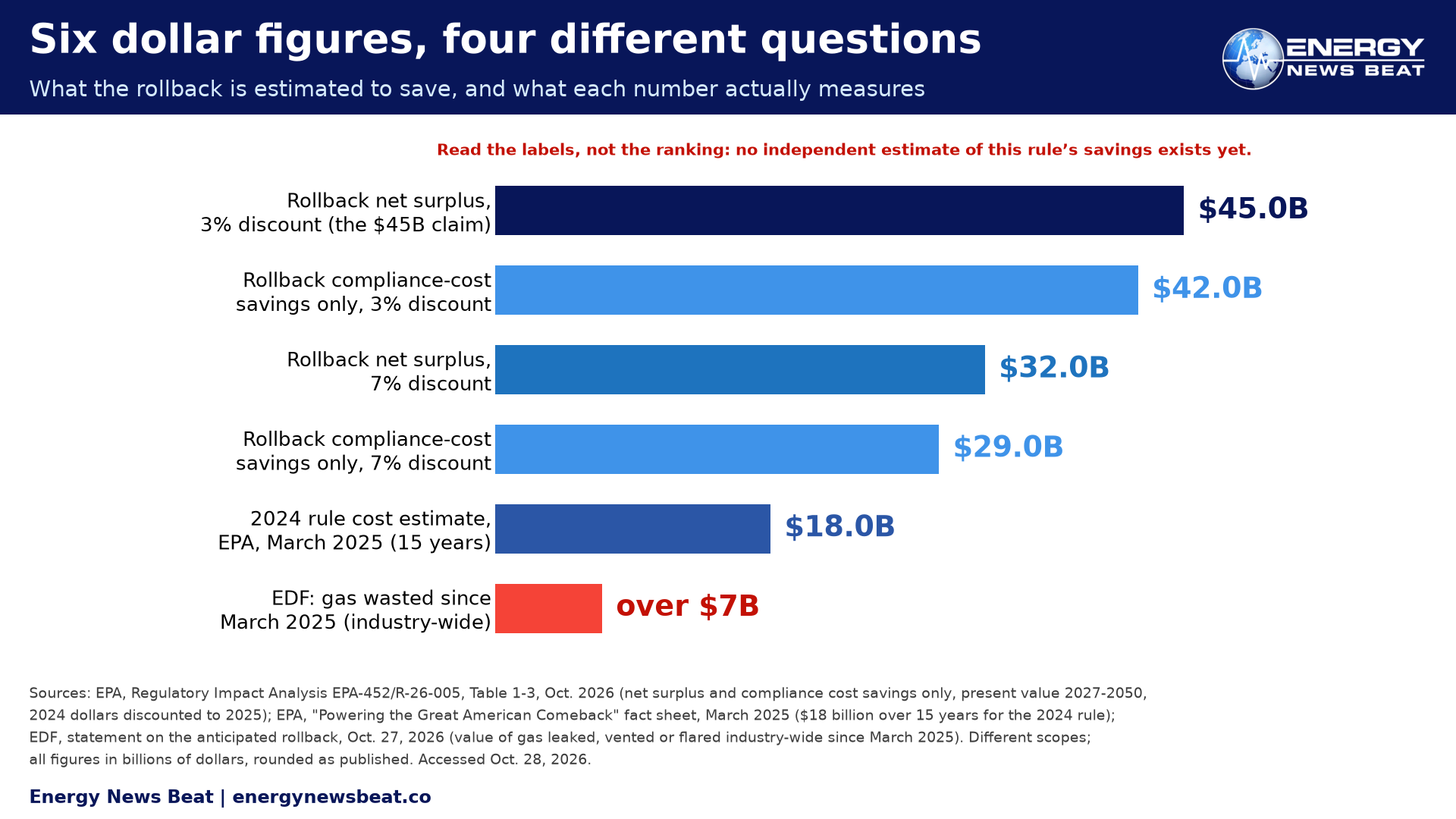
President Trump announced the rollback at a rally in Lubbock, Texas, on Tuesday for Senate candidate Ken Paxton, and EPA released the proposed rule the same day. Trump’s line, as the Associated Press reported it: “I’m officially terminating Biden’s expensive and unnecessary methane regulations to save consumers and energy producers $45 billion in costs.”
What Washington actually proposed
The EPA release leads with the money: the proposal “is expected to save $45 billion in costs to consumers and businesses” and to “unleash an estimated 210 million additional barrels of oil and 1.41 trillion cubic feet of natural gas.” Interior Secretary Doug Burgum called it “an estimated $45 billion in taxpayer savings.” Those are EPA estimates, and we label them so. The scope is not.
- Marginal and stripper wells. EPA is co-proposing two ways to split well sites: by production level, marginal versus non-marginal, with lighter requirements at or below 15 barrels of oil equivalent a day; or by resource type, conventional versus unconventional. EPA’s own documents give the marginal share three ways: 79 percent (general fact sheet), “more than 76 percent” (RIA, whose tables count 793,557 onshore wells in 2023 and find 76% marginal) and “more than 78 to 80 percent” (preamble).
- The Super Emitter Program. EPA would rescind the third-party certification and notification system for very large leaks and tell states to drop mirror programs. The proposal says the program is no longer “well-grounded in policy and law” and that notifications often arrive after the event has ended.
- Flaring and venting. At oil wells, EPA would restore 95%-efficient flaring or another control as the best system of emission reduction, instead of requiring all associated gas to reach a sales line, which the release and the general fact sheet call “not possible in all producing areas.” That phrase is theirs; it does not appear in the preamble.
- Covers, vent systems and control devices. The “no identifiable emissions” test splits into design and operational requirements, with repairs allowed, plus flexibility on flame-monitoring deviations.
The co-proposal EPA is also taking comment on is not identical in effect: Table 1-4 puts its methane increase at 88 million short tons against 60 for the proposed option, 47% more, and Table 1-3 puts its net surplus at $39,000 million at 3% instead of $45,000 million. The difference is how well sites get split: the proposed option by production level, the co-proposal by conventional versus unconventional. Every other dollar and emissions figure in this article is the proposed option’s.
The $45 billion, line by line
The number comes from Table 1-3 of the Regulatory Impact Analysis: net economic surplus of $45,000 million at a 3% discount rate and $32,000 million at 7%, for 2027 through 2050 in 2024 dollars, discounted to 2025. Compliance cost savings alone are $42,000 million at 3% and $29,000 million at 7%. The other $3,000 million is “savings from energy market impacts.” EPA’s own table notes are explicit that the compliance-savings rows “include the change in value of product recovery,” and here that term works against the total rather than for it, because a looser rule captures less gas to sell.
Timing matters more than the total. Table 4-1 shows net compliance cost savings of about $310 million in 2027 and 2028, then $15.0 billion in 2029, then $1.9 billion to $2.4 billion a year. The 2029 spike is where EPA booked existing-source compliance all at once. The agency says so plainly: it assumes those costs “occur in a single year,” while the rule itself “gives States and operators the flexibility to spread these activities over a longer period.” So the single-year concentration is an artifact of the model, not a prediction. It still tells you the savings are front-loaded and lumpy; it does not tell you operators will write one giant check in 2029. EPA goes further and calls its own single-year treatment “almost certainly an overestimate.”
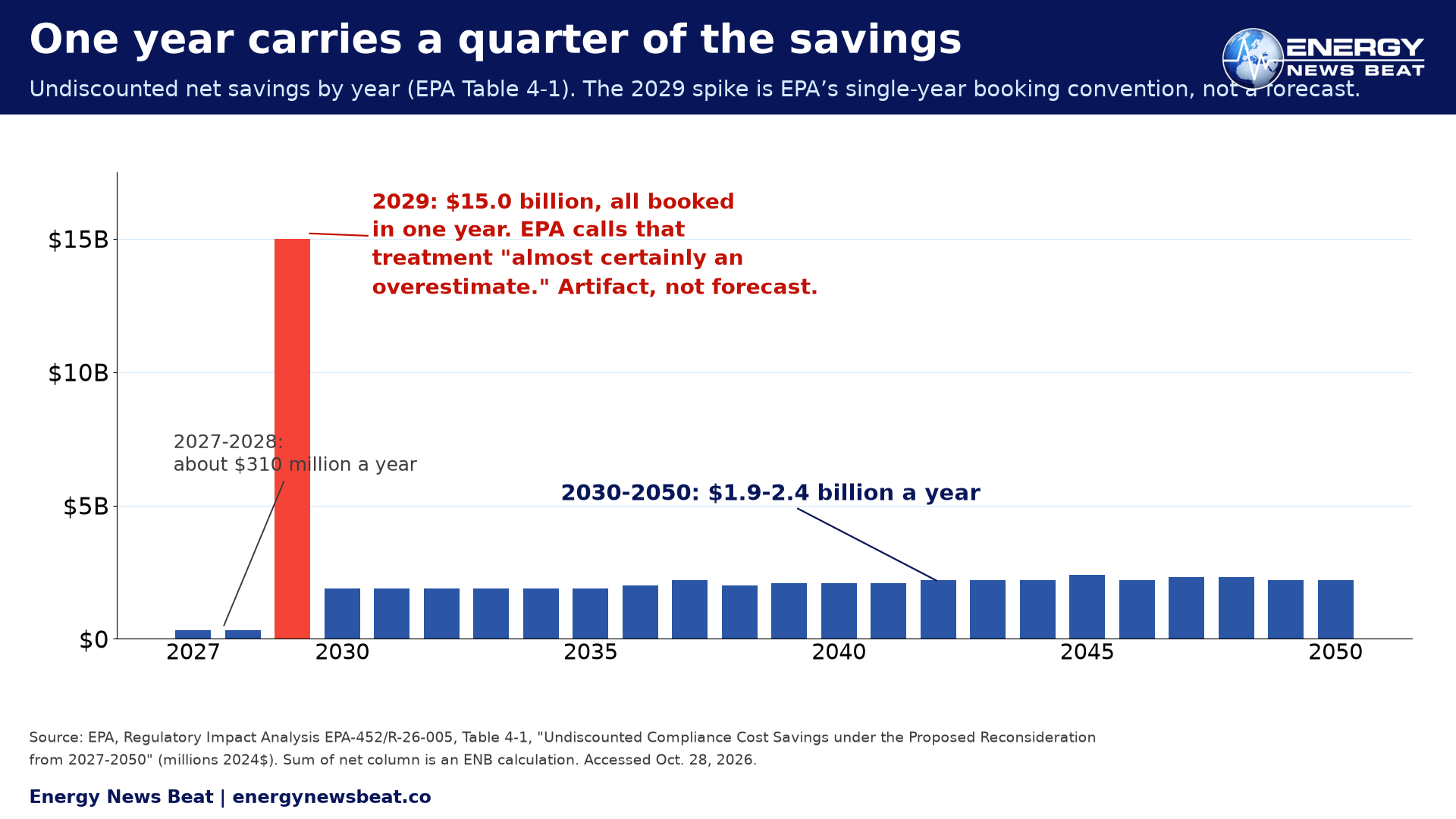
The offsets are counted too, in the same product-recovery line. Table 4-1 subtracts gas that would have been captured and sold under the 2024 rule: about $210 million in 2029, rising to roughly $300 million a year by the 2040s. Less capture is in the official math.
What 210 million barrels buys
Spread the oil across the whole period and the headline shrinks. Table 6-2 adds 4.7 million to 9.5 million barrels a year from 2027 to 2050; summed, those increments come to about 210 million barrels, which is where EPA’s number comes from. The same table sizes the effect: oil production rises 0.09% to 0.22%, and the oil price falls $0.11 to $0.24 a barrel, or 0.14% to 0.28%.
The Associated Press did the translation: 210 million barrels is “about 10 days of U.S. petroleum consumption” — ten days of demand across a generation.
Gas is smaller still. Table 6-2 adds 25 billion to 67 billion cubic feet a year — 0.07% to 0.16% of supply — and takes $0.003 to $0.014 off a thousand cubic feet, against a 2027 reference price of $2.72. EIA’s October outlook has Henry Hub averaging $3.48 this year and $3.16 in 2027. This rule does not move the gas market; weather, storage and LNG exports do.
The wells at the center of it
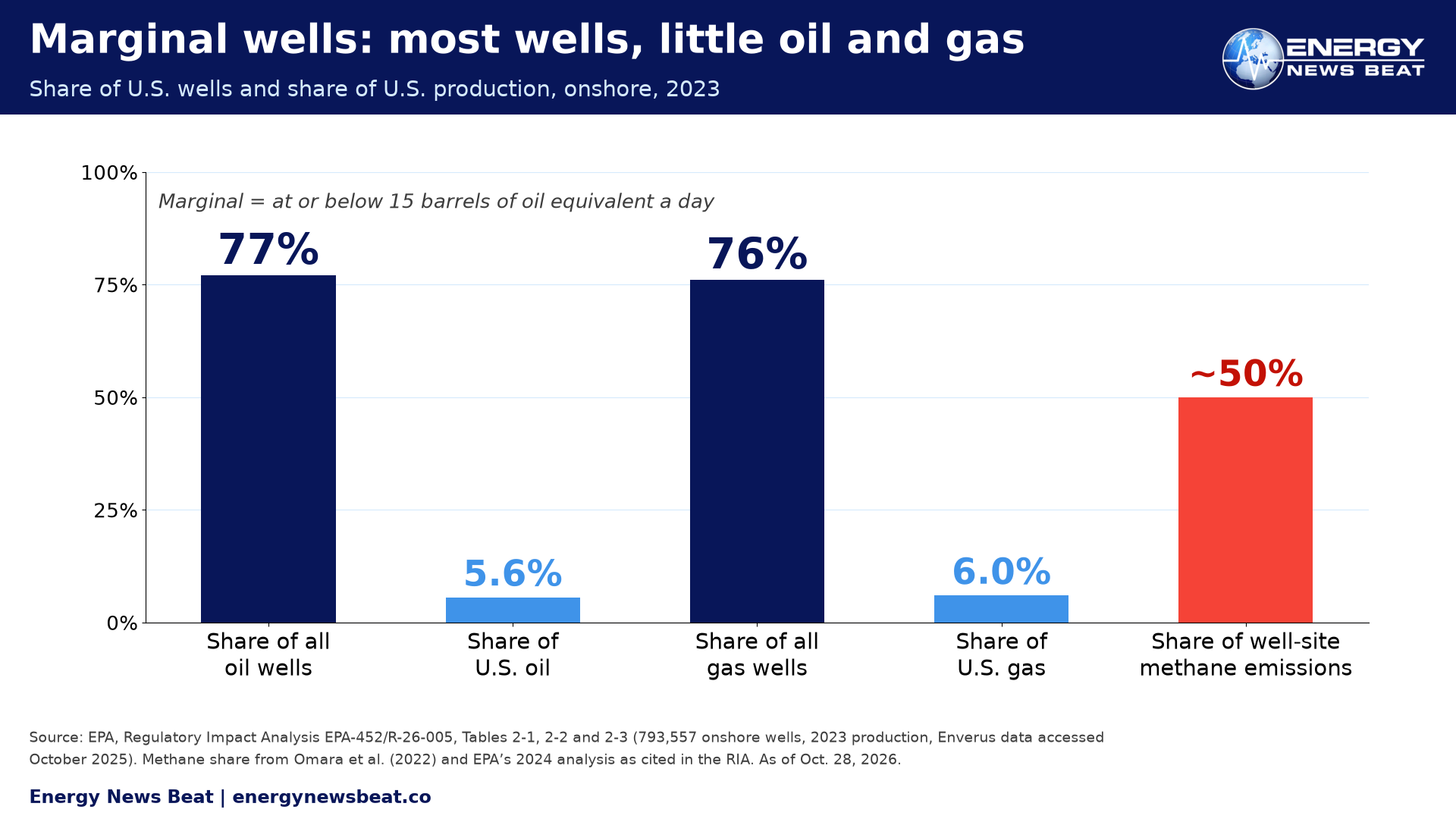
Marginal wells are almost all of the wells and almost none of the barrels. Table 2-2 counts 261,104 marginal oil wells — 77% of U.S. oil wells — producing 5.6% of the oil. Table 2-3 counts 342,360 marginal gas wells, 76% of gas wells, producing about 6% of the gas.
The economics are as lopsided, and EPA published them. Table 2-7, mid-range case, puts annualized net profit for an oil well producing under one barrel a day at about $3,300, on $8,000 of revenue against $4,700 of operating cost. A gas well in that bracket loses about $1,300 a year.
A compliance bill is not abstract for a family with two wells, and invisible to a company with twenty thousand. EPA’s March 2025 fact sheet put the 2024 rule at $18 billion over 15 years, $1.5 billion a year. API’s 2023 modeling found 228,776 wells, 31% of the total, could stop producing in 2027 under a subset of the requirements, taking 2.8% of gas and 1.2% of oil.
Ownership cuts both ways. Table 2-4 finds 98% of the 11,148 operators own a marginal well. But the 127 firms with 1,000 or more wells run 51.3% of marginal wells and 67.3% of marginal production, while the 7,320 firms with ten wells or fewer own 3.2% and 1.9%. The relief is written for small operators; most wells it touches belong to large ones.
Consumer view and investor view
- For households: treat this as a rounding error, not relief. The RIA’s gas price effect is three-tenths of a cent to 1.4 cents per thousand cubic feet — even fully passed through, it would not show up on a winter bill.
- For investors: the money is real but concentrated. The RIA’s $2.5 billion-a-year equivalent is a compliance-cost figure, not revenue, and 2029 carries $15.0 billion of it undiscounted — EPA’s single-year booking convention, not a forecast that operators write one check. Operators holding large inventories of old, low-rate wells benefit; a pure unconventional driller gets a rounding error.
- For Appalachia: Pennsylvania has the second-largest well count in EPA’s data, 77,849 behind Texas’s 254,201. The relief shows up in operating cost, not the commodity — a margin story for the operator, a small one for the royalty owner.
- For the Permian: flaring is the rule that bites. API’s 2023 study found basin operators flared about 1.6% of gas produced in 2022, roughly half of it routine, and estimated that constraining it could cost about 45,000 barrels a day of oil.
Caveats, in fairness
- No independent estimate of the rollback’s compliance savings exists yet. The RIA is EPA’s own model. Oil & Gas Journal noted that the agency had not released the analysis behind the $45 billion when it previewed the number. It has now; it is a model output, not audited savings.
- The costs are not monetized. EPA says it does “not monetize costs of the proposed action,” then quantifies the emissions instead: 60 million short tons of methane, 17 million of VOC and 2.3 million of HAP, 2027–2050. InsideEPA reports EPA is also taking comment on whether to regulate methane from the sector at all.
- The environmental case is specific. Marginal wells produce about 6% of the fuel and, by Omara and colleagues (2022), cited in the RIA, about half of well-site methane; EPA’s 2024 analysis put the range at 47% to 53%. EDF says the industry has leaked, vented or flared more than $7 billion of gas since enforcement stopped in March 2025, and puts flaring’s health and climate cost at $5.6 billion in 2023. Fred Krupp: “EPA should be fighting this waste, not making it easier.”
- The rule being replaced was not cheap either. AP reports it was projected to prevent 58 million tons of methane by 2038 and yield $98 billion in benefits by 2034 — a figure built on the social cost of greenhouse gases, which this EPA rejects. We do not net the two; they are not comparable.
- Litigation is likely. The D.C. Circuit heard argument Oct. 14 on EPA’s earlier delay rule and the panel was skeptical, per InsideEPA; NRDC’s David Doniger told NBC News he expects “another lawsuit” over this proposal.
- The comment window is inconsistent inside the agency itself. The press release promises “at least a 45-day public comment period”; the proposal text and the technical fact sheet say 48 days, while the general fact sheet hedges to “at least a 48-day. Neither is a date until the rule publishes in the Federal Register, still pending Oct. 28. The docket is EPA-HQ-OAR-2025-0163.
What to watch
Federal Register publication starts the clock: 48 days in the proposal text, “at least” 45 in the release, and a virtual hearing 15 days later, per EPA’s action page. The preamble sets a second, earlier clock: comments on the information-collection provisions are “best assured of consideration” if the Office of Management and Budget gets a copy 30 days after publication. Then a final rule, then a courtroom. Interior runs a parallel track: BLM’s June 2026 package, whose Federal Register notices open a 60-day comment window, cuts waste-prevention compliance costs by “nearly $17 million annually” and restores the $25,000 statewide bond; two 2024-rule deadlines now slip to Dec. 10, 2026.
| STU’S TAKE
Opinion. Every number is linked to its source. This is my opinion, so take it as such. Regulation is a cost, and costs do not disappear. They land somewhere — on a well that cannot afford an inspection program, on a compressor station, on a truck — and eventually on a receipt at the grocery store. EPA’s own table makes the case better than any speech: a gas well producing under one barrel a day loses about $1,300 a year before anyone asks it to pay for monitoring. The people squeezed hardest are the smallest ones. 7,320 firms own ten wells or fewer, and for the average firm in that group, 86% of its wells are marginal. They do not have a compliance department, a lobbyist or a lawyer on retainer. When the rule says monitor and repair, the big operator builds a team and the family with two wells sells out or plugs them. I will also say the quiet part about the prize. Ten days of U.S. petroleum consumption, spread over 24 years, is not energy dominance. The $15.0 billion in 2029 is the number that matters to an investor, and EPA books all of it in one year by convention, not because anyone writes one check. Where I part company with the agency is the silence on cost. EPA does not monetize the 60 million tons of methane it expects to release, and it should say out loud what that means instead of leaving the reader to guess. A rule that is honest about its trade-offs survives court better than one that pretends there are none. Watch the docket, not the rally. |
Appendix
A. Sources (all accessed Oct. 28, 2026)
- S. EPA, “EPA Proposes Major New Revisions to Burdensome, Unworkable Biden-Era Oil and Natural Gas Regulations,” news release, Oct. 27, 2026 (Lubbock, Texas)
- S. EPA, “2026 Actions to Reduce Burden on the Oil and Natural Gas Industry,” program page (proposal dated Oct. 27, 2026)
- S. EPA, “Proposed Reconsideration of the 2024 Final Clean Air Act Rule,” preamble, FRL-12726-01-OAR, pre-publication version signed Oct. 27, 2026
- S. EPA, Regulatory Impact Analysis, EPA-452/R-26-005, October 2026 (Tables 1-3, 1-4, 2-1 to 2-7, 4-1, 4-2, 6-1 to 6-3)
- S. EPA, “General Fact Sheet: Proposed Reconsideration of the 2024 Oil and Gas Rule,” October 2026
- S. EPA, “Technical Fact Sheet: Proposed Reconsideration of the 2024 Oil and Gas Rule,” October 2026
- S. EPA, “Powering the Great American Comeback” oil and gas fact sheet, March 2025
- gov, docket EPA-HQ-OAR-2025-0163
- Associated Press, Matthew Brown and Mead Gruver, “Trump plans to loosen restrictions on methane emissions from oil drilling” (syndicated by The Seattle Times as “Trump says he’s ending restrictions on climate-warming methane from oil drilling”), Oct. 27, 2026; original URL Cloudflare-blocked at access
- Associated Press via The Seattle Times, same article, published Oct. 27, 2026, 1:04 p.m. PT, updated 3:55 p.m. PT (full text read)
- NBC News, Evan Bush, “Trump says he’ll roll back Biden-era methane rules for oil and gas companies,” Oct. 27, 2026
- Environmental Defense Fund, “Anticipated EPA methane rollback proposal would encourage worst forms of pollution and waste,” Oct. 27, 2026
- Environmental Defense Fund, “Statement: EPA’s methane repeal would put polluters first and waste America’s energy,” Oct. 7, 2026
- American Petroleum Institute, “Production Impacts of Proposed EPA Methane Rule,” March 2023
- National Stripper Well Association, “NSWA Position on Stripper Well Emissions,” media release, Sept. 29, 2026
- ProPublica, Alex Cuadros, “EPA to Weaken Rules on Methane Pollution From ‘Stripper Wells’,” Sept. 11, 2026
- Oil & Gas Journal, “US EPA plans further rollback of oil, gas methane rules,” October 2026
- InsideEPA, “EPA Floats Plan to Roll Back Numerous Methane Control Requirements,” Oct. 27, 2026 (lede available; full text paywalled)
- S. Bureau of Land Management, “Interior Advances Revisions to Oil and Gas Leasing and Waste Prevention Rules,” June 22, 2026
- S. Bureau of Land Management, “2024 Waste Prevention Rule” page (deadline extensions to Dec. 10, 2026)
- S. Energy Information Administration, Short-Term Energy Outlook, October 2026 (modeling completed Oct. 1, 2026)
- S. Energy Information Administration, Henry Hub Natural Gas Spot Price, daily (data through Oct. 20, 2026)
- International Energy Agency, “Financing reductions in oil and gas methane emissions” (global; cited only to warn against a numerical coincidence)
- Federal Register, document search for EPA-HQ-OAR-2025-0163 (searched Oct. 28, 2026; no publication found)
B. Key primary-document excerpts
“The proposal is expected to save $45 billion in costs to consumers and businesses, including families and small businesses operating marginal wells, and to unleash an estimated 210 million additional barrels of oil and 1.41 trillion cubic feet of natural gas.” (EPA news release, Oct. 27, 2026) Link
“Behind every barrel of oil and every cubic foot of natural gas produced in the U.S. are millions of workers, businesses, and the heartbeat of this nation’s economy. The Biden EPA destructively targeted all this… We have listened to Americans’ concerns and are taking our biggest step yet to fix it. When owners and operators can produce, America benefits with lower prices.” (EPA Administrator Lee Zeldin, same release) Link
“In 2024, the Biden EPA finalized one-size-fits-all, burdensome regulations that were estimated at the time to cost $18 billion.” (EPA news release, Oct. 27, 2026) Link
“EPA will hold at least a 45-day public comment period, including a public hearing, after publication in the Federal Register.” (EPA news release, Oct. 27, 2026) Link
“EPA will hold at least a 48-day public comment period, including a public hearing, after publication in the Federal Register.” (General fact sheet; the technical fact sheet states 48 days flat) Link
“Comments must be received on or before [INSERT DATE 48 DAYS AFTER DATE OF PUBLICATION IN THE FEDERAL REGISTER].” (Proposed rule preamble, DATES block) Link
“Under the Paperwork Reduction Act, comments on the information collection provisions are best assured of consideration if the Office of Management and Budget receives a copy of your comments on or before [INSERT DATE 30 DAYS AFTER DATE OF PUBLICATION IN THE FEDERAL REGISTER].” (Same DATES block) Link
“Note that while we assume that compliance costs occur in a single year, in practice the EG OOOOc gives States and operators the flexibility to spread these activities over a longer period. While we do not distribute compliance expenditures across these years in the RIA, it is certainly possible that States and operators will avail themselves of this flexibility.” (RIA, printed pp. 50-51) Link
“The publication of Federal Register notices for each proposed rule will open a 60-day public comment period.” (BLM press release, June 22, 2026, on Interior’s parallel rulemaking, a separate docket) Link
“We do not monetize costs of the proposed action; however, we quantify the emission increases… All dollar estimates are in 2024 dollars.” (RIA, Section 1.3) Link
“The change would save companies and consumers billions of dollars and unlock 210 million barrels of oil. That’s equivalent to about 10 days of U.S. petroleum consumption.” (Associated Press, Oct. 27, 2026) Link
“America needs more energy, not more energy waste… EPA should be fighting this waste, not making it easier.” (Fred Krupp, Environmental Defense Fund, Oct. 27, 2026) Link
“Oil stripper wells produce approximately 8% of the total U.S. oil production. Natural gas stripper wells produce approximately 7%.” (National Stripper Well Association, Sept. 29, 2026) Link
“This is not about energy dominance… It’s about padding the pockets of oil and gas operators and saddling society with the costs.” (Darin Schroeder, Clean Air Task Force, via ProPublica, Sept. 11, 2026) Link
C. Data tables
C1. The dollar figures, by scope (as of Oct. 28, 2026)
| Figure | Value | What it measures | Source |
| EPA net economic surplus, 3% discount | $45,000 million PV; $2,700M/yr EAV | Compliance savings plus energy-market effects, 2027-2050 | RIA Table 1-3 |
| EPA net economic surplus, 7% discount | $32,000 million PV; $2,800M/yr EAV | Same, 7% discount rate | RIA Table 1-3 |
| EPA compliance-cost savings only, 3% | $42,000 million PV; $2,500M/yr EAV | Cost savings alone, 2027-2050 | RIA Tables 1-3, 4-2 |
| EPA compliance-cost savings only, 7% | $29,000 million PV; $2,500M/yr EAV | Cost savings alone, 7% discount | RIA Tables 1-3, 4-2 |
| EPA energy-market savings | $3,000 million PV (3%) / $3,000 million (7%) | Price and quantity effects | RIA Table 1-3 |
| Co-proposal net economic surplus | $39,000 million PV at 3%; $28,000 million at 7% | Conventional/unconventional split; the alternative EPA also took comment on | RIA Table 1-3 |
| Co-proposal compliance-cost savings | $39,000 million at 3%; $27,000 million at 7% | Cost savings alone, co-proposal | RIA Table 1-3 |
| Co-proposal energy-market savings | $370 million at 3%; $1,000 million at 7% | Price and quantity effects, co-proposal | RIA Table 1-3 |
| 2024 rule cost, EPA estimate | $18 billion over 15 years ($1.5B/yr) | Cost of the rule being replaced | EPA, March 2025 |
| Gas leaked, vented or flared since March 2025 | More than $7 billion | Industry-wide value of lost gas, not a rule estimate | EDF, Oct. 27, 2026 |
| Health and climate cost of U.S. flaring, 2023 | $5.6 billion | EDF research estimate | EDF, Oct. 7, 2026 |
| BLM waste-prevention compliance savings | Nearly $17 million a year | Interior rule revision, separate docket | BLM, June 22, 2026 |
C2. Marginal wells: counts and production share, 2023
| Item | Value | Share | Source |
| Onshore wells in EPA analysis | 793,557 | – | RIA Table 2-1 |
| Operators | 11,138-11,148 | – | RIA Tables 2-1, 2-4 |
| All oil wells | 341,067 | – | RIA Table 2-2 |
| Marginal oil wells | 261,104 | 77% of oil wells | RIA Table 2-2 |
| Marginal share of U.S. oil | 5.6% | – | RIA Table 2-2 |
| All gas wells | 452,490 | – | RIA Table 2-3 |
| Marginal gas wells | 342,360 | 76% of gas wells | RIA Table 2-3 |
| Marginal share of U.S. gas | about 6% | – | RIA Table 2-3 |
| Oil wells under 1 BOE/d | 125,367 | 0.35% of U.S. oil | RIA |
| Marginal wells’ share of well-site methane | about half (47-53%) | – | RIA, citing Omara et al. 2022 |
C3. Undiscounted net compliance cost savings by year, millions of 2024 dollars
| Year | Capital | O&M | Gas revenue | Net |
| 2027 | $290 | $64 | -$44 | $310 |
| 2028 | $280 | $78 | -$49 | $310 |
| 2029 | $14,000 | $1,800 | -$210 | $15,000 |
| 2030 | $260 | $1,800 | -$220 | $1,900 |
| 2035 | $270 | $2,000 | -$310 | $1,900 |
| 2040 | $250 | $2,100 | -$280 | $2,100 |
| 2045 | $420 | $2,300 | -$300 | $2,400 |
| 2050 | $250 | $2,300 | -$290 | $2,200 |
| Total, 2027-2050 (ENB sum) | – | – | – | about $59,700 |
Source: RIA Table 4-1. Selected years shown; full table runs 2027-2050. Totals may not add because EPA rounds to two significant figures.
C4. Modelled production and price effects, proposed action
| Item | Range, 2027-2050 | Source |
| Oil production change | +4.7 to +9.5 million barrels a year (+0.09% to +0.22%) | RIA Table 6-2 |
| Oil price change | -$0.11 to -$0.24 a barrel (-0.14% to -0.28%) | RIA Table 6-2 |
| Gas production change | +25 to +67 billion cubic feet a year (+0.07% to +0.16%) | RIA Table 6-2 |
| Gas price change | -$0.003 to -$0.014 per thousand cubic feet (-0.11% to -0.31%) | RIA Table 6-2 |
| Oil added, summed 2027-2050 (ENB calc.) | about 209.8 million barrels | RIA Table 6-2 |
| Gas added, summed (ENB calc.) | about 1,410 billion cubic feet (1.41 Tcf) | RIA Table 6-2 |
| Methane emissions increase, 2027-2050 | 60 million short tons | RIA Table 1-4 |
| VOC increase | 17 million short tons | RIA Table 1-4 |
| HAP increase | 2.3 million short tons | RIA Table 1-4 |
| Co-proposal methane increase | 88 million short tons (47% more than the proposed option) | RIA Table 1-4 |
| Co-proposal VOC increase | 25 million short tons | RIA Table 1-4 |
| Co-proposal HAP increase | 3.3 million short tons | RIA Table 1-4 |
C5. Market context
| Item | Value | As of | Source |
| Henry Hub spot, 2026 average forecast | $3.48 per MMBtu | 2026 | EIA STEO |
| Henry Hub spot, 2027 forecast | $3.16 per MMBtu | 2027 | EIA STEO |
| Henry Hub spot, 2025 average | $3.53 per MMBtu | 2025 | EIA STEO |
| Dry gas production | 112.2 (2026), 116.1 (2027) Bcf/d | forecast | EIA STEO |
| Henry Hub daily spot | $3.28 (Oct. 19), $3.10 (Oct. 20) | Oct. 2026 | EIA |
| Reference oil price, 2027 | $78.23 a barrel | 2027 | RIA Table 6-1 |
| Reference gas price, 2027 | $2.72 per thousand cubic feet | 2027 | RIA Table 6-1 |
| Retail gasoline, 2026 average forecast | $3.91 a gallon | 2026 | EIA STEO |
The post Methane Rollback: EPA Puts $45 Billion on the Table. Here Is Who Saves appeared first on Energy News Beat.