
On 5 October 2026, members of the Green Party of England and Wales voted at their autumn conference to drop the party’s longstanding blanket opposition to nuclear power. The motion removes nuclear fission from the list of technologies the party had committed to phase out and reclassifies it as a low-carbon option that can be assessed case by case. For households and businesses in England and Wales facing persistently high energy bills, an aging nuclear fleet, and continued political pressure against domestic oil and gas, the shift is modest—but one of the few recent policy signals acknowledging the need for firm, dispatchable power.
The change is narrow. The party still ranks offshore wind, onshore wind, and rooftop solar as the primary sources of electricity. Elected representatives are not required to support new reactors. Carla Denyer, the party’s spokesperson for energy and net zero and a Green MP, said the evolution “does not commit the party to backing new nuclear, but accepts this power source is here to stay for now, while we transition to electricity generation based primarily on renewable sources.” She added that keeping existing stations running is often low-carbon because much of the lifecycle footprint is in construction, and that new proposals should be judged on cost, speed, and environmental impact.
Previously the party’s policy stated that nuclear, coal, and waste incineration “will be phased out.” That language has been replaced with a commitment to phase out generators “not compatible with renewable and low carbon energy goals,” explicitly naming fossil fuels. Related bans, including on shipping nuclear fuel and high-level waste, were also deleted. Supporters of the motion, including Eugene McCarthy of Greens for Nuclear, argued the climate urgency means nothing should be ruled out on the basis of accidents from the 1980s, and that elected members should be free to back lifetime extensions (for example at Sizewell B) where the numbers work and reject them where they do not.
Critics inside and outside the party were quick to respond. Professor Andrew Stirling called the motion “completely irrational,” arguing that renewables plus storage remain faster and cheaper. Former co-leader Adrian Ramsay had previously attacked government support for Sizewell C, saying the money would be better spent on insulation. Leader Zack Polanski had compared new nuclear investment to “creating a fax machine.” Denyer herself said in 2023 that nuclear was “incredibly slow and incredibly expensive” and would not help in the climate emergency. The vote therefore marks a real break with founding-era opposition that linked civil nuclear power to nuclear weapons.
England and Wales’ electricity system still depends heavily on gas for firm power
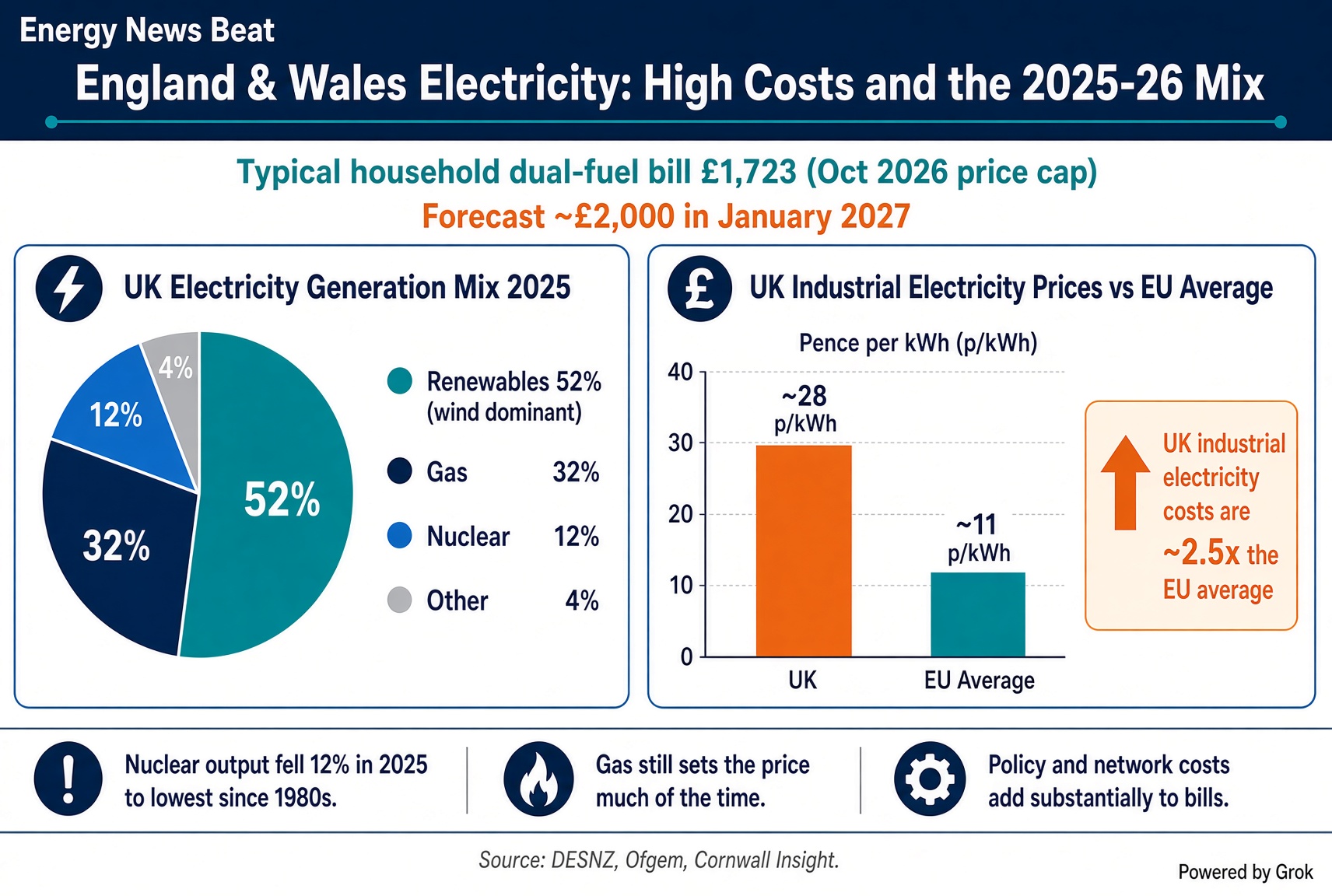
Great Britain’s generation mix shows why firm capacity matters. Official DESNZ figures for 2025 put renewables at roughly 52 percent of UK electricity generation (a record), gas at about 31.8 percent, and nuclear at 12.2 percent after a 12 percent year-on-year drop to 35.9 TWh—the lowest nuclear output since the 1980s—because of refueling, planned maintenance, and unplanned outages on the aging Advanced Gas-cooled Reactor fleet. Coal was already at zero. Low-carbon sources overall slipped slightly to around 64 percent as nuclear fell and gas rose 6.6 percent.
Grid data for 2025 (Great Britain) show gas as the largest single source at 26.7 percent, wind at 23.8 percent, imports at 15.2 percent, and nuclear at 11.8 percent. Year-to-date 2026 figures from one tracker put wind at 25.9 percent, gas at 24.9 percent, nuclear at 11.2 percent, and solar at 7.3 percent, with renewables (wind, solar, hydro) around 41 percent before biomass. Live snapshots frequently show gas supplying 25–40 percent or more when wind is low. The residual fuel-mix disclosure for April 2025–March 2026 still lists natural gas at over 30 percent of supplied electricity once imports are attributed.
New large reactors (Hinkley Point C, Sizewell C) and any small modular reactors remain years away. Sizewell C is not expected before the late 2030s; the National Audit Office has noted it could add up to £17–19 a year to a typical household bill by the time it opens under current financing arrangements, even while government modeling claims longer-term consumer benefits. Meanwhile, the system leans on gas-fired plants and interconnectors whenever renewables dip.
The party’s stance on oil and gas remains unchanged
The nuclear shift does not extend to hydrocarbons. The updated policy still calls for phasing out fossil-fuel generation. In September 2026, Green MPs and peers wrote to the Energy Secretary urging rejection of the Jackdaw gas field, calling approval “climate vandalism” and arguing it would supply only a small fraction of UK demand while failing to cut bills or deliver energy sovereignty. The party has repeatedly opposed Rosebank and any new North Sea exploration or development, aligning with the broader campaign that helped end new exploration licensing. Scottish Greens have stated there should be “absolutely no new oil and gas fields.” Domestic gas production has already fallen to multi-decade lows; further restrictions increase import dependence at a time when wholesale prices remain sensitive to global disruptions, including those linked to Middle East shipping.
Analyst views: system costs and the price outlook
Independent analyst Kathryn Porter of Watt-Logic has argued for years that British electricity prices are driven by more than the wholesale gas price. In her 2025 report “The true affordability of net zero,” she calculated that net-zero policy costs exceeded £17 billion in 2023–24 and were heading above £20 billion a year later in the decade. She notes that UK industrial electricity prices have been among the highest in the developed world (around 28 p/kWh for large users in mid-2024 data versus roughly 11 p/kWh in the EU average), while gas bills rank far lower internationally. Porter contends that the full system cost of intermittent renewables—backup, grid reinforcement, constraint payments, and balancing—explains much of the gap, and that “if you want a low-carbon electricity grid that’s reliable and economic, then you have to go with nuclear.” She has also described the idea that Britain should not produce its own North Sea gas as “idiotic,” pointing out that domestic molecules still trade at a discount to European hubs and reduce exposure to import shocks.
Other data points align with concerns about missing firm capacity. Ofgem’s price cap rose 4 percent from October 2026 to £1,723 for a typical dual-fuel direct-debit household (the VAT cut on electricity limited the increase). Cornwall Insight forecast a further jump of around £276 (16 percent) in January 2027 to nearly £2,000, the largest rise in four years, driven by Middle East-related gas-supply disruption and low European storage. Household electricity prices remain well above pre-2021 levels; IFS analysis shows they have risen almost 150 percent since 2010 in nominal terms, with policy and network costs a growing share alongside wholesale gas. Gas still sets the marginal price a large fraction of the time. Without additional stable, low-marginal-cost generation—whether extended nuclear life, new nuclear built to tighter cost and schedule discipline, or retained dispatchable gas—the exposure to volatile international gas markets and to rising system costs continues.
The conference vote does not reverse the Green Party’s preference for rapid renewable build-out or its opposition to new oil and gas. It does, however, remove an absolute barrier to keeping the existing nuclear fleet online and to evaluating individual projects on engineering and economic merits. For consumers in England and Wales, that is a small but concrete improvement on a policy landscape that has otherwise prioritized the phase-out of firm domestic sources while bills stay elevated.
Check out the World’s Greatest Podcast Show Notes at EnergyNewsBeat.co or EnergyNewsBeat.com.
Appendix: Sources
Appendix: Sources and links
- The Guardian, “Green party drops longstanding opposition to nuclear power,” 5 October 2026: https://www.theguardian.com/politics/2026/oct/05/green-party-nuclear-power-policy
- World Nuclear News, “Green Party drops nuclear phase-out policy,” 5 October 2026: https://www.world-nuclear-news.org/articles/green-party-members-drop-nuclear-phase-out-policy
- Left Foot Forward, “Green Party abandons opposition to nuclear power,” 4 October 2026: https://leftfootforward.org/2026/10/green-party-abandons-opposition-to-nuclear-power/
- Green Party letter opposing Jackdaw, 9 September 2026: https://greenparty.org.uk/2026/09/09/greens-warn-government-greenlighting-jackdaw-would-be-act-of-climate-vandalism/
- DESNZ / GOV.UK fuel-mix and energy statistics (2025/26 disclosure and UK Energy in Brief 2026): https://www.gov.uk/government/publications/fuel-mix-disclosure-data-table/fuel-mix-disclosure-data-table and https://www.gov.uk/government/statistics/uk-energy-in-brief-2026
- Enerdata summary of 2025 DESNZ generation shares (renewables 52.1 percent, gas 31.8 percent, nuclear 12.2 percent): https://www.enerdata.net/publications/daily-energy-news/renewables-surpass-52-uk-power-generation-2025.html
- Purely Energy GB grid reports 2025 and 2026 year-to-date: https://www.purelyenergy.co.uk/grid-report/2025 and https://www.purelyenergy.co.uk/grid-report/2026
- Ofgem price-cap announcement, 26 August 2026 (£1,723 from October): https://www.ofgem.gov.uk/press-release/energy-price-cap-will-rise-4-october-2026
- BBC / Cornwall Insight January forecast coverage, 30 September 2026: https://www.bbc.co.uk/news/articles/cwz0zvj4m1myo
- Kathryn Porter, Watt-Logic, “The true affordability of net zero,” 19 May 2025: https://watt-logic.com/2025/05/19/new-report-the-true-affordability-of-net-zero/
- Kathryn Porter interviews and commentary (Spiked / GB News 2026) on renewables system costs, nuclear, and North Sea gas: https://www.uk-channel.co.uk/wind-and-solar-are-expensive-unreliable-and-dangerous-kathryn-porter-on-net-zero-madness/ and related GB News segments
- National Audit Office / BBC on Sizewell C bill impact, May 2026: https://www.bbc.co.uk/news/articles/cze28927j9no
- Institute for Fiscal Studies electricity-price analysis, September 2026: https://ifs.org.uk/publications/electricity-prices
The post Green Party Drops Longstanding Opposition to Nuclear Power: A Rare Piece of Good News for Consumers in England and Wales? appeared first on Energy News Beat.