
Energy News Beat | August 27, 2026
The U.S. diesel market is doing what tight commodity markets always do: it is advertising the shortage in the only language that matters — price.
For the week ending August 21, EIA distillate stocks fell 2.2 million barrels, or 2.1%, to 103.4 million barrels. That is the lowest level ever recorded for this point on the calendar in a weekly series that starts in August 1982. Stocks sit about 14% below the five-year seasonal average and 9.5% below the 114.2 million barrels held a year earlier. It is not the all-time low — inventories touched 100.8 million barrels in late May — but it is the worst August cushion the United States has ever taken into harvest and heating season.
Retail followed the inventory print. EIA’s national on-highway diesel average jumped 19.8 cents last week to $5.652 a gallon, the highest reading of 2026, above the April 6 wartime spike of $5.643 and only about 16 cents shy of the June 20, 2022 record of $5.81. The price is $1.944 higher than a year ago. California printed $7.040, up 25.5 cents on the week.
Macroeconomist Philip Pilkington put the market’s mood in one line after Barchart circulated the inventory chart: “The diesel market is going to crack. Any day now.” That is trader language for a market that has already lost its buffer and is now one more export surge, refinery outage, or Hormuz scare away from another vertical move.
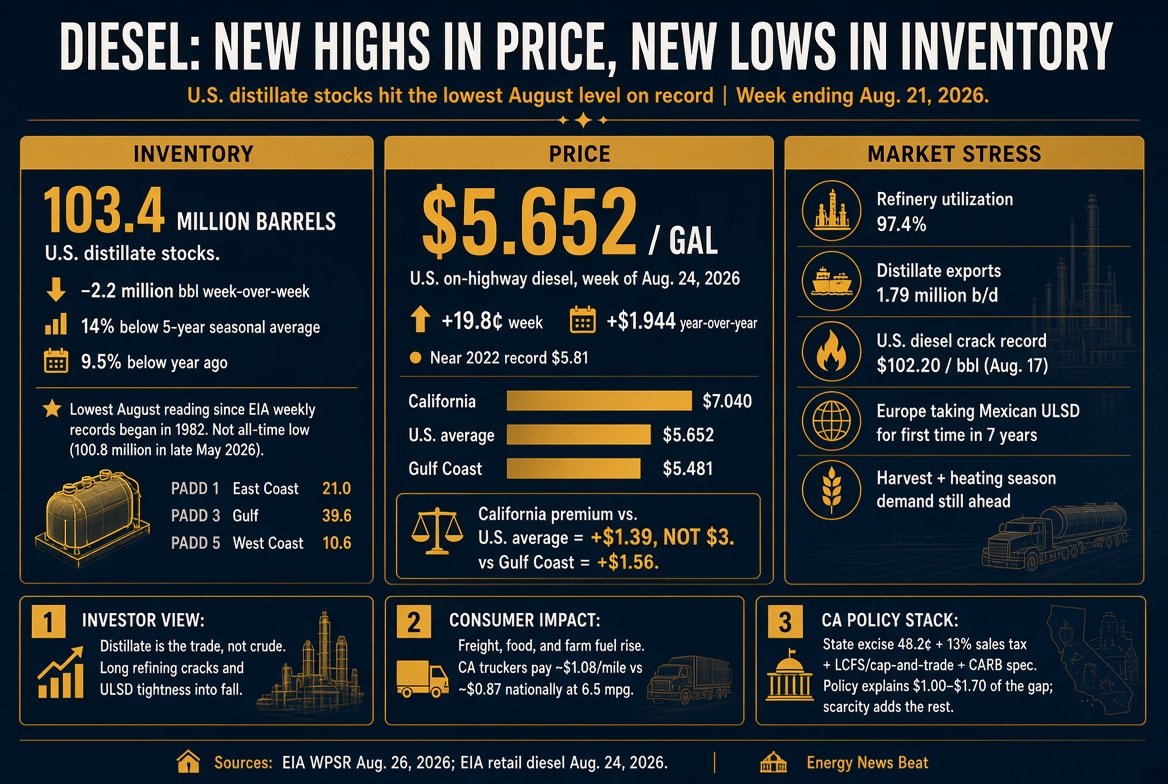
The inventory map is not uniform
The national number hides a regional story that matters for both traders and truckers.
|
Region
|
Distillate stocks, week of Aug. 21 (million bbl)
|
Week-over-week
|
|---|---|---|
|
U.S. total
|
103.4
|
−2.2
|
|
PADD 1 East Coast
|
21.0
|
−1.2
|
|
PADD 2 Midwest
|
28.6
|
+0.2
|
|
PADD 3 Gulf Coast
|
39.6
|
−1.0
|
|
PADD 4 Rockies
|
3.7
|
+0.3
|
|
PADD 5 West Coast
|
10.6
|
−0.5
|
Source: EIA Weekly Petroleum Status Report, week ending August 21, 2026.
East Coast and Gulf Coast tanks did the heavy lifting on the draw. The West Coast, which includes California, is not collapsing in barrel terms — PADD 5 is holding just over 10.5 million barrels — but that region has almost no spare refining flexibility and almost no ability to import generic ULSD when CARB specs wall the market off. A national shortage becomes a local emergency faster in PADD 5 than it does on the Gulf.
Refineries are not sitting idle. Utilization ran at 97.4% last week. Distillate production still averaged only about 5.1 million barrels a day, while exports rose to 1.79 million barrels a day from 1.60 million. The United States is running its plants hard and still shipping product into a world that is short middle distillate. That is why domestic stocks can fall even when crackers look “healthy” on a utilization screen.
This is a refining and product crisis, not a crude headline
Crude has eased from the spring panic. Diesel has not.
The U.S.–Iran war that began February 28 disrupted Strait of Hormuz flows of both crude and refined product. Middle East product exports remain impaired. Ukrainian strikes have cut Russian refinery output, and Moscow halted diesel exports earlier this summer. Argus has put the combined Hormuz-plus-Russia distillate loss near 1.4 million barrels a day, or 15% to 20% of seaborne diesel trade. U.S. diesel crack spreads hit a record $102.20 a barrel on August 17. Northwest Europe printed a nearly $95 premium over crude a day later.
Giovanni Staunovo flagged the next tell: Europe is so short that it has taken Mexican ULSD for the first time in seven years. Pemex shipped nearly 300,000 barrels to Spain this month, according to Kpler and Bloomberg. When Europe is bidding for Mexican barrels, the Atlantic Basin is no longer a source of spare diesel for the United States. It is a competitor. Staunovo post
That is the structural point investors should not miss. Headline oil can look “contained” in the $80s or high $80s while the barrel that actually moves freight, food, and harvest equipment is trading as if the shortage is still in front of the market.
California is worse — but the “$3 over the average” line needs a correction
Social media is running a simpler story: California at $7, Texas closer to $3, therefore Sacramento added $3 a gallon. Hunter Eagleman’s widely shared post captured the political version of that argument after a California account blamed Washington for $7 gasoline. Eagleman post
The price gap is real. The $3 diesel-over-average figure is not what EIA is printing this week.
|
Market, week of Aug. 24, 2026
|
On-highway diesel
|
vs. U.S. average
|
|---|---|---|
|
U.S. average
|
$5.652
|
—
|
|
California
|
$7.040
|
+$1.388
|
|
West Coast less California
|
$5.859
|
+$0.207
|
|
Gulf Coast
|
$5.481
|
−$0.171
|
|
Lower Atlantic
|
$5.350
|
−$0.302
|
Sources: EIA weekly retail diesel. California’s official premium to the national average is $1.39, not $3. Versus the Gulf Coast, the gap is $1.56. California’s own EIA record this cycle is $7.567 (week of April 6, 2026), when the gap to the U.S. average was closer to $1.90. The $3.39 Texas screenshot circulating with the Eagleman post is a gasoline pump price, not diesel. Texas diesel tracks the Gulf Coast price near $5.48.
A conservative build of what California layers on that other states do not:
- State diesel excise tax: 48.2 cents as of July 1, 2026, versus roughly 20 cents in Texas.
- Statewide diesel sales tax of 13%, plus district taxes. At current pump prices, that is roughly 80 cents or more, and it rises automatically when the wholesale price rises.
- Cap-and-trade and LCFS pass-through: commonly estimated in a 20- to 60-cent band depending on allowance and credit prices.
- CARB diesel spec and segregated logistics: typically 10 to 25 cents.
- IFTA’s California combined diesel rate from July 1, 2026 is 97.9 cents a gallon, the highest-jurisdiction rate in the system.
Add those pieces, and California policy plus isolation easily explains $1.00 to $1.70 of the pump gap in a normal year. The rest of this year’s extra dollar is the scarcity premium of a CARB-walled market during a global distillate squeeze, with fewer in-state refineries and almost no ability to accept off-spec imports on short notice.
The figure that really is near $3 is different and often gets mixed into the argument: Union of Concerned Scientists has estimated that the stacked incentive for renewable diesel sold into California averaged about $3.20 a gallon over the last decade. That is a producer subsidy stack (federal credit, RINs, LCFS, cap-and-trade interactions), not the extra amount a trucker pays versus the U.S. average today. Mixing the two numbers inflates the consumer penalty and understates how expensive the program architecture has become.
Net: California is in worse shape. The state enters a national inventory low with the highest diesel price in the EIA survey, the strictest spec, the thickest tax-and-carbon stack, and a refining system that has been shrinking for years. It is not, this week, a clean $3 over the national average.
How investors should view it
Treat diesel as its own market. WTI and Brent are the headline. ULSD cracks, distillate days of cover, and PADD 1 / PADD 5 stocks are the trade.
What the tape is saying
Refiners with distillate yield and export reach are being paid. Record diesel cracks are a transfer from freight and food to Gulf Coast and Midcontinent refining. Names levered to ULSD yield and product exports — not just crude leverage — are the cleanest fundamental expression of this tape.
Exports are the swing variable. Last week’s jump to 1.79 million barrels a day of distillate exports is bullish for refining margins and bearish for domestic inventories. If Europe and Latin America keep bidding, U.S. tanks will not refill before winter on production alone.
Do not fade seasonal tightness on a crude dip. Harvest demand is arriving. Heating-oil demand follows. Inventories are already below every prior August in the weekly record. That is not a setup that needs a new war headline to stay expensive. It only needs normal October demand.
California is a separate options market. CARB diesel plus refinery concentration means West Coast spikes can overshoot the national average by another $1 when a unit goes down. That is margin for in-state racks and a cost shock for anyone whose freight lane cannot leave the state.
The risk to the long-distillate thesis is diplomacy and Russian-run recovery, not U.S. crude stocks. Commercial crude is not the constraint. Product is. A durable Hormuz reopening or a real recovery in Russian and Middle East gasoil exports would collapse cracks faster than it collapses WTI.
Positioning implication: long distillate exposure (refining equity, ULSD cracks, heating-oil seasonality) remains the higher-beta energy expression into fall. Straight crude longs are a noisier, less precise bet on the thing that is actually scarce.
How consumers will feel it
Diesel is the workhorse fuel. Passenger gasoline gets the cable-news graphic. Diesel sets the cost of moving the graphic’s groceries.
- Freight and retail. A Class 8 truck at 6.5 mpg paying $5.65 per gallon for diesel is burning about 87 cents a mile in fuel. The same truck in California at $7.04 is closer to $1.08 a mile. Carriers will not eat a 20-cent national jump and a $1.39 California premium. Fuel surcharges will reset on the EIA print, and the residue will show up in parcel, food, and construction quotes with a lag of weeks, not months.
- Farm country. Harvest is the worst possible week to lose the inventory buffer. Iowa farmers are already talking about doubling late-summer fuel budgets versus a normal year. Higher diesel into combines and grain trucks is an input-cost shock that hits at the same moment crop prices are trying to clear.
- Northeast heat. Distillate is diesel and heating oil. PADD 1 stocks at 21.0 million barrels leave a thin pre-winter cover. A cold October-November would reprice heating bills in New England and the Central Atlantic even if crude is quiet.
- California households and small fleets. The policy stack does not pause for a war. Sales tax is ad valorem, so every wartime wholesale spike is automatically taxed again at 13%. Owner-operators running intra-California miles have no Texas rack to hide in. That is a local inflation problem layered on a global product shortage.
- Inflation transmission. Diesel is not a large CPI weight by itself. It is embedded in food at home, delivery, waste collection, and goods transportation. A $1.94 year-over-year national increase is already large enough to keep goods disinflation from running as clean as crude charts suggest.
The consumer outcome is not theoretical. The last time diesel tagged $5.80, in 2022, it showed up in food-at-home and freight inflation with a delay.
This time, the inventory starting point into fall is worse.
Bottom line
The United States is entering autumn with the thinnest August distillate cover in the weekly EIA record and a retail diesel price that has already taken out every 2026 high except the all-time print from June 2022. The world is bidding for the same barrel — Europe is now taking Mexican ULSD — and U.S. plants running at 97.4% still cannot both export and rebuild tanks.
California’s extra pain is real and policy-driven, but the honest EIA number is a $1.39 premium to the U.S. average and a $1.56 premium to the Gulf Coast, not a clean $3. The $3 figure belongs to the renewable-diesel incentive stack and to gasoline-versus-Texas memes, not to this week’s diesel survey. That correction does not rescue Sacramento. It just keeps the analysis honest: state taxes, carbon programs, CARB specs, and a shrinking refinery fleet have turned a national shortage into a $7 California problem.
For investors, this is still a middle-distillate trade. For consumers, it is a freight-and-food tax that has not finished collecting.
Appendix: Charts, links, and sources
Primary data
- EIA, Stocks of Distillate Fuel Oil (weekly): https://www.eia.gov/dnav/pet/pet_sum_sndw_a_epd0_sae_mbbl_w.htm
- EIA, Weekly Petroleum Status Report: https://www.eia.gov/petroleum/supply/weekly/
- EIA, Retail Prices for Ultra Low Sulfur Diesel: https://www.eia.gov/dnav/pet/pet_pri_gnd_a_epd2dxl0_pte_dpgal_w.htm
- EIA, California Gasoline and Diesel Retail Prices: https://www.eia.gov/dnav/pet/pet_pri_gnd_dcus_sca_w.htm
- EIA Weekly Petroleum Status Report highlights and regional stock tables, release dated August 26, 2026 (week ending August 21).
Price and inventory wrap-ups
- Anadolu Agency, “US diesel inventories fall to lowest seasonal level on record,” August 27, 2026: https://www.aa.com.tr/en/energy/oil/us-diesel-inventories-fall-to-lowest-seasonal-level-on-record/59265
- Blue Book Services, “Diesel prices jump 20 cents from last week, near all-time high,” August 26, 2026: https://www.bluebookservices.com/diesel-prices-jump-20-cents-from-last-week-near-all-time-high/
- Weekly Diesel bulletin, U.S. and California prints for week of August 24, 2026: https://weeklydiesel.com/ and https://weeklydiesel.com/region/california/
- Transport Topics / Bloomberg, “U.S. diesel stockpile falls to record seasonal low,” August 26, 2026: https://www.ttnews.com/articles/us-diesel-stocks-record-low
- FreightWaves, “Benchmark diesel price is now highest since war began,” August 25, 2026: https://www.freightwaves.com/news/benchmark-diesel-price-is-now-highest-since-war-began
- FreightWaves, “Diesel Prices: It’s a Refining Crisis, Not Crude,” August 26, 2026: https://www.freightwaves.com/news/diesel-prices-its-a-refining-crisis-not-crude
Global tightness
- Giovanni Staunovo on Europe taking Mexican ULSD: https://x.com/staunovo/status/2092673136080634276?s=20
- AGBI, “Gulf refinery disruption sends diesel margins to record highs,” August 21, 2026: https://www.agbi.com/analysis/oil-and-gas/2026/08/gulf-refinery-disruption-sends-diesel-margins-to-record-highs/
- CREA, Hormuz crisis cost analysis, March–August 2026: https://energyandcleanair.org/what-the-hormuz-crisis-has-cost-fossil-fuel-importers-march-to-august-2026/
- Reuters commentary on refined-fuel shortage behind the Hormuz crude debate, August 24, 2026: https://www.reuters.com/commentary/reuters-open-interest/hormuz-crude-volume-debate-masks-real-shortage-refined-fuels-2026-08-24/
California policy costs
- California Department of Tax and Fee Administration, fuel tax rates (diesel excise $0.482 from July 1, 2026; IFTA combined $0.979): https://cdtfa.ca.gov/taxes-and-fees/special-taxes-and-fees-tax-rates/fuel-taxes.htm
- Truckers.News, West Coast diesel spread (CARB spec, taxes, logistics): https://truckers.news/diesel-prices/regional-diesel-price-spread-explained
- Union of Concerned Scientists, renewable diesel incentive stack averaging about $3.20/gal over the prior decade: https://blog.ucs.org/jeremy-martin/biofuel-incentives-in-flux-interactions-between-federal-and-california-policy/
- Stillwater Associates on LCFS cost pass-through: https://stillwaterassociates.com/projected-vs-actual-costs-of-low-carbon-fuel-programs/
- Legislative Analyst’s Office, cap-and-trade gasoline/diesel price impact: https://lao.ca.gov/reports/2025/5042/Assessing-Californias-Climate-Policies-Cap-and-Trade-Reauthorization-050725.pdf
Social / market color cited in the article
- Philip Pilkington quoting the Barchart seasonal-low inventory chart: https://x.com/philippilk/status/2092860324546269391?s=20
- Hunter Eagleman on California $7 fuel versus Texas pump prices: https://x.com/Hunter_Eagleman/status/2092665420142592290?s=20
- Barchart original inventory alert quoted in the Pilkington thread: https://x.com/Barchart/status/2092823584687210938
Key figures used in this piece (as of August 26–27, 2026)
- U.S. distillate stocks: 103.391 million barrels (EIA table) / 103.4 million in agency and wire roundings.
- Weekly draw: 2.2 million barrels.
- Five-year seasonal deficit: ~14%. Year-ago deficit: 9.5% versus 114.2 million barrels.
- U.S. retail diesel: $5.652. California: $7.040. Gulf Coast: $5.481.
- All-time U.S. retail diesel record: $5.81, week of June 20, 2022.
- California diesel record this cycle: $7.567, week of April 6, 2026.
- Refinery utilization: 97.4%. Distillate exports: 1.79 million b/d.
- Reported U.S. diesel crack record: $102.20/bbl on August 17, 2026.
The post Diesel Hits New Highs in Price, and Lows in Inventory appeared first on Energy News Beat.