
Houston-based integrated energy company Phillips 66 (NYSE: PSX) delivered a solid first-quarter 2026 earnings beat, reporting adjusted earnings of $0.49 per share—surpassing Wall Street consensus estimates of a $0.39 per share loss by $0.88. The company posted net income of $207 million, or $0.51 per diluted share on a reported (GAAP) basis.
Strong refining operations, buoyed by higher realized margins amid geopolitical tensions in the Middle East that drove oil prices higher, helped offset significant mark-to-market hedge losses of approximately $839 million pre-tax. These losses stemmed from short derivative positions used to hedge commodity price risk and primarily impacted refining, marketing, and renewables segments.
“We are confident in our ability to navigate market volatility due to our integrated business and the strength of our balance sheet. Backed by disciplined execution and strong operating performance, we remain well positioned to provide energy to the global market,” said Mark Lashier, chairman and CEO of Phillips 66. “Attractive fundamentals across our businesses further support our position to deliver strong returns and long-term shareholder value. We remain committed to our previously stated shareholder return and debt reduction targets.”
Financial and Operational Highlights
Phillips 66 reported adjusted EBITDA of $1.268 billion for the quarter. Cash from operations was negative $2.264 billion (primarily due to working capital changes and collateral outflows related to hedges), but excluding working capital impacts, it was positive $699 million. Capital expenditures and investments totaled $582 million, with an additional $66 million in net acquisitions.
Segment Performance (Adjusted Earnings Pre-Tax):Midstream: $591 million (Adjusted EBITDA: $860 million) — Strong contribution from NGL fractionation (980 MBD) and pipeline throughput (930 MBD).
Chemicals: $85 million (Adjusted EBITDA: $250 million) — Global olefins and polyolefins utilization at 94%.
Refining: $208 million (Adjusted EBITDA: $423 million) — Realized refining margin of $10.11 per barrel; crude utilization at a robust 95% with an 87% clean product yield. Turnaround expenses were $178 million.
Marketing and Specialties: $(141) million (Adjusted EBITDA: $(86) million).
Renewable Fuels: $(41) million (Adjusted EBITDA: $(18) million) — Production of 40 MBD.
Corporate and Other: $(451) million (Adjusted EBITDA: $(161) million).
Liquidity stood at approximately $6.0 billion ($5.2 billion in cash and cash equivalents plus available credit facilities). Total debt rose to $27.124 billion (debt-to-capital ratio of 48%; net debt-to-capital of 43%), reflecting hedge-related collateral impacts. The company returned $778 million to shareholders, including $509 million in dividends and $269 million in share repurchases. It also announced a 7% increase in its annualized quarterly dividend.
Capacity Expansions and Strategic Progress
Phillips 66 highlighted operational momentum from recent debottlenecking projects:
Sweeny NGL fractionation capacity increased by 23%.
Freeport LPG export dock capacity expanded by 15%.
Additional projects underway include the Coastal Bend NGL pipeline expansion (to 350,000 bpd by Q4 2026), a proposed 100,000 bpd NGL fractionator in Corpus Christi (FID expected early 2026, startup 2028), and the Phillips 66/Kinder Morgan Western Gateway Pipeline (up to 200,000 bpd of refined products to Arizona and California by mid-2029).
The Iron Mesa gas plant (300 MMCFD) remains on track for Q1 2027 startup.
The company completed the acquisition of the Lindsey Oil Refinery and related logistics assets in the U.K. in April 2026 to bolster its integrated European footprint.
These moves underscore Phillips 66’s focus on optimizing its Gulf Coast NGL value chain and expanding export capabilities amid rising global LPG demand.
Earnings Call Insights
The Q1 2026 earnings conference call took place today at 12:00 PM ET. Management emphasized the integrated business model’s resilience, strong refining utilization despite market volatility, and continued progress on midstream growth initiatives. While a full transcript and slides will be available on the investor relations site in the coming days, the tone reinforced confidence in navigating near-term volatility while executing on long-term shareholder returns and debt-reduction targets (aiming for $17 billion total debt by end-2027).
What Analysts Are Saying
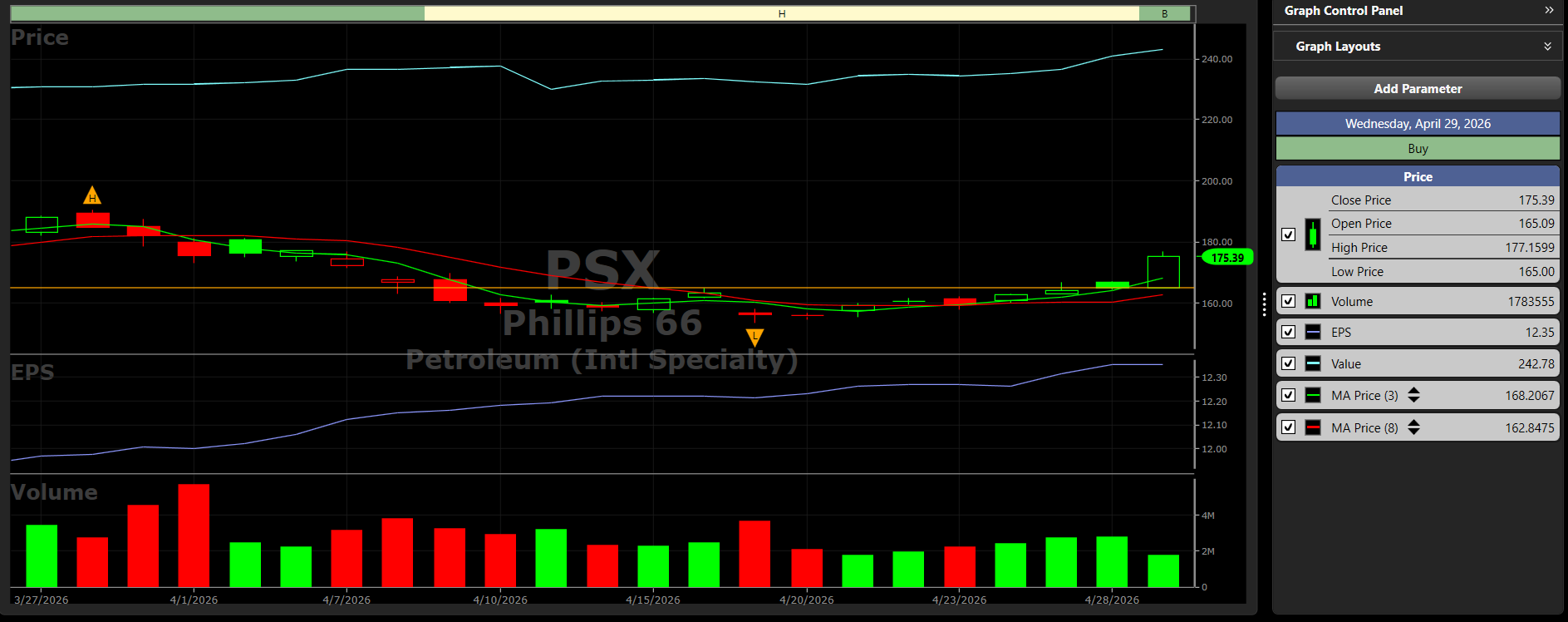
Analysts generally maintain an Overweight consensus on PSX, with an average 12-month price target around $180–$183 (implying modest upside from current levels near $165–$170). The Q1 beat, despite the headline hedge drag, is viewed positively as evidence of underlying operational strength in refining and midstream. Pre-earnings caution around the $900 million mark-to-market hit has largely given way to optimism around sustained refining margins and midstream EBITDA growth trajectory (targeting ~$4.5 billion run-rate by 2027 from prior commentary).
Firms like Piper Sandler, UBS, and TD Cowen have highlighted PSX’s disciplined capital allocation and portfolio optimization as key differentiators in a volatile energy landscape.
What Investors and Consumers Should Watch For
For Investors:
Refining Margins and Utilization: Track crack spreads and clean product yields in the coming quarters, especially with geopolitical drivers supporting margins.
Midstream Ramp-Up: Progress on NGL fractionation, pipelines, and gas plants will be critical to hitting 2027 EBITDA targets and funding returns.
Capital Allocation and Balance Sheet: Continued share repurchases, dividend growth, and progress toward the $17 billion debt target amid liquidity normalization post-hedge outflows.
Strategic Execution: Updates on U.K. refinery integration, chemicals projects (Golden Triangle and Ras Laffan), and any further portfolio optimizations.
For Consumers and Energy Markets:
High refining utilization (95% in Q1) supports a stable domestic fuel supply and helps mitigate price spikes from global disruptions.
Expanded LPG export infrastructure benefits global energy security but can influence domestic NGL pricing dynamics.
Broader refining capacity discipline across the industry (including PSX’s moves) may keep crack spreads elevated longer-term, indirectly supporting gasoline, diesel, and jet fuel availability.
Phillips 66’s results highlight the resilience of integrated downstream players in a geopolitically charged environment, with refining margins providing a timely offset to one-time hedging impacts.
Appendix: Sources and Links
- Phillips 66 Official Q1 2026 Earnings Press Release: https://investor.phillips66.com/financial-information/news-releases/news-release-details/2026/Phillips-66-Reports-First-Quarter-Results-Expanded-Capacity-and-Continued-Strong-Operations/default.aspx
- OilPrice.com Coverage: https://oilprice.com/Latest-Energy-News/World-News/Phillips-66-Beats-Q1-Estimates-by-088-Per-Share-as-Refining-Margins-Surge.html
- Phillips 66 Investor Relations (Earnings Call Details): https://investor.phillips66.com/events-and-presentations/event-details/2026/Phillips-66-First-Quarter-2026-Earnings-Conference-Call/default.aspx
- Consensus Analyst Ratings and Price Targets (MarketWatch, ChartMill, WSJ): Various summaries as of late April 2026.1
- Additional context from Seeking Alpha, Yahoo Finance, and MarketBeat earnings reports.
Energy News Beat will continue monitoring Phillips 66’s progress and provide updates following the full earnings call transcript and any analyst notes.
The post Phillips 66 Beats Q1 Estimates by $.88 Per Share as Refining Margins Surge appeared first on Energy News Beat.